When peaceful protest is allowed to work, democracy works
February 11, 2026
Melbourne’s mass protest against the visit of Israel President Isaac Herzog showed how large, diverse crowds can assemble peacefully when police exercise restraint and common sense. Sydney’s response points to a deeper failure of judgment about protest, power and democracy.
The tragedy of the Sydney protest clashes is that they could have been avoided.
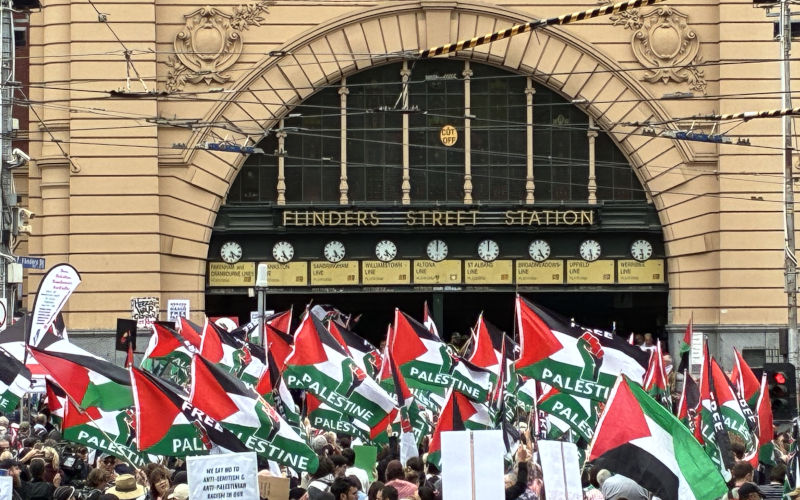
In Melbourne, protesters started gathering well before the advertised start time of 5.30pm. Many rushed down Swanston street to make it after work. But many, many others, had clearly made the kind of careful arrangements that ensured they were not late. Some had walking sticks, some prams. One group, who later led marchers up Bourke Street, were joined by a black and white corgi with a matching keffiyeh around its neck.
People made space as Louise Adler and her husband Max Gillies walked through the courteous crowd, just like everyone else. Jewish Australians were everywhere, many wearing ‘Not in my name’ or ‘Anti-Zionist Jew’ on their shirts.
I thought my 20-year-old daughter was laying it on a bit thick when she warned us to bring face masks and sunglasses in case of tear gas.
Then we all saw eight mounted police come around the corner, with the traffic, that was still flowing as the crowd built and 5.30pm approached. This raised the temperature more than a notch.
Anyone who knows Melbourne knows that Flinders Street station overlooks a seriously congested intersection. It was hard to understand why police had not blocked off the feeder roads of cars and trams already.
When the crowd could no longer be contained on footpaths, under the station clocks, or on the steps of St Paul’s Cathedral, the protest leaders called us all to move into the intersection.
People were being polite, and moved in slowly and carefully, eventually filling the busy intersection. Police shepherded cars into U-turns, trams unloaded passengers.
As the speeches began the by now huge crowd filled all the feeder streets. The crowd was vocal and articulate. The placards were direct: ‘Herzog to the Hague’, ‘Palestinian children are not collateral’. A man in front of us was a school teacher, his placard was held rigid by a 60cm ruler.
About an hour in, the pressure of numbers and passion meant the crowd needed to move. And so we did; along Melbourne’s busiest streets; down Flinders, up Elizabeth and Bourke, and then along Swanston to the State Library. Police moved ahead of us, blocking off streets as we marched. Shoppers were slightly delayed, but mostly people were coming out of restaurants to look, many in support. One young man tried to pick a mini fight with a protestor; one police officer shouldered a protester for no reason we could see. But otherwise we didn’t see any trouble.
I’m not sure what would have happened if the police had demanded we disperse. It seems sad to have to say it but trying to stop reasonable people, from expressing reasonable views, is bound to end badly.
People are angry – their families are being killed, and continue to be killed, even after the Gaza ‘ceasefire’. Inviting the president of the nation committing the war crimes on an official visit is wrong. It makes ordinary Australians feel that our government is not acting in our name, rather aligning us with a genocide.
Recent You Gov polling tells us that a majority of Australians object to the Israeli Government’s actions. But even if it was not true, in a democratic country we have the right to express views, reasonable and unreasonable, within the bounds of the law.
Some say, ‘no one cares what Australians think’. P&I correspondent Refaat Ibrahim who lives in Gaza does not agree. He said this after the Harbour Bridge protests: “The scenes of the massive demonstration were inspiring and carried a noble message. In these moments of extreme suffering… your voice rejecting genocide was like a window of hope from free peoples, carrying to us the message that there are still hearts that hold peace for the world.”
We were allowed to exercise our democratic right to speak up in one Australian capital city this week, less so in another. This is a shameful state of affairs.