Why the governor-general should not be the prime minister’s choice
February 6, 2026
Governor-General Sam Mostyn’s remarks reveal a deeper flaw in Australia’s constitutional arrangements – one that weakens the independence of the head of state and undermines democratic accountability.
I have great respect for Governor-General Sam Mostyn. Yet she has, unwittingly, revealed the central problem with the system that makes her effectively our head of state.
Ours is, of course, a Claytons monarchy, in which the King, literally as far away as is geographically possible, is nominally head while a governor general represents him. Most of us seem unfazed by a system which could have been invented by Gilbert and Sullivan and is further complicated by the existence of six state governors, who also represent the monarch.
After Sir John Kerr’s dismissal of Whitlam in 1975 it is extremely unlikely that a governor general would ever again exercise the considerable powers that are spelt out in the Constitution. Not only does the governor general have considerable reserve powers, but under clause 59 King Charles has the power to disallow any legislation even if it is passed by both houses of parliament and signed into law by the governor general of the day.
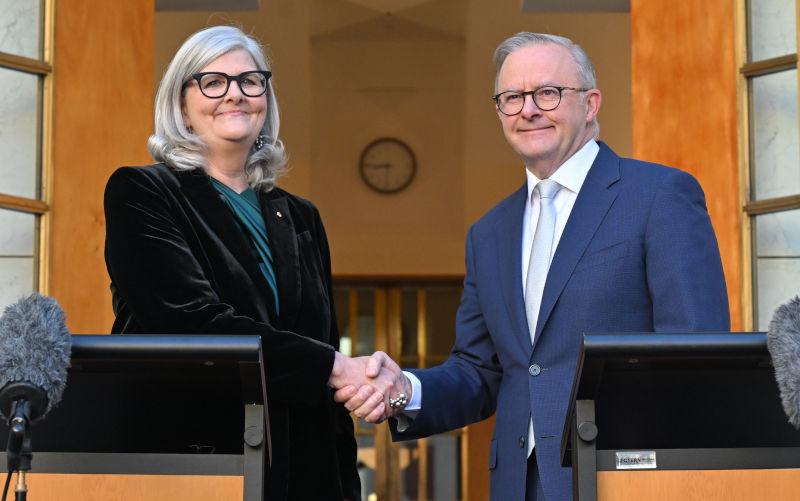
But the central problem is summed up in Mostyn’s comment to The Australian: “I want them [Australians] to be proud of the fact that we have an office of the governor general that is chosen by an Australian prime minister.”
This is where our system breaks with the basic principle of constitutional monarchy. In Britain the prime minister cannot choose his or her head of state, that is determined by the iron law of heredity. The point of constitutional monarchy is that the separation between what Walter Bagehot famously called the dignified and the efficient role of the state provides a check on the sort of authoritarianism best exemplified by Donald Trump.
When I was writing my book _God Save the Queen_, I posed the question, would Britons prefer a President Boris Johnson to a Prime Minister Johnson? This was, for most, a no-brainer. It may be no accident that countries widely regarded as most democratic – the Scandinavian states, Spain, the Netherlands – are also constitutional monarchies.
But how effectively can a governor general provide this balance when she or he is the personal choice of the prime minister? As Sam Mostyn has said, her role is that of a constitutional monarch, namely the right to be consulted, to encourage and to warn. While I suspect Mostyn can fulfil the role perfectly, her predecessor, David Hurley, famously appeared not to question how Scott Morrison was able to make himself minister for five departments to which Hurley had already sworn in ministers.
That a prime minister can choose the person to whom she or he is nominally accountable makes a mockery of the system, however effective a particular governor general may be. And prime ministers will, naturally, choose people with whom they share a particular outlook: while John Howard chose a former archbishop and then an army general, the only two women who have served in the role have been named by Labor prime ministers.
To become a republic would require a major rewriting of our constitution, and a successful referendum. Albanese has made it clear that after the defeat of the Voice he will not attempt further constitutional changes, and quietly dropped the position of minister for the republic after the last election.
However no constitutional change would be required were he to develop a model for appointing the GG through a parliamentary process, maybe one involving a two thirds approval by both houses. Such a system would immediately require a prime minister to consult widely to find a potential head of state with appeal across the entire political spectrum, which in turn would give the chosen person greater legitimacy.
Sam Mostyn showed the importance of a nonpartisan head of state in her response to the Bondi massacre, when our political leaders seemed unable to resist weaponising the tragedy. I would hope that when her term expires there is a more transparent process for appointing her successor than the whims, however satisfactory, of one person.

