Abbott’s finger pointing on overseas students is pure hypocrisy
March 3, 2026
Tony Abbott blames record numbers of temporary residents and international students on recent governments. But policy changes introduced and maintained under his own leadership played a central role in driving that growth.
Last week Tony Abbott published an article on his sub-stack making a range of claims that were both misleading and tried to divert from his Government’s role in the current volume of students in Australia.
As usual, Abbott compliments himself for stopping the boats. He would know that the boats had largely stopped by the time he became Prime Minister. But it’s his complaints about the number of temporary entrants, particularly students, in Australia that is most misleading. Abbott says:
“About 2.5 million people, or about 10 per cent of our total population, are temporary residents. There’s nearly a million people on student visas. There’s over half a million on temporary work visas. And there’s well over 100,000 on bridging visas, appealing against deportation.”
The number of temporary entrants in Australia have indeed increased significantly from the 1.67 million who were in Australia in September 2013 when Abbott was Prime Minister to 2.82 million at end September 2025. In the two years Abbott was Prime Minister, the number of temporary entrants in Australia increased by over 100,000 (apparently Abbott must have thought 1.77 million temporary entrants and growing rapidly was an acceptable number).
The growth in temporary entrants was despite the fact net migration during the Abbott years fell sharply to around 180,000 due to a very large exodus of Australian citizens. That was driven by a sharp increase in the unemployment rate relative to other comparable nations.
The primary driver of the increase in temporary entrants in Australia during the Abbott years and subsequently right through to the start of covid was an increase in students. In fact, the stock of students in Australia increased from 346,962 in September 2013 (around when Abbott was elected) to 425,741 in September 2015 (around when Abbott was deposed).
While this was partly due to changes made under the previous Labor Government following the Knight Review (which the Abbott Government did not reverse), there were further changes made in 2013 that really accelerated growth in student numbers including:
- Reducing the number of evidentiary levels from four to three. All countries in the highest risk Assessment Level Four were moved into Assessment Level Three and the level of funds a student visa applicant had to show from an Assessment Level three country (ie the new highest level of risk) was reduced from 18 months to 12 months;
- Student visa applicants were allowed to use a wider range of English language tests. Prior to 2013, only IELTS test results were accepted.
- Visa processing was streamlined such that any applications with a Confirmation of Enrolment (CoE) from participating institutions for a bachelor degree, masters degree, doctoral degree, student exchange program or study abroad program would be assessed in a streamlined manner (similar to the Assessment Level 1), regardless of their country of origin. As a result, they will not have to supply as much evidence to support their visa application.
- The student visa application charge was reduced from $565 to $535. While not a large reduction, the signal to the industry was clear.
- Introduction of a post-study work visa which allowed international students completing an Australian bachelor, masters or doctoral degree to remain in Australia to gain work experience after they graduate. Graduates of bachelor and masters by coursework degrees can apply for a two-year work visa at the completion of their degree, which increases to three years for masters by research graduates and four years for PhD graduates.
These changes, which were flagged through by the new Abbott Government, led to rapid growth in the number of students in Australia (see Chart 1). Abbott also maintained the permanent migration program at a then record 190,000 which provided a pathway for students to permanent residence. If he objects so much to growth in overseas student numbers, he and his former Immigration Minister Scott Morrison had it in their power to reverse these changes.
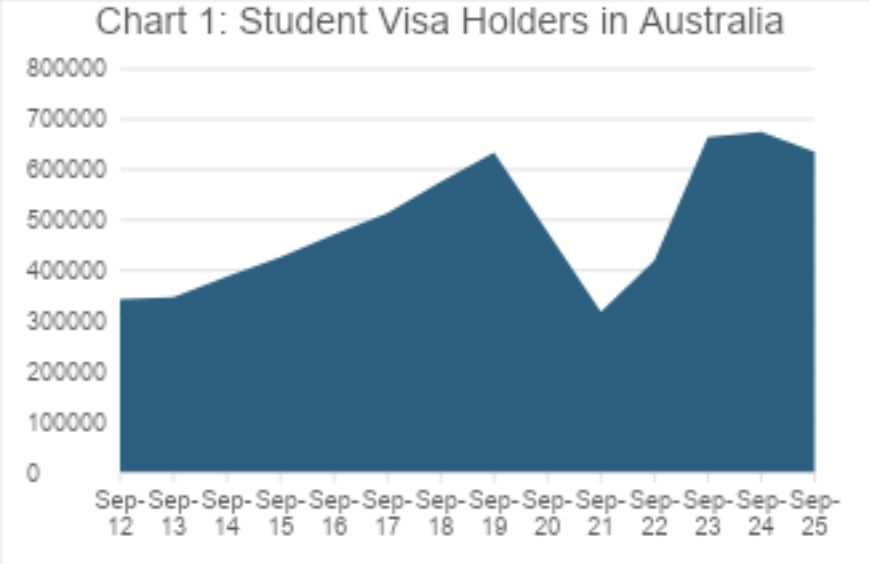
The rate of growth in overseas student numbers from 2013 to 2019 is extraordinary (an increase of over 200,000 in just six years). These understandably fell during covid and then increased even more rapidly after covid due to further measures to accelerate return of students implemented by the Morrison Government. These measures included unrestricted student visa work rights, fee-free applications, and a covid visa which attracted huge numbers of students to switch to this cheap visa with unrestricted work rights and no requirement to study.
The new Albanese Government was slow to tighten these policies. But it is the case that student visa policy is significantly tighter today than under the Abbott, Turnbull and Morrison Governments including:
- Higher funds requirement.
- Higher English language requirement.
- Higher visa application fees (more than double).
- Tighter genuine student requirement.
- Tighter post-study work visa requirements.
- Placement of all South Asian nations into the highest risk category.
These changes have decimated the private VET and ELICOS sectors. And while further tightening is required, Abbott is hardly in a position to point fingers.