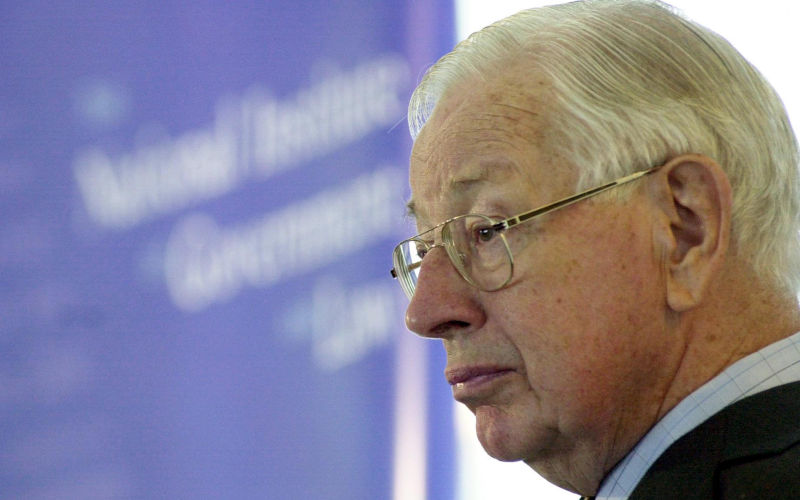
Anthony Mason’s legacy – and the shadow of the dismissal
March 21, 2026
Anthony Mason reshaped Australian law as Chief Justice – but his concealed role in the Whitlam dismissal casts a lasting shadow over that legacy.
This week marked the death of one of Australia’s most influential Chief Justices of the High Court of Australia, Sir Anthony Mason.
Mason was appointed to the bench by the McMahon Coalition government in 1972 and as Chief Justice by the Hawke Labor government in 1987, where he remained until his compulsory retirement from the Court at the age of 70 in 1995.
In his eight years as Chief Justice, Mason presided over the most consequential reshaping of the Court’s intellectual approach to the law in its history. The Mason court moved decisively from the strict legalism and adherence to precedence, described by fellow High Court justice Lionel Murphy as a doctrine ‘eminently suitable for a nation overwhelmingly populated by sheep’, that had locked previous Courts into the interpretations and presumptions of the past – a position of stasis where nothing could ever be done for the first time.
Under Mason the Court reflected a new era of legal interpretation, one that acknowledged that the law is not static and that it takes its shape and interpretative meaning within shifting social and political realities.
Without doubt the most significant of those landmark judgments was the Mabo decision, in Mabo No. 2, which overturned the thoroughly discredited notion of ‘terra nullius’ in Australian law. This foundational ‘legal fiction’ has been reaffirmed as recently as 1971. The Mason Court’s emphatic decision in Mabo finally consigned the specious notion of ‘terra nullius’ to its rightful place in the law’s shameful past.
No less significant were the Court’s decisions on the implied right to freedom of political communication, recognising the free flow of information as intrinsic to democratic practice and as an essential incident to constitutional interpretation within a democratic system.
The right to political communication is today one of the most important legal protections for political speech and protest as we are seeing in real time political and legal challenges to those fundamental rights. The Mason Court’s decision in the Dietrich case 1992 recognising the right to legal representation for those charged with a serious offence is an equally significant implied rights decision ensuring legal protection at trial.
All of which points to the inestimable dichotomy between Mason’s legal acuity, his alertness to the democratic impulses of the Constitution, and the discovery of his secret involvement in the governor-general Sir John Kerr’s dismissal of prime minister Gough Whitlam without warning on 11 November 1975. Kerr’s dismissal of the twice-elected Whitlam government, which retained its clear majority in the House of Representatives, was deceptive, unprecedented, and deeply divisive. While Chief Justice, Sir Garfield Barwick, had long been seen as the legal éminence grise behind the dismissal, Mason was considered, if at all, as just ‘the third man’ in Kerr’s legal deliberations.
I was utterly shocked to find among Kerr’s personal papers his typed 14 page description of his ‘rolling conversation’ with High Court justice Sir Anthony Mason across several months in 1975, “fortifying me for the action I was to take”, as Kerr described it, building towards the procuring of Barwick’s advice and the dismissal of the Whitlam government. Despite the rather strange efforts of some, including Mason himself, to downplay the significance of his role, Kerr’s notes leave no doubt as to Mason’s “most significant part in my thinking at that critical time”.
Mason’s role in the dismissal was far more than one of advising, guiding, and ‘fortifying’ Kerr. And it is in these further steps that the extent of Mason’s active role in the dismissal emerges. Firstly, in their discussions about the nature and extent of the governor-general’s reserve powers to dismiss the government which went back to March 1975. Kerr approached Mason, then a pro-chancellor of the Australian National University, about setting up a group of senior law academics to meet with him, in secret and without the knowledge of the prime minister, and advise him on his powers. Mason facilitated these ‘ governor-general’s tutorials’, before stepping away from them in recognition that they were canvassing matters that might come before the High Court.
Nevertheless, Mason continued to discuss these same matters with Kerr by phone and in person, each time carefully ensuring secrecy from Whitlam who, as prime minister in a constitutional monarchy was Kerr’s actual chief advisor. At one point, the location of their meeting is changed from Admiralty House to avoid any chance of being seen by Whitlam at Kirribilli House. It was a profound breach of the separation of powers that the High Court is bound to uphold. Richard Ackland drily observed that; “Judicial activism has rarely seen such unbridled meddling in the democratic political process.”
Perhaps most significant in terms of an active involvement in the dismissal is that Sir Anthony Mason also drafted a letter of dismissal for Kerr, something he never divulged to his fellow High Court justices nor to our history. Mason’s view was, as he told me, “I owe history nothing”. Yet, astonishingly, Mason also claimed that he “did not encourage Kerr to dismiss Whitlam”.
Well, here in the real world, writing a letter of dismissal for the governor-general to use while actually dismissing the government is usually seen as a pretty big heads-up.
Mason’s claim that his dismissal letter was not used by Kerr, is impossible to verify since it was not among Kerr’s papers and Mason never released it. Suffice to say that the final pithy version of Kerr’s letter of dismissal to Whitlam is vastly different from the verbose meanderings of earlier iterations.
Mason claimed to have told Kerr that if he did not warn Whitlam he risked “being seen as deceptive”. Kerr does not mention it in his account of their ‘rolling conversation’, and it is notable in this respect that Mason drafted a letter of dismissal for Kerr knowing that Kerr had not in fact warned Whitlam, thereby being a party to this acknowledged deception. This diminution of personal responsibility is troubling, and it permeates Mason’s published response to the unwanted revelation of his role. As Whitlam’s Attorney General, Kep Enderby, said on hearing of Mason’s role, he would never have been appointed chief justice by the Hawke government had his involvement in the dismissal been known.
Mason never wanted his role to be made public and it’s quite possible that if I had not located Kerr’s record of it Mason’s involvement in the dismissal would still be unknown today. Kerr, however, did want it known and pleaded with Mason to reveal it, believing that public knowledge of that involvement would somehow vindicate his dismissal of Whitlam. Which just goes to show how delusional Kerr really was about the nature of the public and political opprobrium engulfing him in the post-dismissal ferment. As The Age concluded on the release of Mason’s involvement, “rather than vindicate Sir John’s actions, it makes plain that Sir John deceived Mr Whitlam.”
A final point is that Mason played a key role after the dismissal on the afternoon of 11 November 1975, following Malcolm Fraser’s defeat in a motion of no confidence by the House of Representatives. Since Supply had already been passed by the Senate earlier that afternoon Whitlam, with the confidence of the House, expected that Kerr would do as constitutional and parliamentary convention demanded and recognise the motion of the House of Representatives calling for him to recommission the Whitlam government. As the House rose to enable the Speaker to transmit the motion to the governor-general, Kerr rang Mason for a final piece of advice – what should he do? Mason told Kerr that the no confidence motion, the defining motion by which governments are made and unmade in a Westminster-style parliamentary democracy, was ‘irrelevant’, leaving Fraser in office despite a live motion of no confidence against him.
Sir Anthony Mason’s involvement in that deception of the prime minister and his government, and in the dismissal itself, mars the extraordinary legacy of a Chief Justice whose Court gifted us transformative legal decisions that changed Australian law and society for the better.