As the US destabilises, Asia Pacific steps up
March 23, 2026
As the United States shifts from stabiliser to disruptor, regional institutions in the Asia Pacific are becoming more central to maintaining order in an increasingly uncertain world.
The United States’ external posture has transformed from that of the global order’s underwriter to its chief disruptor, leveraging the vulnerabilities created by global integration to its own benefit. The result is a growing salience of regional institutions, with Asia Pacific states assuming greater importance in sustaining order amid intensifying great power rivalry.
Allies such as Japan, South Korea and the Philippines are concerned, but US President Donald Trump’s political targets have been abrupt and not necessarily tied to an intimate US linkage.
For example, Laos faced a ‘Liberation Day’ tariff of 58 per cent and shared the highest revised tariff rates in August 2025 with Syria and Myanmar for no apparent reason. Vietnam must be careful because of its trade surplus with the United States – which may explain why the country became a founding member of Trump’s Board of Peace.
Compared with Washington’s other relationships in Asia, China–US relations are the least affected by these disruptions. Despite US concerns about the China threat, China’s asymmetric parity with the United States gives it sufficient counter-leverage to discourage bullying. According to the US Department of War’s 2026 National Defense Strategy (NDS), ‘Trump seeks a stable peace, fair trade, and respectful relations with China, and he has shown that he is willing to engage President Xi Jinping directly to achieve those goals’.
By contrast, Taiwan has reason to be concerned about its lack of mention in the NDS. The NDS does promise ‘a strong denial defence’ along the first island chain – of which Taiwan is a central part – and massive military sales to Taiwan have been announced. Yet Trump’s removal of President Nicolas Maduro from Venezuela, war with Iran and threats of regime change against Cuba – not to mention the hope of annexing Greenland – undermine traditional arguments for the strategic ambiguity of US–Taiwan policy.
Strategic ambiguity has not shifted decisively to US intervention or non-intervention: it has simply evaporated. The ambiguity is no longer strategic, but transactional. From Trump’s point of view, strategy is for losers.
Trump’s posturing has also reduced confidence in the United States as a global power, increasing the significance of relationships with China. This can be seen at the global level, but it is even more apparent within the Asia Pacific. It is part of a long-term trend of economic displacement within the region, but Trump’s policies in 2025 triggered a sudden acceleration.
It is not that China has become a friend because the US has become the enemy. Rather, China remains steady while the United States has become unpredictable. But China’s neighbours will now be even more concerned about their dependence in a China-centred region. It is yet to be seen whether China will respect their autonomy and core interests, or try to establish a hegemonic order as Trump appears to be doing in ‘his’ hemisphere. China is averse to hegemony, but as a global power in increasingly asymmetric relationships, it is likely to neglect the needs of its smaller neighbours.
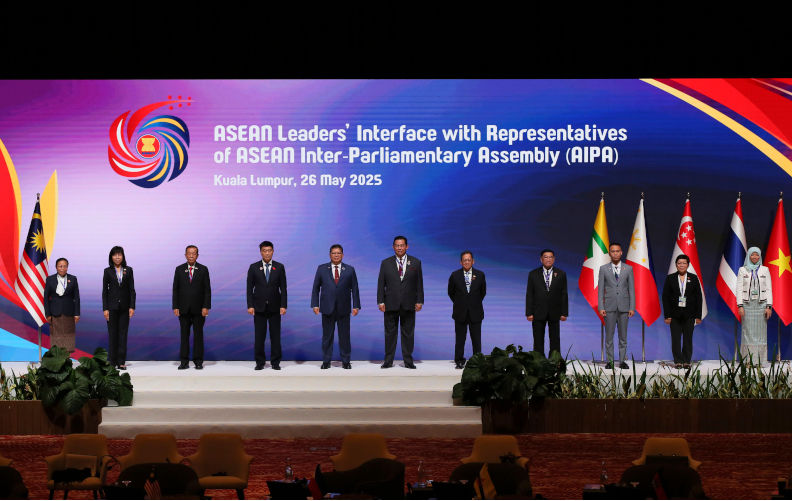
The increased importance of regional institutions can be seen as a product of these changes, but it also has its own momentum. ASEAN’s growing internal cohesion and self-respect are even more important in an unsettled global environment. Its manifold outreach activities have contributed to a sense of regional coherence and identity.
The Regional Comprehensive Economic Partnership facilitates broader regional ties, as do China’s various efforts such as the Belt and Road Initiative, the Asian Infrastructure Investment Bank and the Shanghai Cooperation Organisation. Just as importantly, the Asia Pacific’s visceral commitment to international connectivity lessens concerns about dependence on China.
Asia Pacific regionalism does not come at the expense of globalism. But regional organisations such as the Quad that imply defensive distance from China – and some conceptions of the Indo-Pacific – suggest that some forms of regionalism can manifest as a non-China entente.
The increased global prominence of the Asia Pacific is evident in the NDS, which states that the Indo-Pacific has ‘fundamental’ implications for vital US interests. As US forces ‘focus on Homeland defence and the Indo-Pacific,’ the NDS concludes, ‘our allies and partners elsewhere will take primary responsibility for their own defence with critical but more limited support from American forces.’
Asia Pacific states would be uncharacteristically foolish to take sides between two great powers. Indeed, the first global power to require submission inevitably becomes the greater threat. Meanwhile, the rest of the world seeks the relational stability that the Asia Pacific can provide.
The diversity of the Asia Pacific provides many points of contact, and the integration of its regional economy provides an incentive for international cooperation. Canada’s desire to side with other middle powers, of Europe to rebalance its risks, of Africa to continue development or of Latin America to look beyond its hemispheric fence all enhance interest in the Asia Pacific.
At the 2026 World Economic Forum in Davos, Canadian Prime Minister Mark Carney eloquently decried the systemic rupture caused by the United States. But his portrayal of the rupture as a betrayal of middle powers by global powers is more apt for Canada than for the Asia Pacific. For the region, it simply confirms that stability will increasingly rest on homegrown institutions and relationships.
This piece was originally published by East Asia Forum.