Australia’s ‘middle power’ myth
March 11, 2026
Talk of Australia as a ‘middle power’ sounds comforting, but our record in Asia and in global diplomacy often tells a different story.
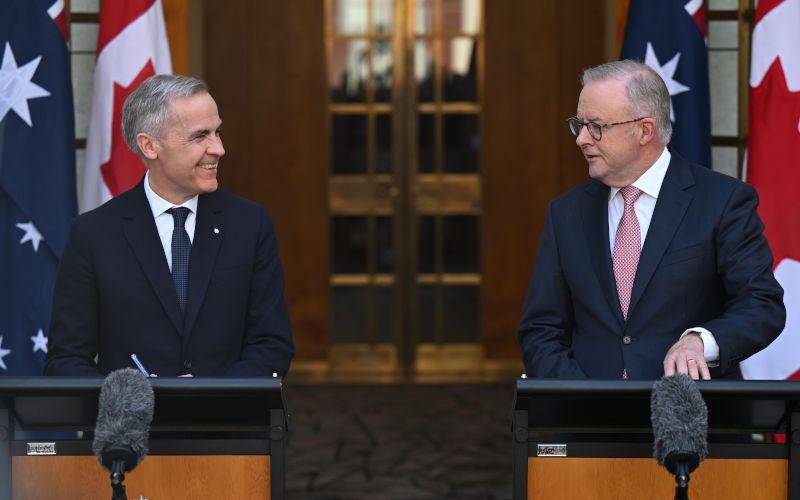
The visit to Canberra by Canada’s prime minister Mark Carney has revived happy talk of Australia as a ‘middle power’.
But do we qualify? Australia’s past record has at times been worse even than that of ‘big power’ USA.
The Vietnam War was the test. Canada refused the US request to send troops. Instead, in March 1966, with the war was underway it sent a retired diplomat, Chester Ronning, to Hanoi in a bid to find a peace agreement to end the war.
Meanwhile what was the Australian government doing?
At the time I was working in our Moscow Embassy. There, incredibly, we were told to inform the Soviets that Australia was disappointed at Moscow’s inability to realise the need to counter the vicious Viet Cong aggression in Vietnam.
Back in Canberra I discovered that in 1965 the government had tried to head off some high-level moves in the US to end Vietnam hostilities, then seen as inspired by Beijing.
Canberra’s obsession over China, clearly not shared by Canada at the time, was to be constant thread in Australia’s Asian policies. One of the uglier results was the willingness to abet Indonesian’s atrocities in East Timor, including the killing of Australian journalists, in the belief Jakarta’s intervention was needed to head off an opposition party, Fretilin, then seen as Chinese influenced.
Fretilin has since come to power, and we have not seen any Chinese takeover.
In 1971 when China’s premier, Zhou En-lai, was struggling against fanatics in his bid to open China to the outside world by inviting the world’s ping-pong teams to Beijing, even the US said yes.
Canberra said no.
Then when the Australian team decided to ignore the government and go, we discovered Canberra had tried to prevent the team from accepting Zhou’s invitation by organising a Taiwan visit instead. Not much ‘middle country’ wisdom and moderation there.
It was only the publicity created by Zhou’s ‘ping-pong’ diplomacy that forced Canberra out of its stubborn refusal to recognise Beijing.
Elsewhere Australia has been notorious for its Asian apathy, the reluctance to learn Asian languages especially. When even Sweden and a very distant EU felt compelled to try to broker an end to the 30 year struggle by Indonesia’s Aceh province separatists, Australia’s government just looked on.
When John Menadue, as former ambassador to Japan, tried to propose a working holiday visa scheme to allow young Japanese to come to Australia, government bureaucrats tried to say no. The scheme has since been adopted, and copied worldwide.
Maybe it’s time to tone down the self-congratulations about middle power virtue, and try a bit harder to be like Canada?