Canada and Australia: working together – without the US
March 7, 2026
Mark Carney’s blunt declaration that the rules-based international order has ruptured challenges countries like Australia to rethink their alliances and consider new coalitions among middle powers.
When the Canadian Prime Minister, Mark Carney, told the World Economic Forum in Davos in January that the world order was ruptured and the rules-based international order had broken down it was very much an ‘Emperor has no clothes’ moment. Just in case anyone missed it, he has been repeating his message ever since – together with his plea that middle-sized powers, such as Australia, must recognise the facts and act accordingly.
It was the same message he delivered again and again during his brief visit to Australia: “Middle powers like Canada, and I would suggest Australia, should recognise that the rupture in the international system represents just that.”
No-one doubted that Carney was correct. What helped elevate him to international stardom was that he was the first national leader to say it out loud, and to suggest what middle-ranking powers such as Canada and Australia needed to be doing in this new era.
As he told the Lowy Institute on Wednesday evening he said: “In a world of great power rivalry, countries such as ours have a choice: compete with each other for favour or combine to create a third path with impact.”
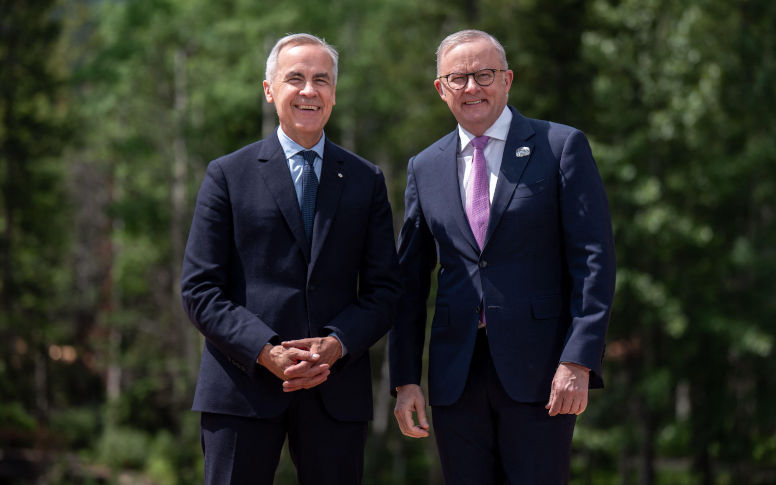
Carney’s January speech was followed quickly by the announcement by Prime Minister Albanese that he had invited Carney to come to Australia and address the Parliament. Carney had already won favour with Albanese’s Government through his strong resistance to the American President’s tariff war against Canada and his rejection of Donald Trump’s assertion that Canada should become the 51st state of the United States.
Albanese’s dealings with Trump weren’t as fraught as Carney’s. The threats to Australia weren’t of the same magnitude. But Albanese had rejected the fawning approach adopted by many other world leaders in their meetings with Trump. He and Carney were equally disenchanted with their supposed ally.
Carney’s visit then, would be an opportunity for Albanese to bask in his friendship with another Prime Minister with a similar world outlook. However Carney’s Davos speech meant that Albanese would be very much in the shadow of his guest.
As it turned out – and as Albanese was well aware at the time he issued the invitation – he was able to share the spotlight with his visitor thanks to a series of bilateral and multilateral deals that would be signed off during the visit.
In the course of his various speeches and appearances in Sydney and Canberra, Carney outlined his country’s intention to build ‘coalitions’ with ‘trusted, reliable partners like Australia’. He emphasised the plural, partners. He called his policy framework “variable geometry – creating different coalitions for different issues, based on common values and interests.”
Not mentioned by name – in this context or any other – was the United States.
“In a post-rupture world, the nations that are trusted and can work together will be quicker to the punch, more effective in their responses, more proactive in shaping outcomes, and ultimately more secure and prosperous,” he said.
“Middle powers like Australia and Canada hold this rare convening power because others know we mean what we say and we will match our values with our actions … in a world of great power rivalry, middle powers have a choice: compete for favour or combine for strength.”
There was a message for Australia in another comment: “Canada’s strategic imperative is to build sovereign capabilities in these critical sectors, at home and abroad, by convening coalitions with trusted, reliable partners like Australia, to ensure that integration is never again a source of our subordination.”
That has not been Australia’s way, other than in trade matters. In developing alliances Australia has tried to ensure that the US is always a partner. Canada is now taking the opposite approach. The partnerships it wants to develop do not include the US. It has had enough of subordination.
Australia won’t always be involved in these partnerships that Canada is developing. But there were quite a few that do that were signed off or announced during Carney’s visit, including critical minerals, defence issues, artificial intelligence, trade and access to capital – the last involving Canadian pension funds and Australian superannuation funds.
The acknowledged breakdown of the world’s rules-based order isn’t quite complete. Carney, and others, carefully avoid putting names to what he calls the ‘hegemons’ – the US and China no doubt. But the reality check is welcome.
So much so that Opposition Leader Angus Taylor, during his speech welcoming Carney to the parliament, agreed that the world order had broken down and commented unfavourably on ‘autocratic regimes that act with impunity’. Could that be, or include, the United States?