Diplomacy as cover – how the road to war with Iran was paved
March 9, 2026
Negotiations with Iran appeared to promise a diplomatic breakthrough, but the launch of Operation Epic Fury suggests the talks served mainly to mask a pre-planned path to war driven by political and strategic pressure.
Since April 2025, the Omani capital, Muscat, had been the scene of what appeared to be an “historic breakthrough." On the table were the most complex dossiers: Iran’s nuclear program and the shadow of US sanctions. The sessions were not merely procedural; the Omani mediator spoke openly of “significant progress,” while Iranian Foreign Minister Abbas Araghchi described the talks as “advancing along positive tracks.”
Iran showed flexibility in accepting international inspections and the scene suggested calm, but what unfolded later revealed that this negotiating path was nothing more than a “diplomatic curtain” to relieve political embarrassment, while the drums of war were sounding elsewhere.
In Washington, the most ardent advocates of war did not see negotiation as a solution but as an obstacle. US Secretary of Defence Pete Hegseth did not hide his intentions. In his book The American Crusade, he did not speak in the language of numbers or traditional national interests but used explicit “crusader” language. He viewed the battle not as a struggle for regional influence but as an existential conflict with what he called “Islamists.” For him, negotiation was not a solution but an obstacle delaying the inevitable resolution. This explains why the diplomatic rounds were merely a warrior’s pause to organise the pieces.
Senator Lindsey Graham and other senior officials exerted continuous pressure to bypass diplomacy. A report by The Cradle indicated that these figures promoted the idea that military confrontation with Tehran was the only path to ensuring dominance, and that any nuclear agreement was merely a “postponement of the crisis.”
Events show that the idea of war had been present and ready in the desks of decision-makers in Washington from an early stage. Operation Epic Fury was not a spontaneous reaction to an unexpected event but a prearranged scenario awaiting the right pretext.
Here lies the great paradox: while the administration pushed for escalation, American public opinion was in a different place. A Reuters/Ipsos poll conducted as the war began showed that 43 per cent of Americans opposed the attacks, compared to only 27 per cent in support.
The partisan gap was striking. Some 87 per cent of Democrats believed Trump was using force excessively, while Republicans were more divided when it came to the “human cost,” with support for the war dropping to 42 per cent once the possibility of American casualties was mentioned.
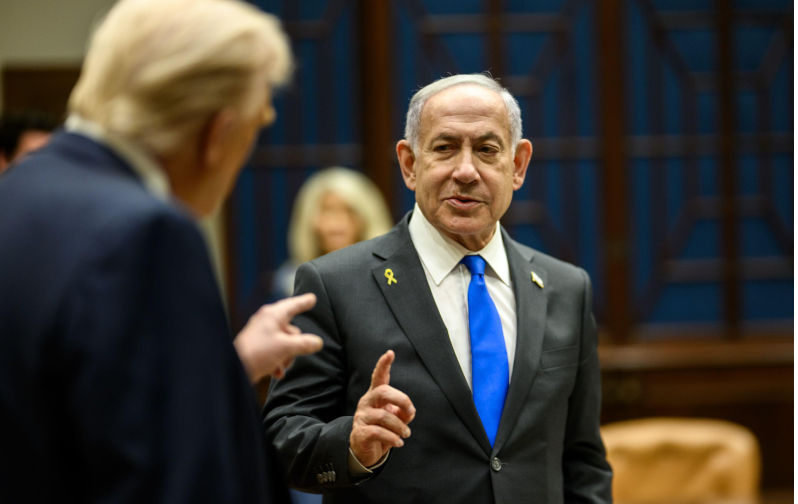
If the American people did not want war, who pulled the trigger? Facts point to organised pressure forces, led by Benjamin Netanyahu, who faced a domestic nightmare from political trials and the failure of October 7. For Netanyahu, war was the only lifeline to remain politically viable and overcome the requirements of the 2026 elections.
On 10 February, during his visit to Washington, the operation was coordinated away from the eyes of diplomats. When Fox News asked Netanyahu in March whether the United States was being dragged into war, he responded with: “That’s absurd… Trump does what he sees fit.” Yet The New York Times pressed the point, asking: “Did Israel force Trump into war?”
The Epic Fury operation launched at the peak of a negotiating round that Israel had already infiltrated with an initial strike. The result? Regional escalation followed immediately. Iran responded by targeting US bases in the Gulf, placing Washington at the centre of a “circle of fire.”
Only three days after the attack, the true cost became apparent: the Department of Defence requested $50 billion from Congress to compensate for the depletion of air defence systems, including Patriot and THAAD, as well as Tomahawk missiles.
The acknowledgment of six US soldiers killed in the early days of the confrontation dying for Israel, not for their own country, was sobering.
How does this end? Once again, the United States is dragged into a war that is not its own, serving the interests of an ally seeking to reshape the region according to a narrow vision. The problem is not only the outbreak of war but the dictatorship of decision-making conducted in secret while the world is lulled by negotiating tables.
In March 2003, speaking with journalist and military historian Ritt Atkinson, General David Petraeus asked bitterly: Tell me, how does this end? The same wisdom had been offered by General Matthew Ridgway to President Eisenhower in 1954, warning against involvement in Vietnam: “We will need eight years and eight military divisions.”
Today, the United States appears to be sinking once again into the sands of the Middle East, as if it had forgotten the most important lesson of history: that those who have the power to ignite the fire do not necessarily have the ability to predict when and where it will be extinguished.
