Environment: If people like Grace Tame can’t be ‘difficult’, who can? – speaking up as ecosystems reach breaking point
March 22, 2026
Human demand is pushing ecosystems beyond safe limits – while weak policy, unrealistic emissions targets and the silencing of dissenting voices make the crisis harder to confront.
Humans take too much energy from the land
It is common knowledge that humanity’s footprint can be found almost everywhere over the world’s land surface. But how do you measure the heaviness of the footprint? How does the heaviness vary from place to place? How has it changed over time? And how does the heaviness affect the integrity and functioning of the ecosystems that form the biosphere in each place?
Almost all the energy within the biosphere is derived from photosynthesis by plants. Within any defined area, the energy produced by all the plants can be measured and is called the Net Primary Production (NPP). In many places, humans commandeer some of the NPP for their own uses (for instance by removing biomass for food, clothing and building materials and by land use change). The amount that humans have appropriated (HA) at any time can be expressed as a proportion of the NPP in pre-industrial times (the Holocene) and used as a measure of our impact on that patch of the environment. This proportion is abbreviated to the rather intimidating HANPPHol.
The energy contained in the NPP powers important (for humans and other species) ecosystem functions such as pollination, sediment retention, the health of soil microbiota, water retention and flow, and pest regulation (although the last is a very anthropocentric orientation). The more of that energy that humans remove, the less there is available to keep the ecosystem functioning and resilient.
So it’s not surprising that as the amount of NPP that humans appropriate in each location increases, the greater is the decrease in species richness and biodiversity in the area, although the precise effects are highly context specific.
Taking an HANPPHol of 10 per cent as the threshold for moving from a safe (sustainable) human footprint to one that puts the ecosystem at risk and 20 per cent as high risk, globally the 10 per cent boundary was crossed around 1900 and the 20 per cent boundary around 1990 – which seems logical considering the population growth and the industrial and agricultural development that occurred in both magnitude and coverage during the twentieth century. In 1900, just over a third of global land had passed the 10 per cent mark and 14 per cent was already in the high risk zone. Today the figures are 60 per cent and 38 per cent respectively.
In 1850, the largest but still relatively light human impacts on NPP were seen in Europe and to a lesser extent India, north-east China and the eastern US. By 2000, however, as demonstrated in the map below, only remote, lightly populated areas of the globe remained in the safe (under 10 per cent) zone, while many regions had moved well into the high risk zone.
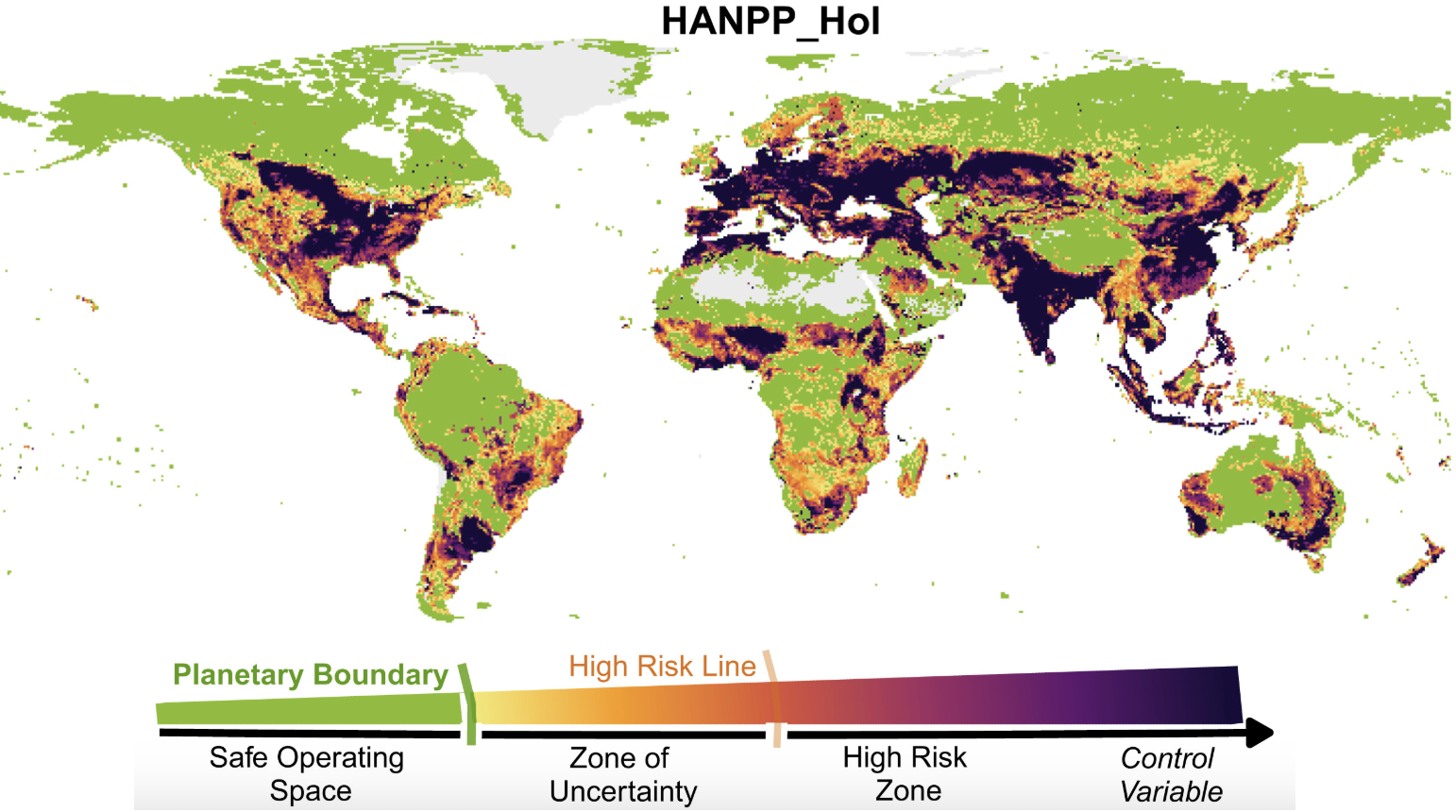
A stable Earth System, one that provides liveable conditions for modern humans, requires a healthy biosphere but human activities are pushing many ecosystems beyond safe limits. The planetary boundaries framework was developed to quantify the effects of human pressures on nine critical Earth systems and to propose boundaries for each system beyond which the system would no longer be functioning safely for humans. Biosphere integrity is one of the planetary boundaries. HANPPHol provides a measure of the harm we are doing to that integrity.
The authors of this study conclude that “the integrity of ecosystems has already been critically compromised across large parts of the planet. Critical natural ecosystems need to be kept intact or restored to protect biodiversity functions. This requires land prioritisation for nature.”
Those last six, easily missed, words are critical for human survival, on a par with reaching net zero emissions and avoiding nuclear war, although you wouldn’t know it from Australian government policies.
Unrealistic government expectations for mining’s diesel emissions
The government projects that greenhouse gas (GHG) emissions from the use of diesel in the mining industry will fall from 22 Mt CO2e in 2023 to 13 Mt in 2035. Most of the emissions currently arise from the mining of coal (48 per cent) and iron ore (26 per cent). The government expects that the major contributions to the necessary 4.5 per cent per year reduction will come from decreased coal production and the Safeguard Mechanism – see graph below.
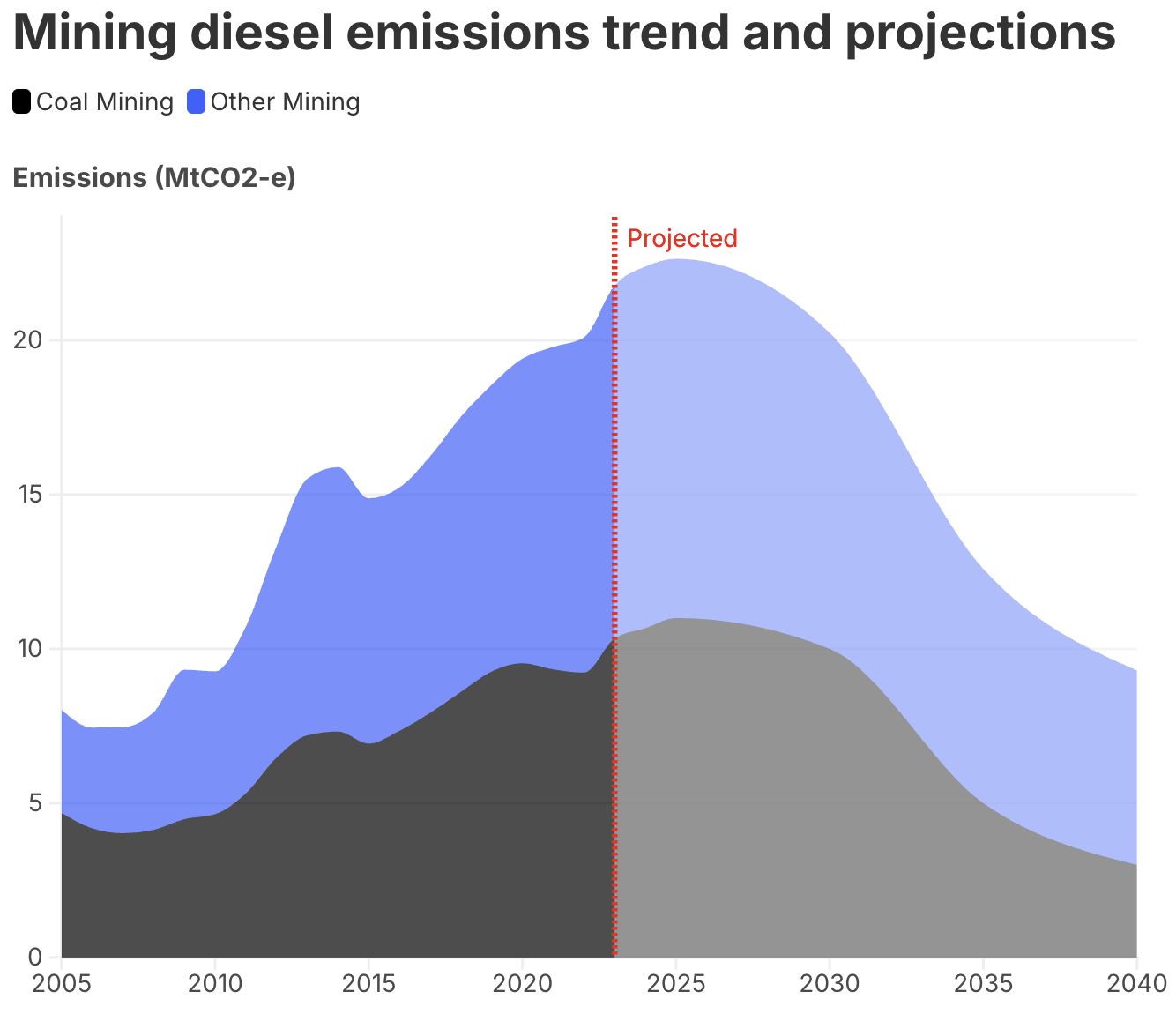
But the government’s projections seem unrealistic:
- The industry’s diesel emissions, which enjoyed their nadir at 7.5 Mt in 2006/7, have been increasing at 6 per cent per year recently.
- The shift to open-cut coalmines has increased the use of diesel per tonne of coal mined by 50 per cent since 2010.
- The Safeguard Mechanism and other regulations provide weak incentives to reduce emissions.
- The $5 billion per year granted to the industry under the diesel fuel tax rebate scheme is a disincentive for companies to adopt alternatives to diesel.
- Major miners have been deferring decarbonisation plans (e.g, transitioning to EVs and clean fuels) to the 2030s.
- Concerns about the long term future of coal mining make investment in decarbonisation projects unappealing.
- Even when adopted, decarbonising mining involves long timelines.
It seems quite possible that mining’s diesel emissions will increase by 30-40 per cent over the next decade rather than decrease – yet another example of the government’s wishful thinking and/or addiction to the distribution of woollen eyeshades.
Gayini Conservation Area, NSW
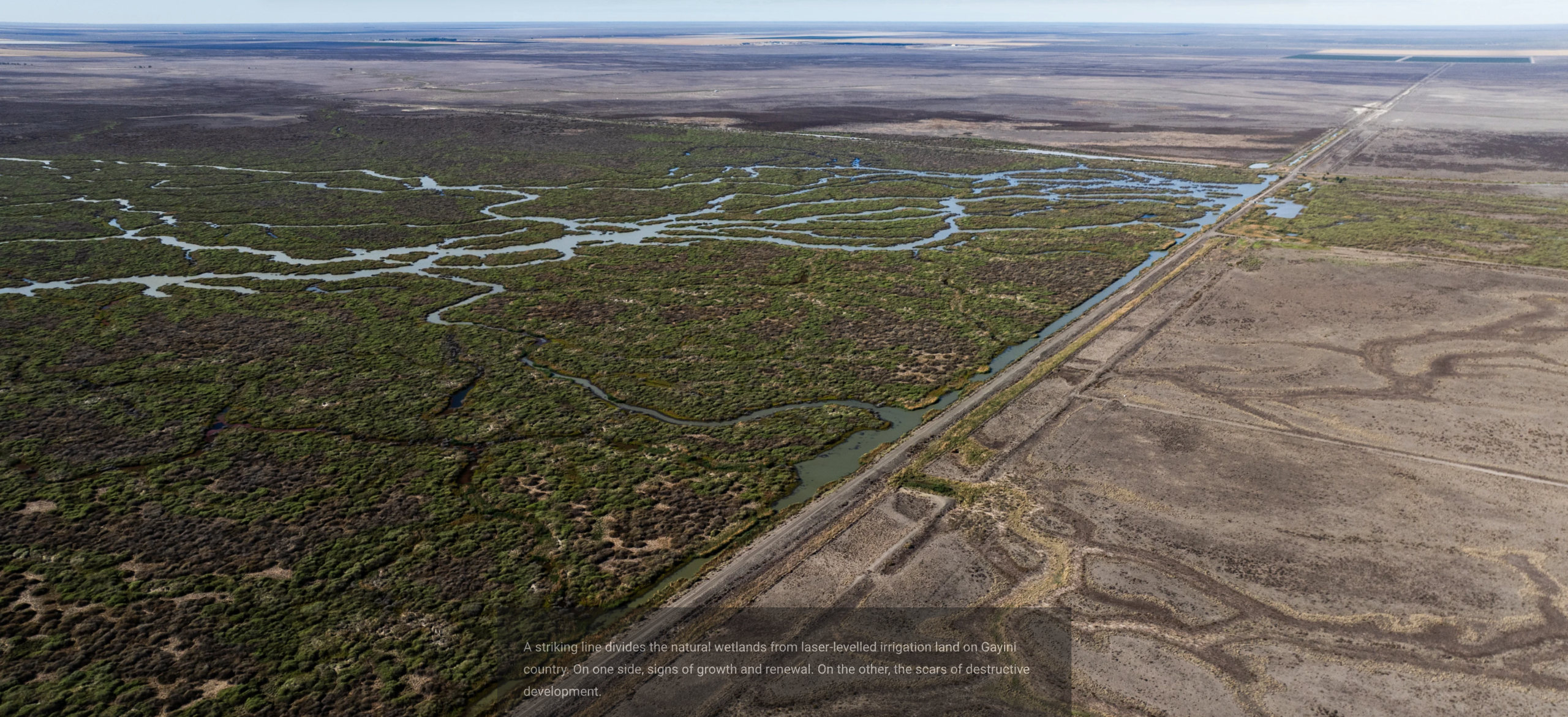
One half of the remarkable picture above shows the recovering wetland of Gayini Conservation Area, an 88,000 hectare property owned and managed since 2019 by the Nari Nari Tribal Council (NNTC). Gayini (the Nari Nari word for water) is situated about 50 km north-east of Balranald in southern NSW and is part of the largest remaining area of wetland in the Murrumbidgee Valley. The other half of the picture presents the less appealing and environmentally degraded adjacent property which still bears the scars of long-term irrigation and grazing. Not so long ago, both sides of the road looked degraded.
The picture itself appears in an article about the work of the UNSW Centre for Ecosystem Science and The Nature Conservancy (and others) in supporting the NNTC to measure how their work to restore flooding regimes and manage livestock is helping the landscape, water, soil and vegetation to recover from two centuries of water and land exploitation.
I spent three days on Gayini last July and I can tell you that it looks great and is teeming with waterbirds.
That’s a good news story but the even better news is that the NNTC has recently become the owners of the adjoining 16,000 hectare Great Cumbung property, part of the Great Cumbung Swamp (cumbungi is the Nari Nari name for the bulrush which grows in the area). Let’s hope that a few years of restoration work will result in all of the area above looking green and healthy.
In praise of Grace Tame
Politicians, the media, people who feel threatened by dissenting voices and many members of the general public like to tell famous people who start to express their opinions and become activists outside the fields within which they have made their reputation to stay in their box – who wants to know what a dumb footballer or rich movie star or uppity teenager thinks about war or poverty or climate change?
There are many examples of attempts to silence and disparage famous people who have spoken out: (Hanoi) Jane Fonda, Peter (Olympic silver medallist) Norman, Bono, Greta Thunberg, David Pocock, Craig Foster, Cate Blanchett and Brigitte Bardot spring to mind.
Well, I’d like to express my support for Grace Tame. I like the way she conducts herself, whether it’s about gender violence or the Middle East or whatever. Previous Australian of the Year or not, she isn’t obliged to be “nice” to people in power. Why shouldn’t she make some people feel uncomfortable, speak truth to power, challenge received wisdom, established ways of doing things, prejudice, inactivity and injustice.
“If people such as Grace Tame don’t do it, who will?”. That’s what I expect a Labor prime minister to say.
Why are you stepping out of your box? What’s this got to do with the environment?, some may ask. The world’s environmental problems do not stand apart from intra- and inter-national discrimination, inequity and geopolitics. It’s completely unrealistic to think that we will be able to manage climate change and loss of biodiversity in a world where oppression, exploitation, unfairness, poverty and violence continue to be widespread. Either we find a way to tackle, concurrently and rapidly, all the serious political, social and environmental problems that beset the world or we will perish, first as a civilisation and then as a species.
I don’t think that Grace Tame needs any encouragement from me to keep doing what she does best but I hope she does.
Trump’s wall destroys nature
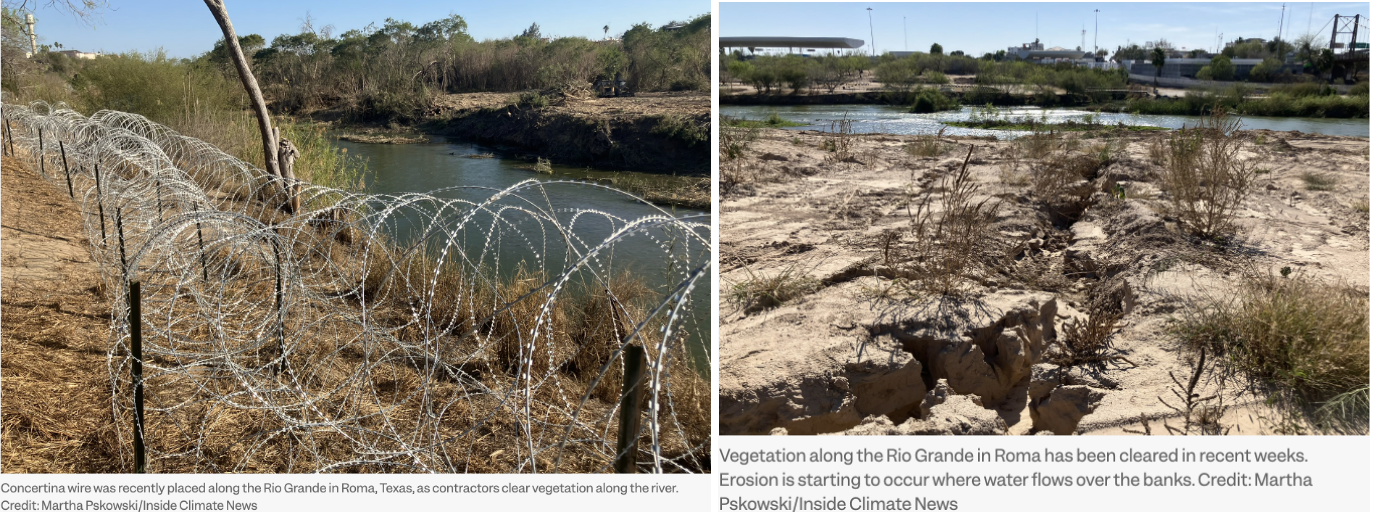
The “wall” along the Rio Grande to stop illegal migration from Mexico to the US has garnered lots of attention since Trump first became President but I haven’t seen much discussion about its environmental consequences. Not surprisingly, however, the construction of concrete and razor-wire barriers and the bulldozing of vegetation along the banks of the river are having serious consequences for the riverbanks, the islands in the middle of the river, the aquatic and riparian ecosystems of animals and plants, and the birds and insects that use the Rio Grande Valley as a flyway during migration. None of this will be of any consequence to the President himself, I’m sure.