Environment: A hotter Middle East, a warming Arctic and heatwaves that won’t retreat
March 1, 2026
Arab nations face a very hot future, more severe heatwaves will continue for 1,000 years after we reach net zero, and changing land use has contributed to global warming, now global warming is damaging the land.
Arab nations warming at twice the global rate
The Arab region contains 22 very diverse countries that span North Africa, East Africa and the Arabian Peninsula. It is about 70 per cent larger than Australia and its population is about 16 times larger. The region (which geographically includes Israel of course) is one of the most climate vulnerable in the world:
- The regional average temperature in 2024 was the highest on record: 1.94oC above the average for 1961-1990 compared with the global average of 1.19o
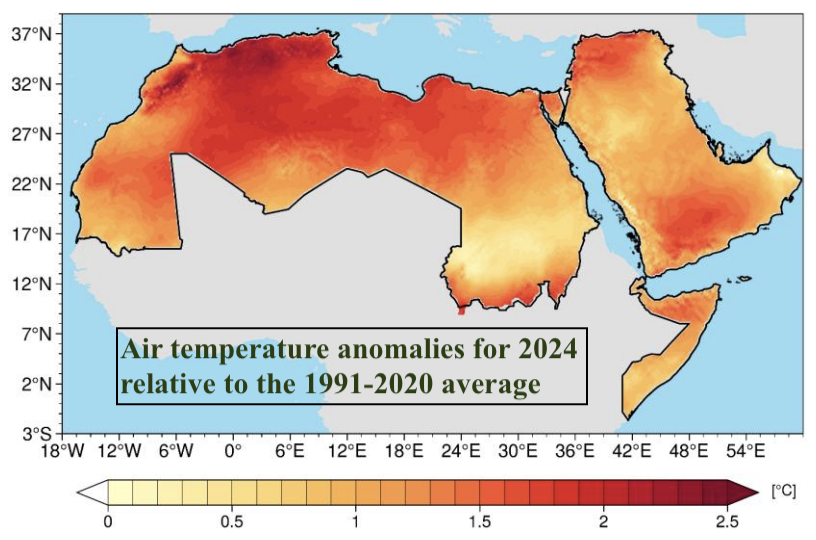
- Since 1991, the region has been warming at twice the rate of 1961-1990 and twice the global average rate (0.43oC per decade compared with 0.2oC).
- In 2024, rainfall was up to double the average in some areas (eg, northern Sudan and the southern Arabian Peninsula) and less than half the average in the north of the region.
- Sea level rise has exceeded the global average of 3.4 mm per year except along the Mediterranean Sea.
- The region is among the hottest in the world and since 1981 the number of heatwave days per year has been increasing, particularly in the near east and the north of Libya and Egypt.
- Extreme weather events, mainly floods and heatwaves, caused 300 deaths and affected 3.7 million people in 2024.
- 19 of the 22 countries are considered water-scarce and the region contains 15 of the world’s most water-scarce countries.
- Droughts are a long-term feature of the region but drought intensity does not seem to be increasing. In western North Africa droughts worsened in 2024 after six failed rainy seasons.
It is clear that many of the countries in the region will be severely challenged by both short duration and more permanent declines in agricultural yields, damage to physical infrastructure including homes, increasing health problems, displacement of large numbers of people, increases in social inequality, disruptions to supply chains, economic losses and poor prospects for investors.
Land-use change and climate change in vicious cycle
For agriculture, settlements and infrastructure, humans have been tearing down forests, ploughing up grasslands and draining wetlands at increasing rates over the last three centuries. The changes we’ve made to the use of the land have been significant sources of greenhouse gas emissions. Now, climate change is increasingly causing the land to change. For instance:
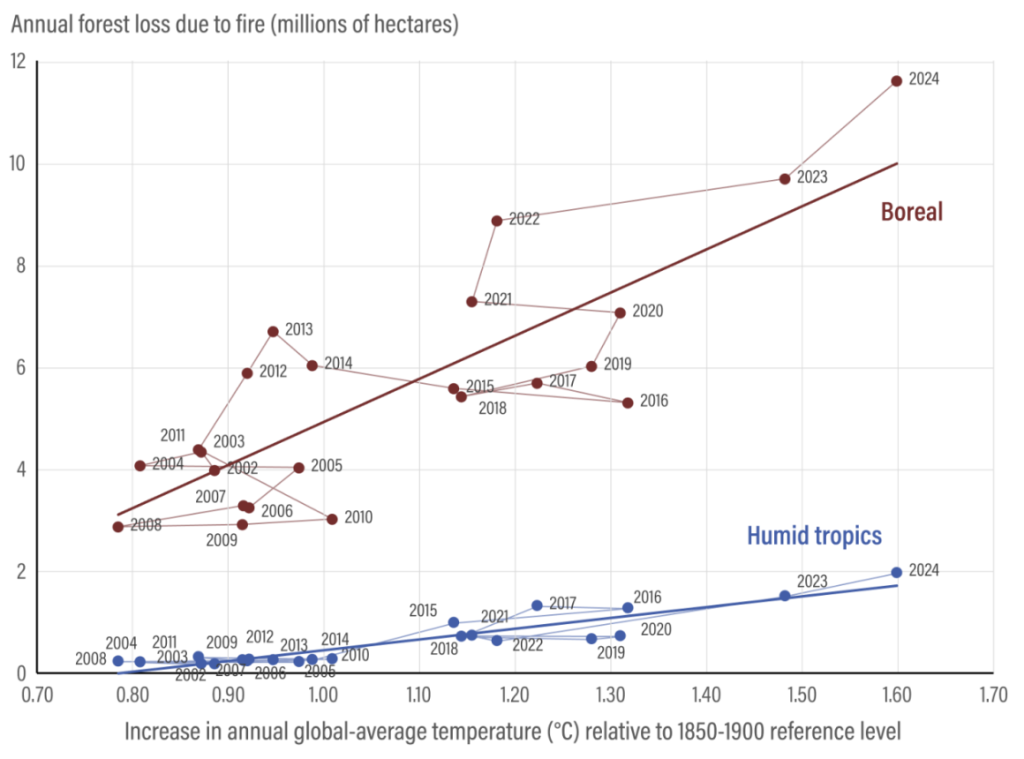
- Hotter, drier conditions are increasing the risk of forest fires – see graph below. Globally, more than twice as much forest burnt in 2015-24 as burnt in 2001-10 and emissions from (mainly boreal) forest fires have increased 60 per cent since 2001. In 2023 a third of land cover change was caused by fires.
- Climate change-induced droughts are killing trees, depleting river basins and flows and destroying crops. A combination of lack of rain and very high heat can lead to rapid drying of the land – ‘flash droughts’.
- A warmer climate provides the energy for stronger, longer-lived storms that destroy trees and coastal vegetation and cause floods that erode the topsoil and create landslides.
All of these events disrupt ecosystems and push vulnerable species closer to extinction.
The emergence of unchecked reinforcing feedback loops within systems (an increase in A causing an increase in B which further increases A, etc.) creates runaway system change and spells catastrophe. Unless something happens to restore balance in the system, it will either collapse or move to a different state of equilibrium.
Tackling climate change, destruction of the physical environment and decreasing biodiversity separately increases the risks of unforeseen consequences, including the creation of reinforcing feedback loops. The stresses we have put on the environment must be tackled simultaneously, in a coordinated manner and NOW if we are to avoid environmental and social collapse.
What happens to heatwaves once we reach net zero?
In broad terms, the global community has focused on two goals for combating climate change: 1) keep global warming below 1.5oC (now revised to 2oC at best) and to achieve this 2) reach net zero greenhouse gas emissions by mid-century.
I’m all in favour of goals and quantifiable targets to assess progress but I think there’s a false sense in the community that once we reach these two targets we’ll be on top of climate change; its effects on the living and physical environment, weather patterns and human health and wellbeing will then stabilise and even start to abate, so the story goes. This delusion persists even though there is plenty of evidence that, once triggered, climate-induced changes in some natural processes will inevitably continue for decades, centuries and even millennia even if emissions and global warming are reduced.
Research conducted by Australian scientists into what will happen to heatwaves (lasting at least three consecutive days) in a net zero world has poured even more cold water on the popular fantasy:
- Heatwaves will be hotter, longer and more frequent the longer it takes to reach net zero and will reach their most dangerous levels if net zero is not attained before 2060.
- Delaying net zero beyond 2050 will create longer, hotter heatwaves than a temporary overshoot of 2oC …
- … but in the unlikely event that we hit net zero before 2040, heatwaves will be less severe than after a temporary 2oC overshoot.
- Countries closer to the equator will experience the worst of the heatwaves. They are also the most vulnerable to the consequences.
- Over most of the world, once net zero is reached there will be no decline in the heat, length or frequency of heatwaves over the next 1,000 years. They may not get worse but nor will they improve; ie, there will be no rapid return to pre-industrial heatwave patterns.
- The, probably to many people surprising, 1,000 year finding is likely due to a combination of ongoing warming in the Southern Ocean, changes in polar sea ice and the absence in most computer modelling of any use of technologies that remove CO2 from the atmosphere (negative emissions).
Three broad strategies are proposed to avoid the worst heatwaves and cope with those that happen: serious carbon emissions reductions, rapid and extensive introduction of adaptation measures (involving, for instance, early warning systems, public infrastructure, housing, health services and working conditions) and adoption of negative emissions technologies to push emissions below net zero, reduce the level of atmospheric CO2 and lower global warming. (The evidence that negative emissions technologies will achieve any meaningful reduction in atmospheric CO2 is sparse. I’ll discuss this another time.)
The import of this Australian simulation study is not whether the dates and temperatures are exactly correct but that it suggests that humanity cannot sit back and relax even if we do reach our climate targets. The researchers conclude that (1) the earlier net zero is reached, the more likely it is that high-impact heatwaves will be kept within a reasonable coping range, but (2) the findings “critically challenge the general belief that conditions after net zero will begin to improve for near future generations”.
Australia’s LNG exports are costing Australians
It’s difficult to see many benefits to Australians arising from the expansion of Australian LNG exports since 2015. Jobs in the oil and gas industry are about the same now as they were a decade ago; after paying no tax for years, the companies are still paying a very modest amount despite considerable profits; and the money collected from royalties is well below expected.
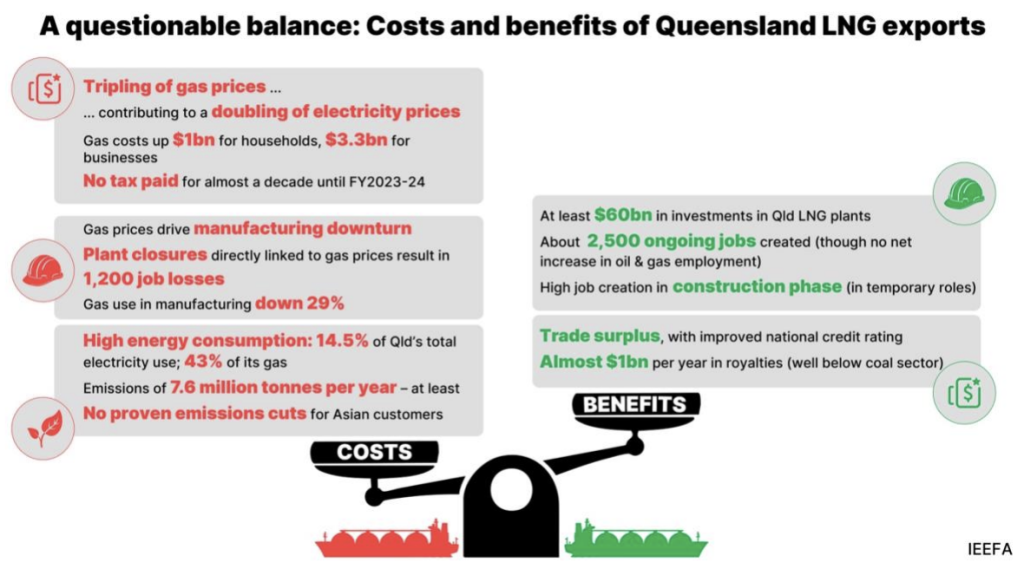
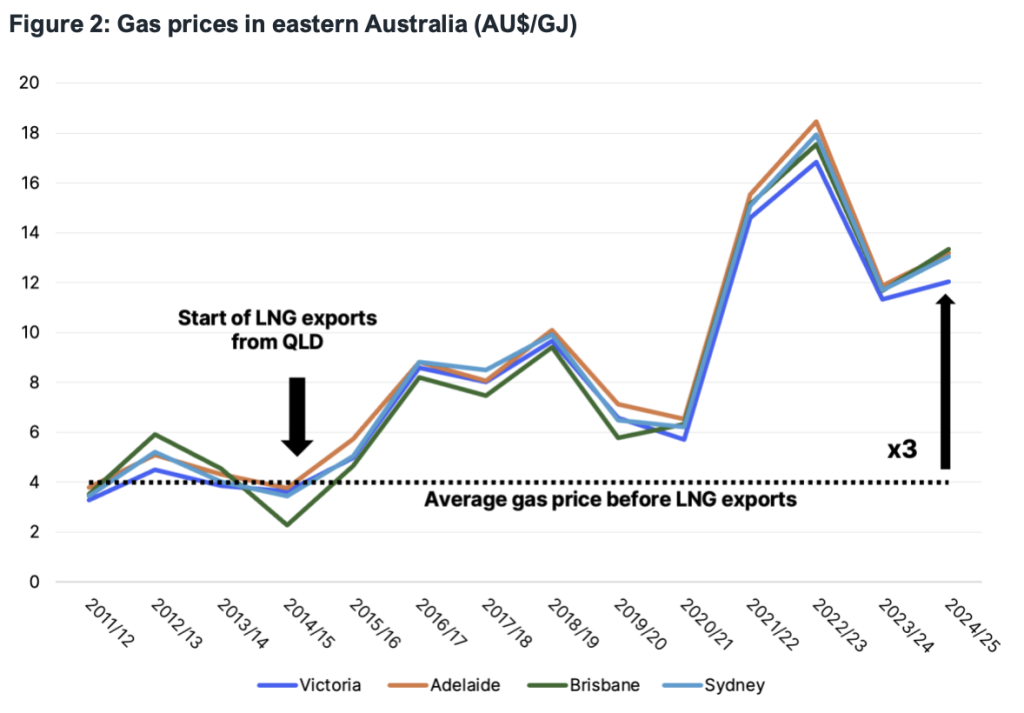
And while one always needs to be cautious about confusing association with causation, the graph below suggests that our booming LNG export industry has been a serious contributor to the increased price of gas for Aussie households.
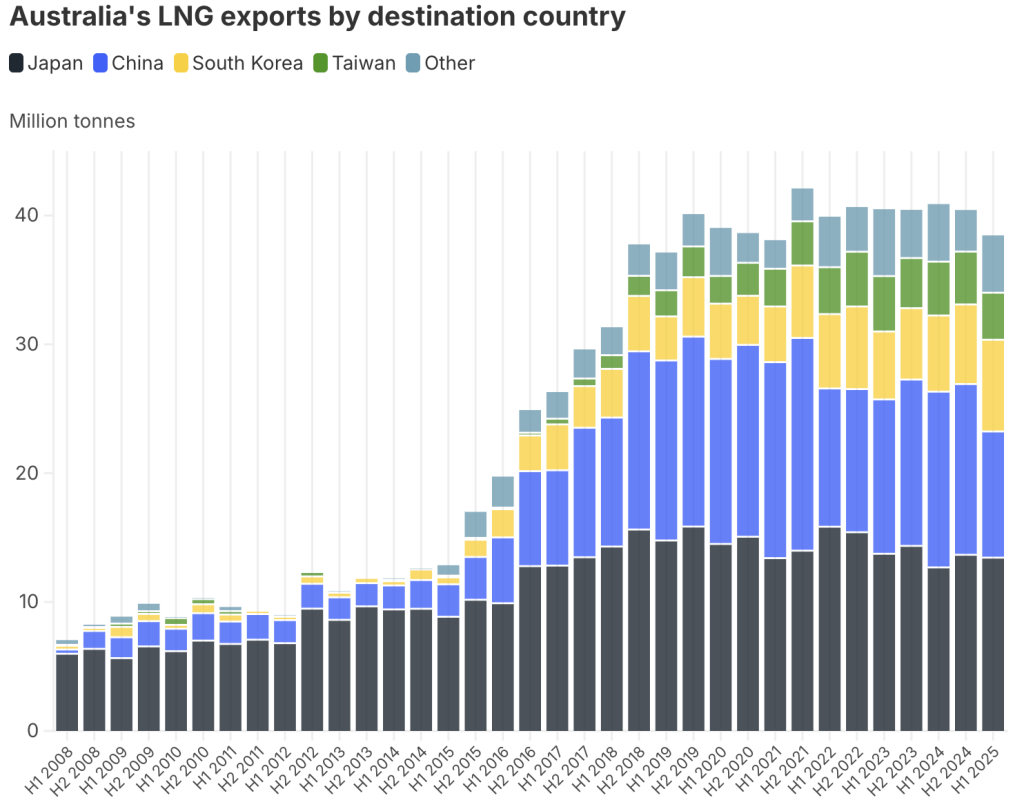
Australia exports about 83 per cent of the gas it produces. Where does our LNG go? As demonstrated in the histogram below, most of it (about 60 per cent) goes to Japan and China. Add in South Korea and Taiwan and it’s 90 per cent. Australia currently supplies about 40 per cent of Japan’s LNG imports and 30 per cent of China’s.
Vicious cycle of global warming in the Arctic
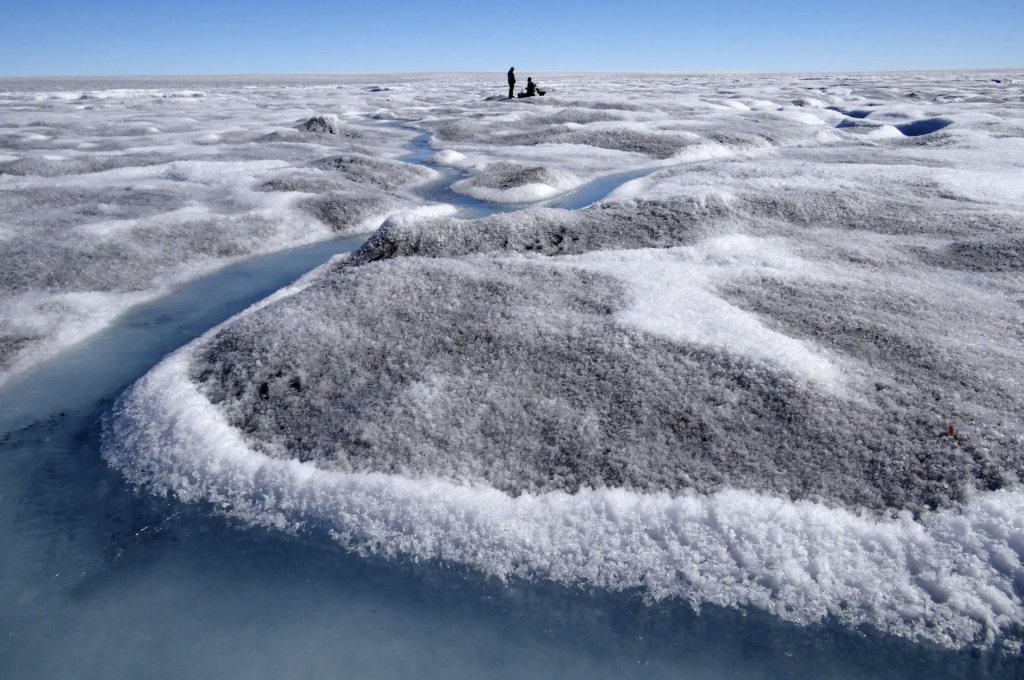
This visually intriguing but environmentally devastating photograph shows part of the Greenland ice sheet with a supraglacial stream running over the surface. The white ice is clean, so to speak, but the grey ice is darkened with algal growth which is leading to increased global warming, faster melting of the ice and more sea level rise.
Winds blow algae and nutrients such as phosphorous and nitrogen from Greenland’s narrow rocky coastal areas onto the inland icesheet. The icesheet is already melting due to global warming, which is much faster in the Arctic than the global average. The nutrients carried on the wind mix with others that were trapped in the ice when it froze and are now being released as it thaws and together they feed the algae.
The clean white ice is very good at reflecting the sun’s energy but the algal-darkened surfaces absorb more of the sun’s energy, get warmer, increase the melting (and global warming) and promote more algal growth. And so it will go on until all the world’s ice has disappeared unless we stop global warming by eliminating our use of fossil fuels.