Environment: warming oceans, sinking coasts and Covid’s impact on birds
March 8, 2026
New research shows oceans warming to depths of 2,000 metres, human-driven land subsidence intensifying sea level risks in China, and pandemic lockdowns altering bird evolution in Los Angeles.
Warmer oceans spell danger for humans and ecosystems
The oceans are a giant reservoir not only for water but also for CO2 and heat. They have absorbed about half of all the additional CO2 that humans have pumped into the air over the last 250 years and more than 90 per cent of all the additional solar energy (as heat) that the Earth has retained as a result of the higher concentration of CO2 in the atmosphere. Consequently, the oceans now hold more total energy (Ocean Heat Content or OHC) than in pre-industrial times and the water is warmer.
The increased heat content and temperature were initially mainly limited to the oceans’ surface layers but they are now extending down to 2,000 metres. OHC is one of the most robust measures of long-term climate change because it is less sensitive to short term fluctuations than, for instance, the commonly used global average surface temperature.
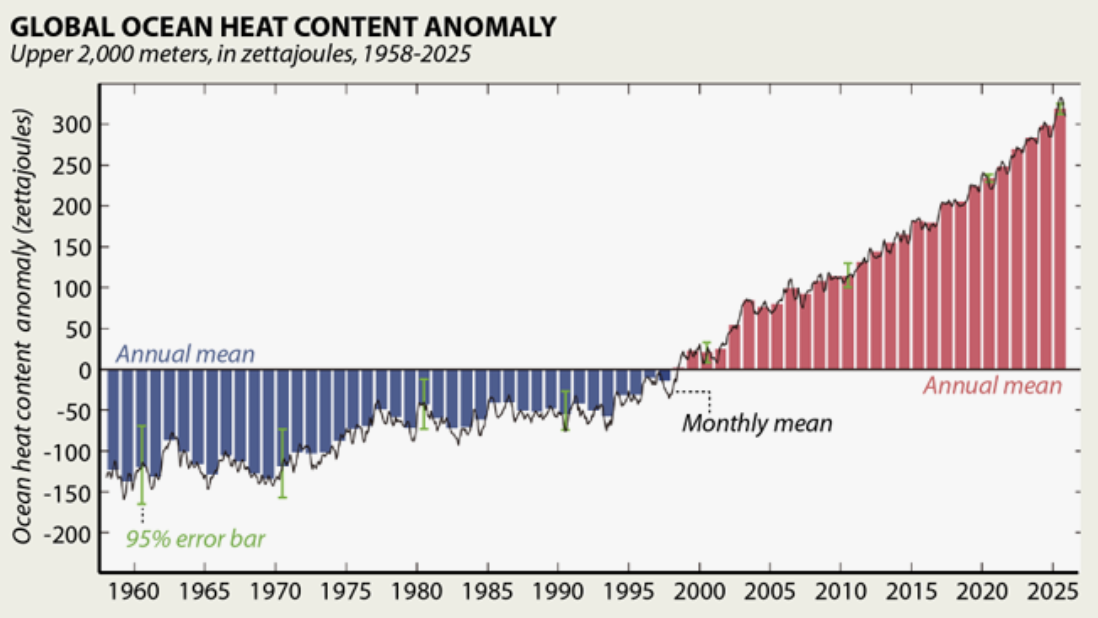
The OHC of the top 2,000m has been increasing steadily since the 1950s, with the rate of change increasing four-fold from 2.9 Zettajoules per year (ZJ/yr) during 1958-85 to 11.4 ZJ/yr during 2007-25. In 2025 the OHC increased by 23 ZJ. The largest changes in 2025 occurred in the North Atlantic and Southern Oceans, Mediterranean Sea and an area of the Indo-Pacific. The North Atlantic and Mediterranean are also hotspots of salinisation, deoxygenation and acidification which all pose significant threats to ocean ecosystems.
The histogram below displays the annual variation of the OHC from 1958-2025 compared with the average for 1981-2010.
The global mean Sea Surface Temperature (SST) has also increased markedly since the 1950s, at an average rate of 0.12oC/decade. In 2025, the SST was 0.12oC lower than in 2024 (mainly due to a weak La Niña) but even so the SST in 2025 was 0.49oC above the 1981-2010 baseline and the third highest on record.
Hotter oceans speed up sea level rise via thermal expansion of the water. They also increase the frequency and intensity of marine heatwaves, with disastrous consequences for coral reefs. Warmer water also increases evaporation. Warmer, wetter air contains more energy, leading to more extreme and more unpredictable weather, particularly stronger rainfalls and more rapid intensification of cyclones.
Even once global warming is contained, it is likely that the warming of the oceans will last for centuries.
John Abraham, a professor of thermal sciences in the US, commented that reducing ocean heating is a matter of will rather than capability: “We can solve this problem with today’s technology. There is real optimism among scientists.”
I agree with the first sentiment but am doubtful about the second. I find it very difficult to believe that any well-informed person could be optimistic about the world reducing global warming in a timeframe that will avoid multiple human and environmental disasters, particularly when the global sheriff prefers regime change to climate change (even to the extent of pressuring the International Energy Agency to drop tackling climate change as a priority).
Subsidence compounds sea level rise in southeast China
When the last Ice Age ended about 12,000 years ago, the massive glaciers that had spread from the poles melted and global sea levels rose rapidly for the next 8,000 years. There then followed a period of relative stability until the mid-19th Century, since when sea levels have been rising again, principally due to global warming. But coastal conditions vary and in preparation for the ongoing rise of sea levels it is important to know the amount of change that has occurred, what can be expected and the factors influencing this.
Southeastern China, roughly Shanghai to Hong Kong, has a population of approximately 100 million people and is one of the most densely populated areas in the world. It is an area of immense importance to China and the world generally. Sea level changes in the region over the last 12,000 years are shown in a greatly simplified form in the table below.
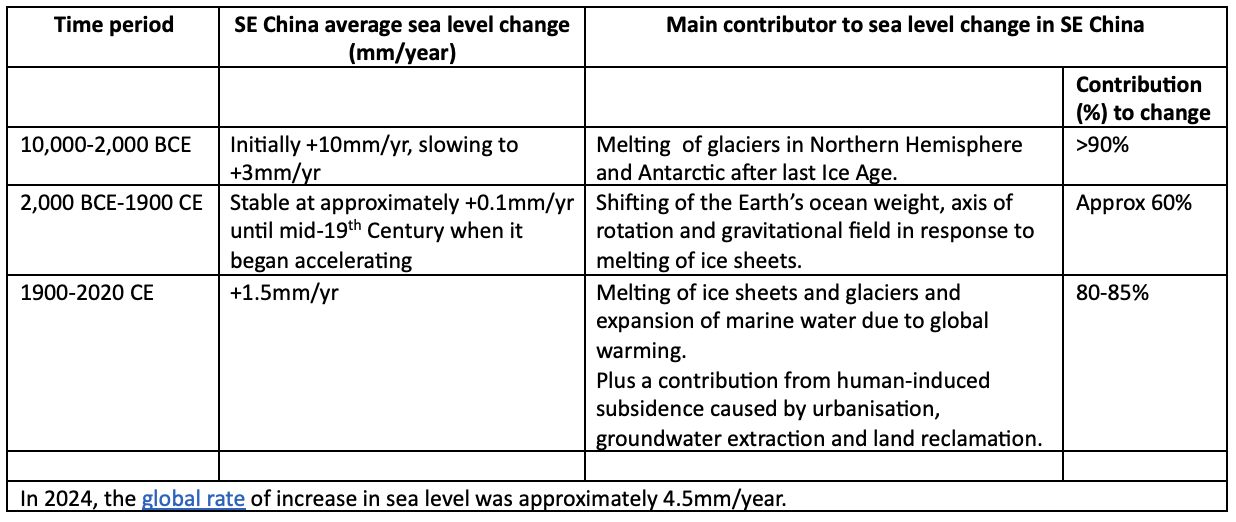
Anthropogenic climate change has been the major driver of rising sea levels for the last 170 years but more recent large scale urban developments mean that human activities are now also a significant cause of land subsidence (responsible for about 95 per cent) in most of southeast China’s metropolitan coastal areas, particularly in river deltas where it intensifies the already considerable natural subsidence.
The study authors conclude that without effective city-level risk management strategies, the concurrent acceleration of global sea level rise and rapid localised subsidence (both caused by human activities) will pose critical challenges to the sustainability and resilience of China’s densely populated coastal communities (and probably in other areas of the world).
Sorry, Anthropo-what …?
Anthropause: “a significant, temporary reduction in human activity on a global scale, and the subsequent observable effects on the natural environment." The term was coined by scientists in 2020 to describe the period of widespread lockdowns and travel restrictions during the COVID-19 pandemic. The observed effects have included reduced air, water and noise pollution leading to improved ecosystem health, changes in wildlife behaviour such as land and marine animals moving closer to areas of human habitation, and harmful consequences such as increased poaching due to reduced surveillance.
We, well I, have until recently tended to think of evolution as being driven by random genetic mutations, each of which affects the physical form or function of the individual in a way that confers on the individual a slight advantage. If it’s an advantage that improves breeding success, the possessor’s offspring slowly, over multiple generations, become the dominant form of the species. Of course, if the mutation creates a survival disadvantage, it is likely to die out, possibly quickly.
To complicate matters, however, I have in recent months mentioned a couple of examples where human intervention has caused changes in the form (smaller Atlantic cod) and behaviour (birdsong in the US) of a species over quite short periods.
Research now strongly suggests that the Covid pandemic induced changes to the shape of the bills of dark-eyed juncos, a species of normally forest-dwelling sparrow, that had taken up residence in urban Los Angeles. Before Covid struck, the bills of the urban juncos had become shorter and thicker than their forest-living cousins. During the pandemic, however, the LA juncos’ bills reverted to their longer form, only to change back to their shorter form afterwards – demonstrated in the graph below of the ratio of bill length to depth over time.
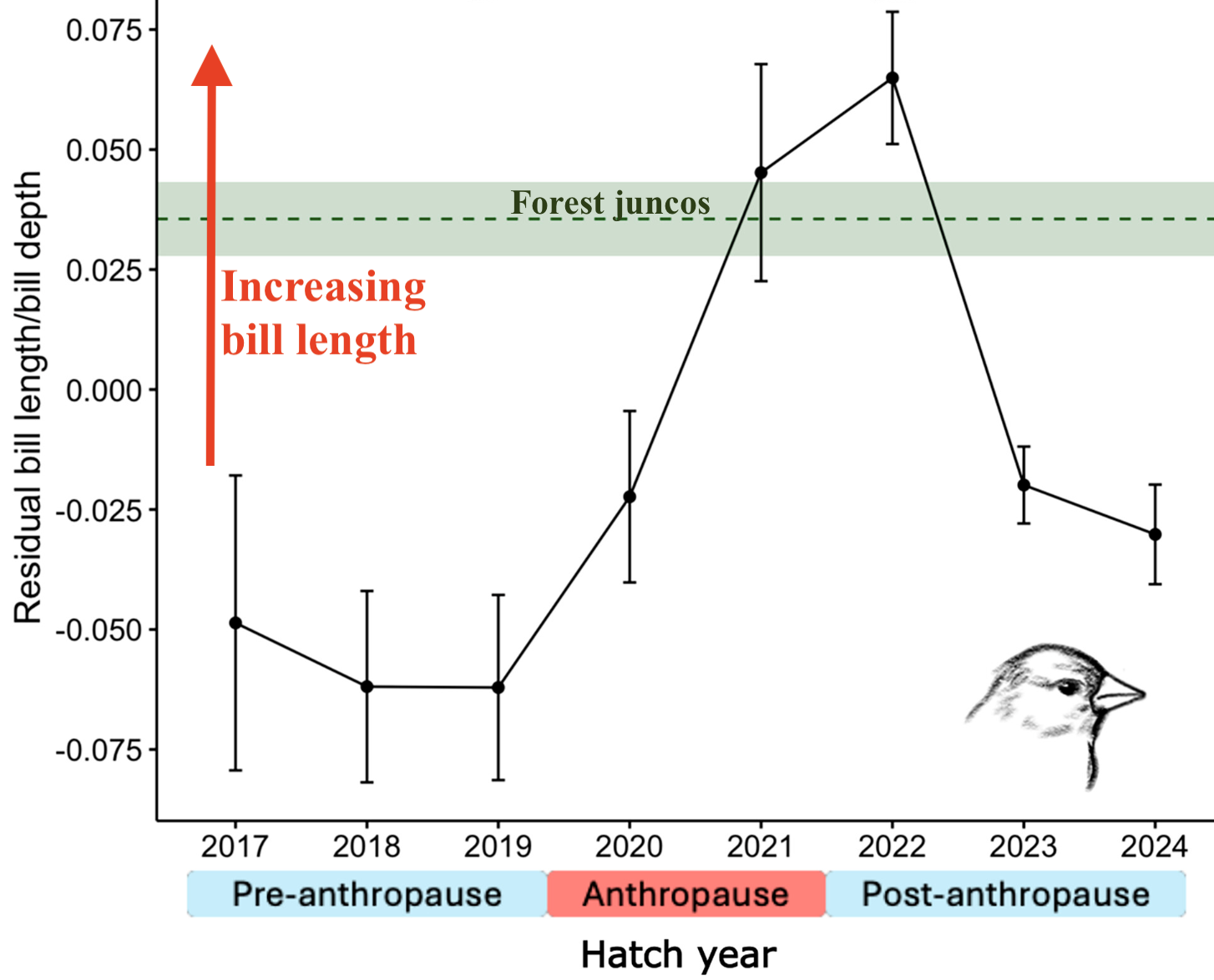
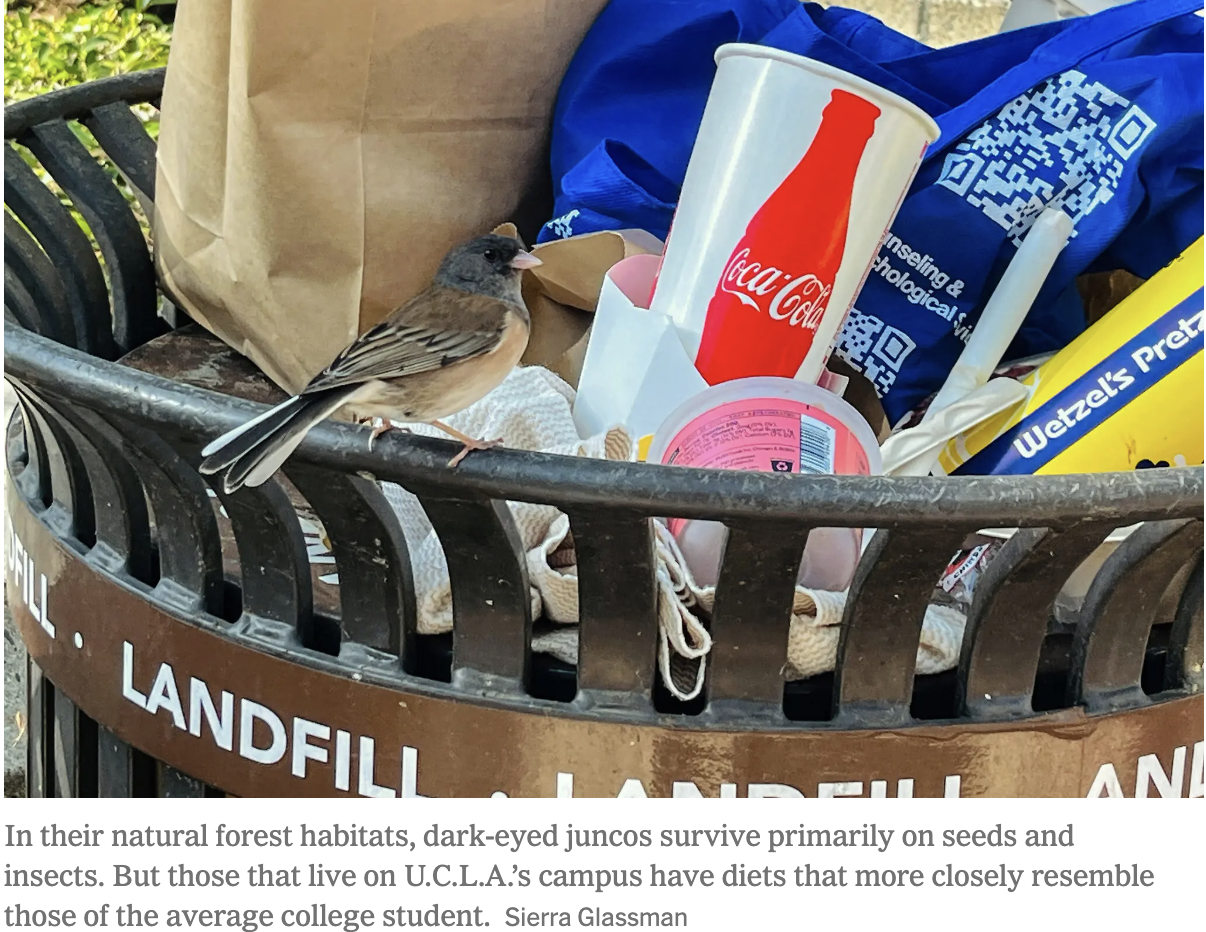
The reason for the changes observed during this natural experiment seem to relate to the availability of food. Forest-living juncos eat mainly seeds and insects for which a longer, thinner beak is most functional – indicated by the horizontal green bar in the graph. But the juncos that moved onto a university campus started dining on human scraps (photo below) for which a shorter, thicker bill works best.
The graph clearly shows that the LA chicks born in the northern springs between 2017 and 2020 (the pre-anthropause period) had shorter bills than their forest cousins. However, when Covid hit, the bills of the academic junco chicks born during the anthropause (the springs of 2020 and 2021) became longer, more like the forest juncos. It is suggested that this is because university classes moved online, the campus became relatively deserted and the resident juncos reverted to a more traditional diet, most likely due to the absence of easily available junk food. When Covid restrictions were lifted and students and staff returned to campus, the juncos quickly returned to the human-generated smorgasbord and the bills became shorter again – seen in the chicks born in the post-anthropause springs of 2022-2024.
The researchers considered a variety of underlying genetic and non-genetic explanations for the beak changes but on the evidence available they favoured adaptive evolution which requires genetic variation.
The authors conclude: “These findings show how rapidly and strongly humans can affect other species. In turn, wildlife can profoundly affect humanity’s health and well-being. Our work highlights the need to understand the complex interactions between humans and other species” – feigned or genuine ignorance of which among many politicians and vested interest groups is a theme to which I keep returning.
Birdwatching helps the economy soar
Approximately 96 million US residents are birdwatchers, over a third of the population who are 16 years and older. On average they birdwatch on about 75 days a year. Men and women and all age-groups are enthusiasts but the participation rate increases with income. They nearly all do it from home and 43 million take trips of over 1.6 km to watch their feathered friends.
In 2022, birdwatching contributed A$160 billion to the US economy. The vast majority (85 per cent) was spent on equipment, including bird food, nest boxes, binoculars, cameras, guides, maps and special clothing and also big ticket items such as boats and campervans. The remainder was spent on trip-related expenses – travel, accommodation and food. This created 1.4 million jobs, A$130 billion of employment income and A$58 billion in taxes.
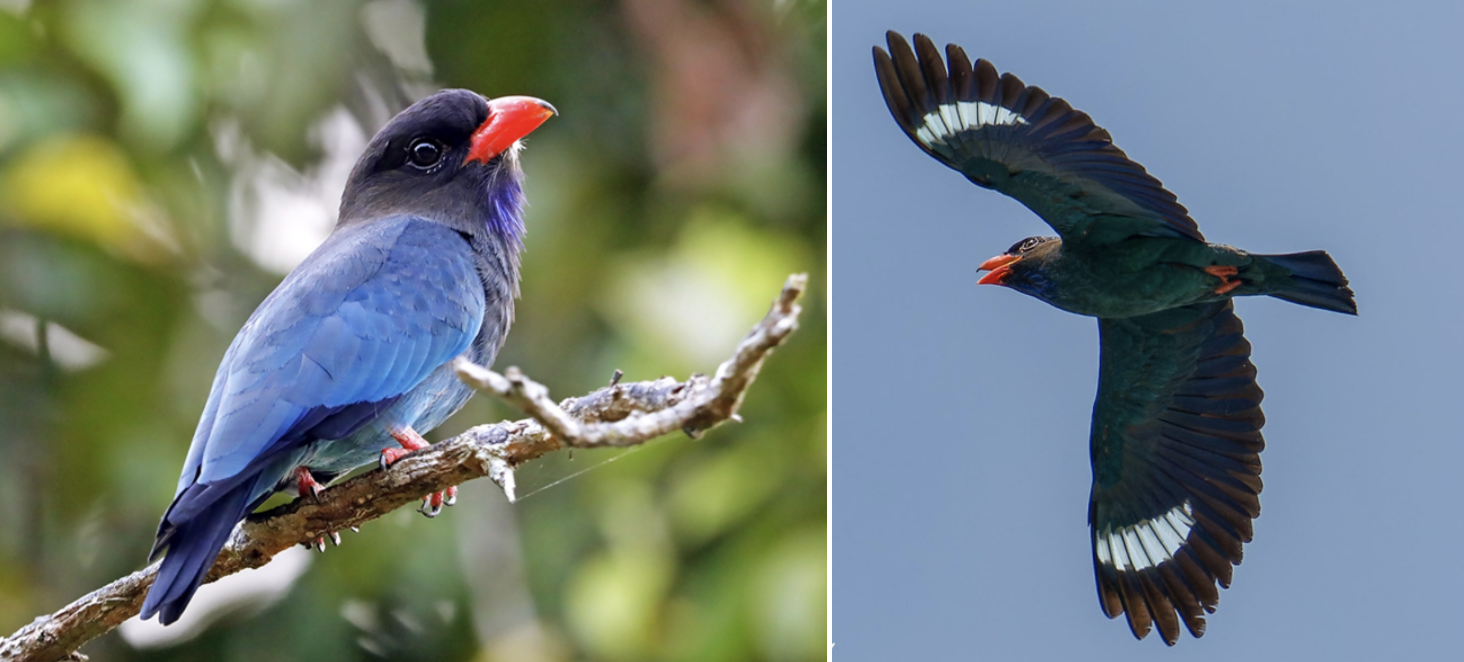
Eurystomus orientalis (“wide mouthed one from the east”), a summer visitor to northern and eastern Australia, now regards its common name as an example of nominal determinism.