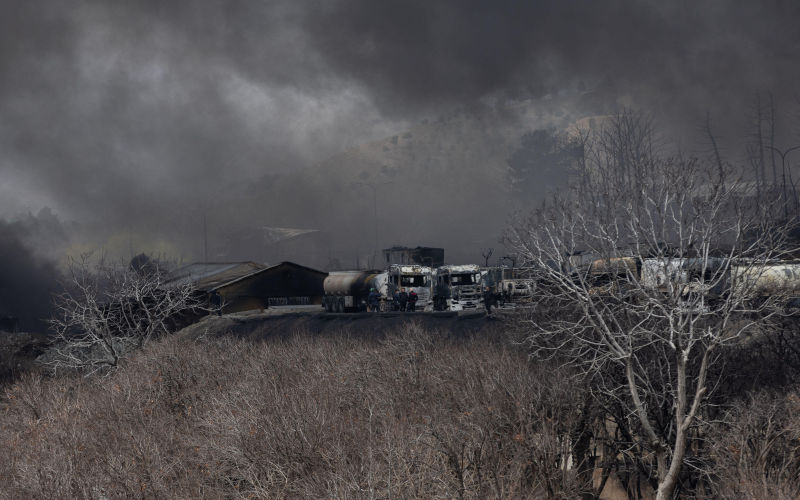
Former defence leaders say oil wars threaten our security, and climate change deepens the danger
March 13, 2026
In full-page statements in the national media today, 19 Australian security practitioners and former Defence leaders have published an Open Letter on why Australia’s dependence on fossil fuels is a critical economic and security vulnerability.
Published in the _Australian Financial Review_ and the _Sydney Morning Herald_, the letter’s signatories include Admiral Chris Barrie, the former Chief of the Australian Defence Force, Air Vice-Marshal John Blackburn AO, Deputy Chief, Royal Australian Air Force (Retd), Cheryl Durrant, the former Defence Director of Preparedness and Mobilisation, and Brigadier Michael Bond CSC and Bar, Australian Army (Retd).
They say that protecting Australians by accelerating the renewable energy rollout is now a security priority:
**“**We call on the Australian government to accelerate the transition to clean, domestic energy. Rapidly expanding renewable energy – including wind, solar, batteries, hydro and renewable fuels produced in Australia – and electrifying our transport system with home-grown energy will strengthen Australia’s security, reduce exposure to global energy shocks and help limit the escalating risks driven by climate change.”
Major conflicts in Ukraine and in the Middle East – including the Suez crisis, two Arab-Israeli wars, the Iran-Iraq war, the Gulf war of 1991 and the 2003 invasion of Iraq by the USA – have all caused energy supply and economic shocks. The consequences are rising food prices, higher transport costs and potentially severe economic disruption. Today, with the Israel/US/Iran conflict, we face another oil shock, possibly far worse than its predecessors.
With oil and gas production in the Gulf now either curtailed or stopped, and the prospects of an extended closure of the Strait of Hormuz, Australia is particularly exposed. Our heavy reliance on imported oil, with gas prices now tied to global markets, mean higher costs for Australian households and businesses. Renewed inflation and the likelihood of higher interest rates are a concrete expression of the burden that oil wars place on Australians, and the price paid for Australian governments’ support for such wars over many decades.
Not only does the Gulf oil crisis interrupt the global petrol and diesel supply, but also the petrochemical feedstocks essential for fertiliser production, apparel manufacturing, copper and nickel mining, microchip production and much else. This has direct impacts on the production of digital technology from AI servers to batteries, cars and phones.
At the same time, climate change, driven by fossil fuel use and subsidies, is increasing instability and conflict. Food shortages, water stress and extreme heat have already contributed to social breakdown across the Middle East and North Africa. In 2010, simultaneous wheat harvest failures in three of the world’s breadbaskets led to a tripling of the spot price for wheat. In the Middle East and North Africa, where there are the countries most dependent on wheat imports, the food-price crisis resulted in riots and the widespread unrest that became the Arab Spring.
That food crisis, allied with an epochal drought in eastern Syria, was a driver of the Syrian civil war that displaced a quarter of the population into neighbouring countries and then some into Europe, with significant political consequences.
In the letter, the 19 security leaders write:
“As global warming intensifies, competition for water, food and resources including oil will further increase the risks of insecurity and war. And the conflicts themselves add to climate change with increased military and reconstruction emissions."
“These risks are connected. Continuing fossil fuel dependence, let alone the government’s current support for expansion, intensifies climate change, creating a growing threat to Australia’s economic and national security.”
Climate change and fossil-fuel dependence are increasingly linked in a reinforcing cycle. Burning fossil fuels drives climate change. Climate change, in turn, increases the likelihood of instability and conflict in vulnerable regions. At the same time, geopolitical conflict often disrupts oil supply, triggering price spikes and economic shocks and social unrest. This creates a feedback loop where fossil fuel dependence, geopolitical conflict, and climate instability amplify one another, increasing economic and human security risks.
The Albanese government would have been clearly warned about these risks in Australia’s first climate and security risk assessment, carried out by the Office of National Intelligence (ONI) and delivered to the government in December 2022. The ONI report was immediately put under lock and key and even parliamentarians, let alone the public, have not been told what it said. So the parliament is working in the dark when it comes to security risks such as those triggered by this new oil war in the Gulf.
The Australian Security Leaders Climate Group has repeatedly urged the government to get ahead of these risks, rather than playing catch-up. Their suggestions include:
- Establishing a Climate Threat Intelligence Unit within the Office of National Intelligence (ONI) to assess climate-related security risks and provide integrated analysis across government.
- Producing an annual declassified climate security assessment for Parliament to improve transparency and inform national policy planning.
- Developing an Abrupt Climate Change Early Warning System, coordinated by the Climate Threat Intelligence Unit, to monitor emerging tipping points and rapid climate shifts that could have major geopolitical and economic consequences.
These initiatives would have been very useful, right now.
Successive governments have also been warned for years about Australia’s extreme exposure to oil shocks, arising from declining domestic oil production, oil refinery closures and ideological reliance on market forces to meet demand, but have done little to seriously address it.
We now have a political system where the two main opposition parties, the LNP and One Nation, deny climate change despite the increasing climate damage being endured by their constituents. Meanwhile, the Albanese government professes climate leadership, whilst doing everything possible to negate its modest climate policies by encouraging fossil fuel export expansion.
All are in thrall to the amoral leadership of the fossil fuel and finance industries, determined to maximise short-term profit regardless of the consequences. There is no evidence that either the political or business leadership have the capacity or courage to face the big threats we face, the security implications of the crisis in the Gulf being just one of many.