Free speech and antisemitism: drawing the line
March 25, 2026
In this extract from his submission to the Royal Commission on Antisemitism and Social Cohesion Gareth Evans argues that it is crucial that protest language claimed to be inherently antisemitic be evaluated on a case-by-case basis, taking into account context and intent.
It is not surprising that the explosive increase in speech and conduct characterisable, accurately or otherwise, as antisemitic, has occurred over the last two and a half years, in the aftermath of the appalling events of 7 October 2023. Israel was perfectly entitled to respond with furious intensity to the indefensible outrage perpetrated by Hamas militants on that date – a massacre of over 1,000 innocent Israelis which, however explicable the emotion which triggered it might be, remains impossible to morally justify.
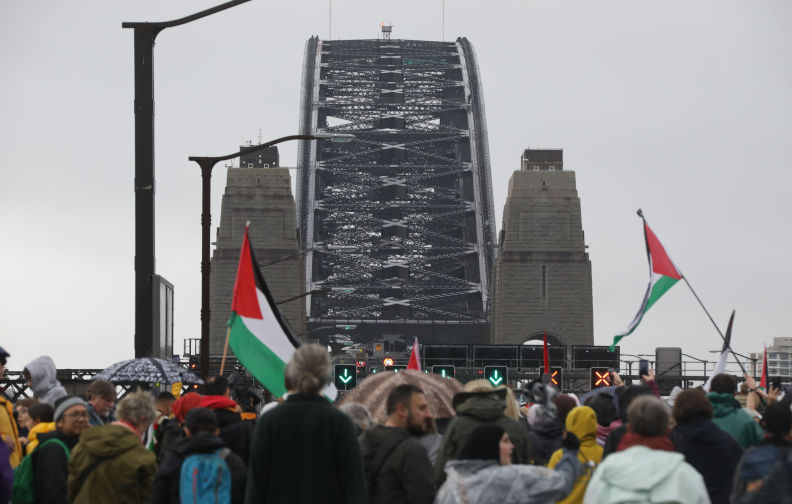
But it was not very long before the number of innocent Palestinians men, women and children indiscriminately massacred in return came to wildly exceed, now by many scores of thousands, the Israeli death toll. And that disproportionate response, and some of the hateful rhetoric accompanying it, has triggered the intense continuing public protests, in this country as elsewhere, with which we are all now familiar.
It is equally unsurprising in this context that those with responsibility for maintaining order and defusing communal tensions – governments, police forces, university administrations and others – should, in order to simplify their enforcement task, be tempted to make explicitly unlawful, or subject to automatic institutional discipline, particular slogans and other forms of expression deemed to be inherently antisemitic, rather than subjecting them to case by case evaluation, taking into account, as necessary, both context and intent. The most currently attractive linguistic candidates for such specific outright bans – already in place in Queensland, and proposed in NSW – have been the slogans ‘Globalise the Intifada’ and ‘From the River to the Sea, Palestine shall be Free’.
However understandable this response, it is submitted that it is a serious over-reaction, one very troubling in its implications for the paramount democratic value of free speech, now recognised by the High Court as the constitutionally protected implied freedom of political communication, and should be explicitly rejected by the Commission. Potentially problematic forms of expression should be left to be dealt with by general hate speech law, properly drafted and applied.
General principles which should govern hate speech laws
Hate speech legislation, or more general hate crime legislation including hate speech provisions, is not problematic to the extent it focuses on the causing of harm. Words can incite to violence; they can intimidate, creating a fear of injury or some other adverse consequence; and they can humiliate, causing real psychological damage. And as such it is entirely appropriate that there should be legal sanctions against their public use. But words can also be offensive or insulting without necessarily being harmful in any of these senses. Such words can be socially or morally unacceptable, to be deplored, and justify educational effort and social pressure to try to get people not to use them in public, but not be so damaging as to justify any kind of formal legal proscription, given competing values like freedom of political and artistic expression.
In this context, there is continuing public debate about the legitimacy of s.18C of the Racial Discrimination Act 1975, added in 1995, which makes it unlawful (and subject as such to civil complaint proceedings, but not criminal penalties) to ‘offend, insult, humiliate or intimidate’ persons or groups because of their race, colour or national or ethnic origin. My own strong, and long-held, view, which I hope the Commission might be willing to embrace, is that this section, while retaining its application to language or behaviour which is likely to cause harm by way of humiliation, intimidation or incitement, should be amended to remove its application to language or behaviour which merely offends or insults. Expression that one personally hates is not the same as expression that incites or provokes race hatred.
There is also ground for at least some concern, on free speech first principles, with a provision of the Combatting Antisemitism, Hate and Extremism Act 2026, passed after the Bondi massacre. A ’hate crime’ is here defined, inter alia, as conduct ‘that would, in all the circumstances, cause a reasonable person who is the target or a member of the target group, to be intimidated, to fear harassment or violence, or to fear for their safety’. While on the face of it this sets a reasonably objective benchmark, I think the better view is that which is articulated in para 29 of the parliamentary inquiry submission made by the Human Rights Commission, viz. ‘some would argue that adopting a broader ‘reasonable member of the Australian community’ standard would better promote freedom of expression and legal certainty. A community-wide benchmark reduces the risk of speech being curtailed based on highly contextual sensitivities and reflects a more uniform standard of tolerance in a pluralistic society.’
‘From the River to the Sea, Palestine shall be Free’
It is submitted that there is no justification whatever for imposing a blanket prohibition on public use of this language. Supporters of such a ban claim that it is antisemitic because of the perception that it necessarily implies the establishment of a Palestinian state extending across the entire territory from the Jordan River to the Mediterranean, which would mean the destruction of Israel, not just the state but the ideal.
But leaving aside for now the question (revisited below in discussing ‘Zionist’ language) of whether criticism of Israel’s existence is indistinguishable from hostility to Jews as such, it is not necessarily the case at all that use of this slogan means the destruction of Israel and the disappearance of its Jewish population. Opponents of a blanket ban say that it can, equally, be seen as a demand that Israel dismantle its illegal occupation, allow the creation of a Palestinian state, and come to a just solution of the refugee return issue. Or, alternatively, be seen as a call for the creation of a single state in which Palestinians would have absolutely equal rights to its Jewish citizens. In either case Palestinians would be free.
It is submitted that this is not even a case where it is necessary to make a case-by-case evaluation of context and intent. The slogan in question is inherently ambiguous, and one that any decent respect for free speech would allow to be freely used.
Globalise the Intifada
This particular language is more troubling because of the now almost universal perception that the concept of ‘intifada’ necessarily entails serious violence (as it certainly did during the Second Intifada of 2000-05), and that to ‘globalise’ its acceptance would necessarily mean accepting the perpetration of terrorist violence not just against Israeli institutions and Jewish Israelis, but Jews everywhere, which would unarguably involve antisemitism. But opponents of a blanket ban say that ‘intifada’ in Arabic means just ‘shaking off’, and at most ‘uprising’, which latter might take the form (as did the First Intifada of 1987-93) mainly just of non-lethal demonstrations and civil disobedience, and as such be a legitimate political position.
It is submitted that this is a case, as with so many other manifestations of alleged anti-semitism, where context and intent are crucial. Some Jewish groups acknowledge that the intent of persons using the phrase may be different, but still support a blanket ban on the ground that its impact of any such use on the Jewish community remains the same.
The counterargument is that if one is serious about protecting free speech, then one cannot allow subjective perceptions to determine characterisation of any given language as antisemitic: the words in question must, objectively, manifest hatred, hostility or prejudice towards Jewish people generally. That may be the case for some users, but it certainly will not be for all.
Anti-Zionist statements
There is some truth in the argument of many Jewish community organisations that verbally targeting ‘Zionists’ can be a socially permissible way to target Jews generally, while offering plausible deniability. The great majority of Jews, in Australia as elsewhere, identify as Zionists, and a great many no doubt see Zionism as ‘a core component of Jewish identity, grounded in strong cultural, religious and familial connections to Israel’ (as a recent Victorian Civil and Administrative Tribunal ruling put it). No doubt many have had experiences justifying their suspicion that use of Zionist terminology is just a cover to disguise hostility or prejudice towards Jews as such.
But there is also truth in the argument of many of those with strong concerns about the impact of the Zionist enterprise – and the way in which Israel has over the decades used its statehood to forcibly displace Palestinians from its territory, illegally occupy Palestinian territory, and work to make claims to Palestinians’ own statehood in the region practically impossible to realise – that anti-Zionism has long been deliberately conflated with antisemitism in order to defuse those criticisms.
Public admissions of that reality are rare, but occasionally surface, most notably with the well-known statement of the highly regarded former Israeli Foreign Minister and UN Ambassador Abba Eban, recorded in the Congress Bi-Weekly publication of the American Jewish Congress in 1973, that ‘One of the chief tasks of any dialogue with the Gentile world is to prove that the distinction between anti-Semitism and anti-Zionism is not a distinction at all’.
One of the most obvious ways of demonstrating that there is such a distinction is to point to the fact that over the decades a great many Jews around the world, including in Australia today, have been and remain hostile to Zionism. They famously include Albert Einstein and Isaac Isaacs, who were not about denying Jewish belonging or rights, but rather refusing to build those rights on ethno-nationalist violence, enforcing Jewish supremacy in a land historically shared by Palestinians.
All that said, I do believe it to be prima facie unacceptable, and quite likely to be driven by antisemitism, to describe Zionism or Zionists as inherently racist. It is a perfectly accurate and defensible exercise of free speech to call out some strong defenders of Israel – including some current Israeli Government ministers – as unapologetic racists. But it is unarguably the case that great many people who would happily describe themselves as Zionists – who supported the creation of Israel, and who continue to strongly support its existence behind safe and secure boundaries – are, and always have been, equally supportive of Palestinian rights, and cannot remotely be described as racist.
This is a position to which I can readily relate personally: while a strong and vocal supporter of Palestinian rights my whole adult life, I was given an award by the Zionist Federation of Australia in 1992 for my support as Foreign Minister for the campaign to revoke the UN General Assembly ‘Zionism as racism’ resolution.
But when self-identified Zionists take their commitment to Israel to ideological extremes – and do behave in colonial-supremacist ways, with total indifference to legitimate Palestinian claims of right, and making their own claims for a Jewish state extending from the river to the sea – they also deserve to be called out, and not allowed to get away with the old trope of painting their critics as irredeemably antisemitic.
Whether anti-Zionist statements can be characterised as antisemitic depends, as with so much other language and behaviour in this space, on case-by-case evaluation of context and intention. It would be helpful, in the cause of defusing community tensions on this issue, were the Commission to so find.
The point here, as elsewhere, is that there is no one-size-fits-all solution to the problem of antisemitism. As Kylie Moore-Gilbert put it in a December 2025 _Age_ article, “there appears to be no singular, monolithic antisemitism festering in Australia but rather multiple different mutations of this ancient virus”. She identifies the three of most concern as being ‘Islamist extremists’, ‘far-right neo-Nazis’, and ‘individuals whose extreme anti-Israel views have crossed the line into anti-Jewish sentiment, and for whom any distinction between diaspora Jews living in countries like Australia and the actions of the Israeli government has long since disappeared’.
She makes the point in relation to the last group that the ‘vast majority of pro-Palestine protesters do not fall into this camp’, motivated as they are essentially by horror at the deplorable situation in Gaza. Anti-Israel protesters come in all shapes and sizes, and particular language that may appear unequivocally antisemitic in the mouths, or on the signs, of one group, may look much less so in the case of another. The law should recognise that reality.