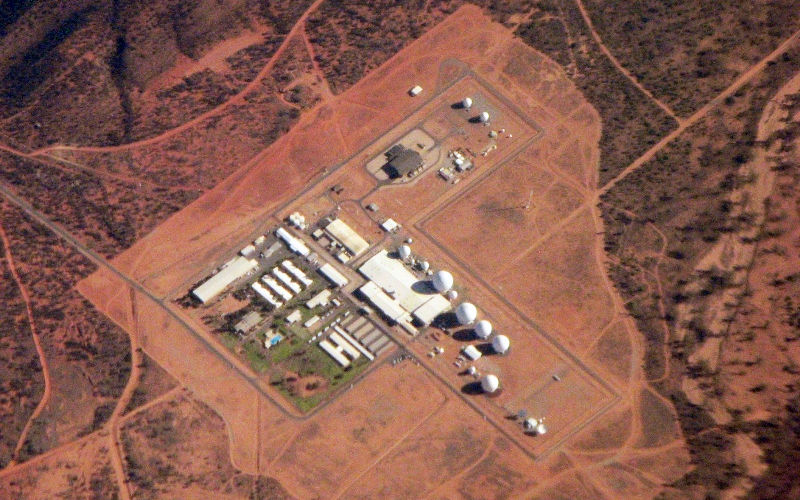
How US bases make Australia part of the Iran war
March 12, 2026
Australia’s role in supporting the US-Israel war against Iran with the hosting of a string of US military bases across the country is a critical contribution to the US war machine.
Australia is doing what it has done for decades when the United States wages war in the Middle East.
Australia is providing intelligence architecture, intelligence collection, communication systems, military intelligence specialists, and the political cover that helps support the assault.
Canberra says Australia is “not involved” because it is not dropping the bombs itself. That is the usual deception. But modern war is not just the aircraft over the target.
In a globally networked world, it is the satellite feed, the launch detection, the target support, the command post, the battle management platform, the submarine signals, the refuelling base, the overflight corridor, the embedded officers inside the coalition forces.
The country that provides those things is not outside the war, but is an intricate part of it.
When the federal government announces it is sending a “surveillance” plane “in support of collective defence” of countries in the Persian Gulf, it will by necessity be effectively integrating and cooperating with the US-Israel operation in the Gulf.
The line between ‘defensive’ and offensive’ is a blurry one at best. By defending the Gulf states from Iranian attacks, the Wedgetail will be mapping out the launch locations of the missiles and drones, to help track and intercept incoming strikes.
But the intelligence it gathers can also assist in US-Israeli attacks on the identified launch sites and associated facilities inside Iran. The E-7A Wedgetail is much more than a mere defensive aircraft and is described by the RAAF itself as “one of the most advanced airspace battle management capabilities in the world”:
“The Wedgetail’s ability to coordinate a joint air, sea and land battle in real time significantly increases the effectiveness of the Australian Defence Force. The Wedgetail has been modified for the modern battlespace…. simultaneous tracking of airborne and maritime targets is made possible.”
The sprawling US satellite base at Pine Gap in the centre of Australia just outside of Alice Springs is not a passive listening post. It is one of the US’ most sophisticated satellite surveillance hubs, a source of real battlefield intelligence, and is integrated into US nuclear warfighting.
Bringing overwhelming military surveillance technology to conflicts and wars, including the present war against Iran, is one of the main purposes for which the Joint Defence Facility Pine Gap (JDFPG) was built by the United States in Central Australia over 50 years ago.
And it has expanded exponentially since then. Initially hosting just two satellite dishes, the base has rapidly expanded in the past five years, and is now host to 45 satellite radomes and dishes.
An American former NSA analyst and veteran of Pine Gap verified what experts have long deduced, when he confirmed to Declassified Australia in November 2023 that Pine Gap was collecting intelligence data not only on the conflict in Gaza but also on “surrounding areas” in the Middle East. The intelligence gathered in Australia is passed to the US who forwards much of it to Israel.
A gathering crowd of international law experts is condemning the attack on Iran as “illegal aggression” under international law and questioning any Australian involvement. This comes in the face of Prime Minister Anthony Albanese’s, foreign minister Penny Wong’s, and defence minister Richard Marles’ public support for the invasion and bold denial of any use of Australian assets.
And it puts huge legal questions over Australia’s continued agreement to allow US bases to operate from Australian soil.
All roads lead to Pine Gap
Four ‘Advanced Orion’ satellites, amongst an array of spy satellites launched by the US, are controlled through Pine Gap. They give complete satellite surveillance coverage of the entire country of Iran and surrounding nations in the Middle East.
In geosynchronous orbit 36,000km above the Indian Ocean, the Orions can target a huge swathe of the earth’s surface stretching from western Europe, through all of Asia, to the central Pacific Ocean (and that includes Australia).
The capabilities of the spy satellites Pine Gap uses are astounding. They can be tasked to intercept satellite communications, satellite uplinks, satellite phones, telecommunications transmissions, microwave transmissions, telecommunications tower transmissions, military communications, air defence systems, radars, radio communications, and missile telemetry.
Much of this data allows for highly accurate geolocation of selected targets who may be using Internet connections, satellite phones, or mobile phones. This is used in the missile and drone targeting of individuals in their homes, their workplaces, when travelling, and likely has been used in assassinations of individual political figures and Iranian military leaders.
Key experts, the late Des Ball and Richard Tanter, have shown this, and how Pine Gap also receives intercepted infrared emissions from rockets, shoulder-launched missiles, medium range missiles, intercontinental ballistic launches, and even from the jet engines of military aircraft.
The destruction of Iranian launch sites and missiles in flight, by defence systems, such as the Patriot, THAAD and Iron Dome anti-missile systems, are likely enabled by the data on the infrared thermal signatures being collected by Pine Gap. However there is much evidence emerging from the first week of the Iran War of the ineffectiveness of those defensive systems.
Meanwhile, the Iranian missiles fall, the US-Israeli attacks intensify, retaliation by Iran continues to see considerable damage to US bases in the region and to sites in Israel – and the fear arises that should Israel feel existentially threatened, it may resort to unleashing some of its estimated 200 nuclear warheads – a decision left in the hands of their merciless prime minister. And of course, the US has thousands of nuclear bombs in the control of their mercurial president.
Deep and silent
The second Australian facility of real war-fighting significance is the jointly run Naval Communication Station Harold E Holt, at Northwest Cape on the coast of Western Australia near Exmouth. In fact, the town of Exmouth was created and built by the Americans in the 1960s for the purposes of supporting the construction and operation of the base.
Sitting amongst a cluster of high technology defence facilities, the North West Cape base is usually described blandly as a joint US-Australian very-low-frequency transmission station capable of communicating with US and allied submarines deep underwater in the Indian Ocean. The base’s main antenna forms a hexagon 2.5 km wide across 400 hectares, made up of a spider’s web of cables supported on 13 giant towers as high as 380 metres.
The orders delivered to the suspected US attack submarine, USS Minnesota, to torpedo the Iranian frigate IRIS Dina without warning in international waters in the north-east Indian Ocean on 4 March, were likely transmitted from Australia, through the North West Cape base in Western Australia 4,750 kms to the south.
The Iranian frigate was on a formal visit to India. The US submarine, a Virginia-class nuclear-powered conventionally-armed vessel, was on a ‘hunt and destroy’ mission.
Result for Iran: 140 sailors dead or missing. Result for the USA: hubris from the secretary of the Department of War. Result for Australia: with the intelligence and communications support as stated, the nation’s complicity in the Iran war is exposed.
The USS Minnesota may be familiar to Western Australians as it had paid a routine port visit to the HMAS Stirling naval base near Perth early last year. Such visits are part of the increasing arrival of US submarines to their new US-UK Indian Ocean naval base. Known as Submarine Rotational-Force West, the base has stealthily been made into a US naval base as a part of the AUKUS Pillar I program.
Deepening the Australian involvement, media reporting revealed that three Australian RAN submariners were serving aboard the nuclear-powered submarine capping off their operational training as part of AUKUS Pillar 1, preparing for crewing Australia’s on-order nuclear-powered US submarines.
Around 100 Australian Naval personnel are serving with, on secondment, or undergoing training in the United States for operation of Australia’s future AUKUS submarines, with about 50 currently serving on-board US nuclear-powered submarines.
Through AUKUS and the US bases on Australian soil, Australia is more deeply involved in the aggressive and illegal US-Israeli war against Iran than most Australians know.
Australian personnel in the Gulf Region
There are numerous Australian military and intelligence personnel embedded with US military or intelligence units around the world including in the Middle East where there are more that 100 personnel stationed in military facilities in United Arab Emirates (UAE), Bahrain, and Qatar.
The Al Minhad Airbase in UAE is the Australian military’s main operations centre in the Middle East. Under ‘Operation Accordion’, the core staff of Australians stationed at the base may number as many as 80 personnel. An additional 85 personnel will add to this number as they accompany the RAAF’s newly deployed E-7A Wedgetail battle management aircraft operating out of Al Minhad base.
At the US Fifth Fleet Headquarters in Bahrain, Australian personnel are deployed to the US’ Combined Maritime Forces initially responding to Houthi blockade and attacks on shipping headed to Israel. Under ‘Operation Manitou’, at least 16 personnel have been deployed.
In Qatar is the biggest US military base in the Middle East, the Udeid Airbase. An unstated number of Australian personnel are embedded there in the Combined Air Operations Centre (CAOC) of the forward headquarters of CENTCOM, the US Central Command. ADF personnel also maintain the Australian National Command Element at US CENTCOM Headquarters, MacDill Air Force Base in the United States.
There are likely more Australians serving in US military sites spread across the region. These may well include numbers of SAS special forces soldiers as well as ASIS intelligence agents, though their actions and locations are closely guarded. However even details of the raw numbers of the military personnel involved across the region, and not the specific military units or functions, are denied to the public.
The long list of US bases struck by defensive and retaliatory missile and drone strikes by Iran shows the determination of Iran to take out America’s ‘eyes and ears’ in the Gulf. At least 16 US bases have been struck by missile and drone attacks in Bahrain, Kuwait, UAE, Qatar, Jordan, Syria, Saudi Arabia, and Iraq, with other strikes made against military accommodation and against some oil facilities, in addition to military targets in Israel.
The targeting of these bases has revealed the vulnerability of the host countries who had thought that the presence of the bases was a security guarantee from America.
Not only were they not a security guarantee, they were also a vulnerability in such a war especially, as they have seen, they serve as an attraction for missile and drone attacks. The numbers of destructive strikes at the bases has shown the US military as quite inept in defending them with largely ineffective defence systems, even from cheap drones.
The secret UAE defence commitment
Australia has a direct defence agreement with UAE, the host country for the Al Minhad base, Australia’s primary “forward deployed headquarters”, Australia’s only such military base in the Middle East region.
A leaked Secret Australian government document obtained by ABC News in January 2018 states that since 2012 Australia has had a hitherto publicly unknown Defence Planning agreement with UAE to help defend the country in a conflict with Iran. The report was found amongst a plethora of documents in government filing cabinets donated to an furniture reseller in Canberra.
The leaked National Security Committee (NSC) report is classified ‘SECRET AUSTEO’ meaning it is for Australian Eyes Only, and is titled: ‘Bilateral planning with the United Arab Emirates on the defence of the UAE in the event of Iranian Hostilities’. It seems to be the development of a commitment by Australia to militarily defend UAE if it comes under Iranian attack.
An FOI application submitted immediately following the leaks by this writer while working at the ABC Four Corners program, seeking any documents mentioning or related to this “Bilateral planning” agreement with UAE, was returned with a letter stating no relevant documents could be found, despite its actual title appearing in the leaked documents.
The leaked defence agreement refers specifically to plans to defend UAE from Iranian attack. This aspect is not publicly referred to in Australia’s 2008 Defence Agreement with UAE. The current status of the leaked agreement is not known, but since it was drawn up trade, defence and security cooperation with the UAE has increased as have Australian military exports to the country.
We now know that the government of UAE has in fact called upon direct military assistance from Australia as a consequence of Iranian attacks on US military bases and other sites in UAE, following the start of the US-Israel war against Iran a week ago.
Heightened risk to US Bases in Australia
Australia’s close and growing presence and involvement in the Middle East is certainly putting Australian personnel at increased risk during the escalating US-Israeli war of aggression against Iran and the spreading retaliation attacks.
The possibility of an Iranian military attack on a US military base located on Australian soil is remote, but not impossible. The 9,000km distance from the North-West Cape communications base to Iran would suggest a low likelihood.
However the war has been brought closer to home with the US sinking of the Iranian frigate little more than 4,000 kms to our north in the Indian Ocean off Sri Lanka. The role of the Harold E Holt Naval Communications Station at NW Cape is the transmission of radio communications to US submarines in the Indian Ocean, a fact of which Iran is no doubt now aware. It is therefore impossible to completely eliminate the risk of military retaliation to the base.
Former Head of CENTACOM and ex Director of the America’s Central Intelligence Agency, retired US Army general David Petraeus, conceded on ABC Radio that the risk to American military and intelligence bases on Australian soil is remote, but not zero:
“I don’t think so. You know, you can never rule out some deranged individual… It’s possible there’s someone out there, but I seriously doubt that, that there could be anything really serious – despite the wonderful partnership between Australia and the Americans, and despite the various bases that some of which we’ve had there for many, many decades, others or which have been expanded in the past decade or so.”
This is a curiously circular argument to suggest that US military bases in Australia are unlikely to be attacked in retaliation by Iran, because America has so many bases here and they are expanding in size and number.
The US Bases are already a target
A former head of Defence intelligence and now a respected senior defence strategist, Paul Dibb, is certain the US bases in Australia will be targeted in a war which involves the United States and China. He wrote in 2023 that Pine Gap will be China’s most important early nuclear target:
“The joint US–Australia intelligence facility at Pine Gap near Alice Springs will be by far China’s most important and time-urgent nuclear target. [This is] because of its [Pine Gap’s] ability to give the US instant, real-time warning of a Chinese nuclear attack, the precise number of missiles, their trajectory and their likely targets.”
If the US confrontation with China over Taiwan occurs in the next few years, and missiles start flying and ships start sinking, the experience with Iran has shown Australians that an ‘adversary’ like China would most likely be wanting to immediately blind the ‘eyes and ears’ of the US military.
Those ‘eyes and ears’ in Australia are the US-run bases at Pine Gap and North-West Cape and other bases across northern Australia. Those US bases most certainly appear to be on China’s targeting list if they retaliate against American aggression in a hot war.
The Iran war has reminded Australians just how closely Australia supports US conflicts and wars – and it has given a jarring insight into what Australia might expect if a war breaks out much closer to home.
Republished from Declassified Australia, 8 March 2026
