Immigration and toxic nostalgia
March 14, 2026
A counterfactual simulation suggests Australia would be smaller, older and economically weaker today if immigration policy had remained restricted to predominantly European sources.
Migrants have been blamed for many things – from housing costs to crime – by the opposition and One Nation. Pauline Hanson is notorious for saying Australia is being swamped by Asians and for casting doubt on whether there are any good Muslims.
But the Opposition’s message is darker than economics or house prices alone. It is part of the culture wars that the new conservatives relish.
Andrew Hastie has spoken of Australians “feeling like strangers in their own home”.
Tony Abbott, who sees himself as an intellectual leader of the proud conservatives, a defender of the faith and a protector of western civilisation, has expressed nostalgia for the immigration policy of the 1950s and 1960s, when “ there was an expectation on integration from day one and ultimately assimilation”. And more than that, there is probably a dog whistle about the other aspect of immigration policy in those years: White Australia.
Abbott went on: “Our character is essentially Anglo-Celtic and Judaeo-Christian. That’s what has made our country attractive to migrants, and we should keep it that way.” Being a savvy politician, he added the usual qualification: “There are many people who happen to be Muslim who absolutely accept Australian values and are wonderful Australians.”
He argued that modern, diverse and multicultural approaches are “profoundly misguided” and that Australia should emphasise national unity over diversity. Anyone for a ban on hijabs or burqas?
This emphasis on restricting immigration to people “more like us” marks a slide from progressive patriotism – loving one’s country while acknowledging its flaws, through nationalism – my country right or wrong, to nativism – we only want people like me.
So what if Tony Abbott, Andrew Hastie and Pauline Hanson had had their way, and Australia had not changed its immigration policies from those of Arthur “two Wongs don’t make a White” Calwell and Robert Menzies? Both men bitterly opposed their parties’ abandonment of White Australia. What would the country look like now?
I asked ChatGPT 5 to develop a counterfactual simulation to test that question. I told it to use Treasury Intergenerational Report logic, ABS data and Productivity Commission Reports plus any relevant peer reviewed material but to assume that from 1970–71 net overseas migration in every year was half what it actually was, and drawn only from predominantly ethnically European, Judaeo-Christian countries. In other words, no “mass migration” and a vastly narrower talent pool. I also asked it to assume birth rates followed their historical path and that impacts on university-level education and workforce participation fed back into GDP and GDP per capita.
Its backcast suggested that, under a de facto revived “White Australia” approach, Australia today would probably be:
- around 3–4 million people smaller
- materially older, with a significantly higher aged dependency ratio
- running a much smaller economy (-12 per cent to -16 per cent)
- slightly poorer per person (-3 to -6 per cent)
- collecting markedly less government revenue (–17 to –24 per cent)
- more constrained in care, health and other skilled labour markets;
- more likely to see lower female labour-force participation, because shortages in formal care would spill back into unpaid care, still mainly done by women
- supported by a smaller, less well-funded university sector, with weaker skill formation and lower capital formation overall
The budget effects were dramatic and negative. Real defence spending is unlikely to have fallen much in this more uncertain world. Nor would spending on the NDIS and aged care have declined anywhere near as fast as revenue. With GDP markedly lower but major spending lines relatively sticky, government expenditure was estimated to rise to around 31–33 per cent of GDP, compared with an actual current figure of 26.9 per cent. Gross debt under the counterfactual was estimated at around 50–60 per cent of GDP, rather than the actual 34 per cent.
On housing, the picture is more mixed. Lower population growth would clearly reduce demand. But supply constraints would still bite, and in some respects would worsen because the skilled construction workforce would also be smaller. So the likely result would be lower rents, especially in migrant-heavy inner-city markets, somewhat lower dwelling prices, but no dramatic collapse in housing costs, because the supply response would remain poor.
This is, of course, a thought experiment – one given a degree of quantification by a popular AI model. I could have cross-checked with other models, but I doubt the broad flavour of the outcome would have changed. The underlying economic lesson is simple: be careful what you are nostalgic about.
But beyond the dry economics lies the larger question: what sort of society would this have produced? A plausible summary looks like this:
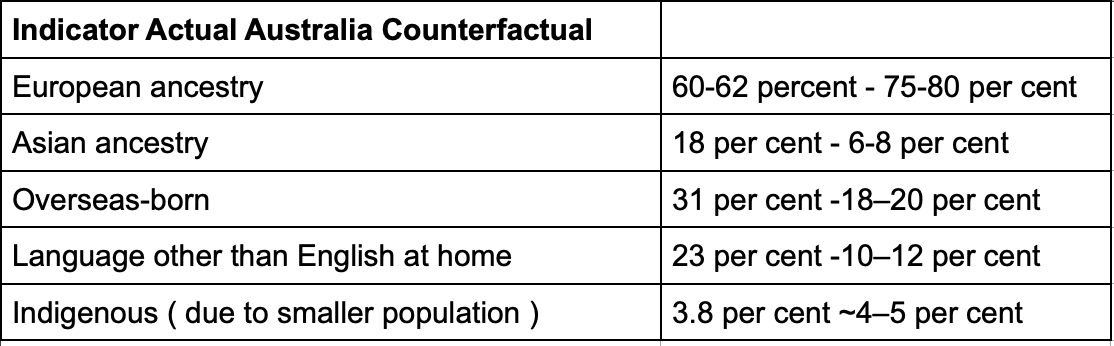
Perhaps that is the one set of changes that would please the nativists?
But the damage would not stop there. What would this emphasis on ethnic and cultural unity over diversity have meant for Indigenous Australians? Was this not the kind of thinking that helped produce the Stolen Generations? What would it have meant for freedom of religion and speech? For Australia’s standing in the region? For the character of our institutions? For our own health and care services? For our own families? Nothing good, I suspect.
Messrs Abbott, Hastie and Ms Hanson may not like the immigration policies of the past 50 years. But we are a vibrant multicultural society with relatively high social cohesion and few illegal migrants. They should think very carefully before feeding a toxic nostalgia that would damage both our prosperity and our social fabric.
Our strength is not ethnic and cultural sameness. It is unity in diversity.