India’s Iran calculus – Part 3
March 25, 2026
In a new three-part series, Ramesh Thakur examines dimensions of the Iran war. In part three, he takes a look at India’s contemporary and historic relations with Iran.
The regional turbulence and global repercussions of the war of choice on Iran by Israel and the US have tested the principles, resilience and coherence of India’s foreign policy.
Its ties with the region are deep, historical, commercial, cultural and religious. Its regional stakes in the war are substantial and varied, ranging from energy security to a substantial expatriate community and transformative diplomatic partnerships. It is reliant globally on the US for trade, investment and technology, on Israel for arms and anti-terrorism intelligence cooperation, on Iran for energy and connectivity to Central Asia, and on the Gulf monarchies for oil, gas, fertilisers and remittances.
Independent India’s foreign policy of nonalignment was based on three impulses: anticolonialism, political pluralism and autarkic state-directed industrialisation on the Soviet planning model. With Pakistan opting for alliance with the US, India’s ties deepened with Moscow.
The end of the Cold War upended the underlying bases and it undertook a complete reorientation of foreign policy towards the US while liberalising its economy. As it rose in the international power hierarchy, India acquired a stake in a polycentric global order underpinned by a policy of strategic autonomy that aimed to maximise good relations and exploit market and investment opportunities in every continent. It has also been redirecting arms purchases away from Russia towards France, Israel and the US.
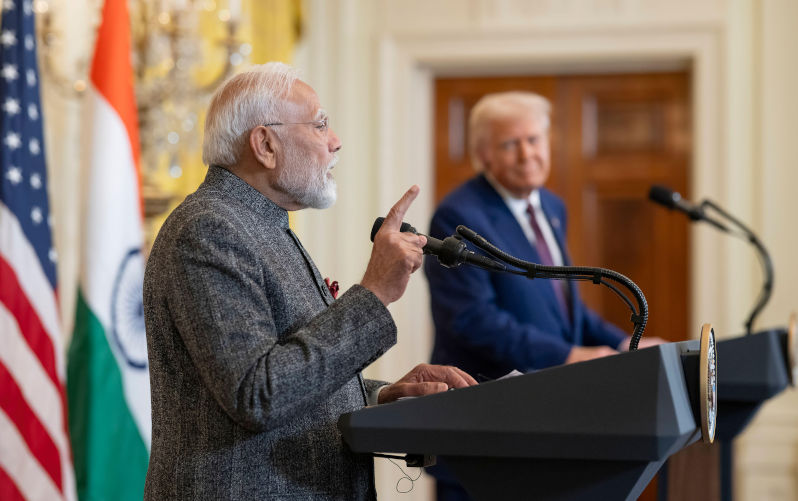
On Ukraine, India prioritised the energy needs of its poor over the luxury-belief moralism of NATO countries. At various times, Prime Minister Narendra Modi has embraced President Donald Trump as a ‘ true friend,’ ‘ dear friend,’ and ‘ great friend of mine’. Yet, with an impost of 50 per cent tariffs as punishment for buying Russian oil, Trump reversed 25 years of bipartisan efforts on both sides to expand and deepen bilateral ties and build a strategic partnership. In response to US economic coercion, India began a public pivot towards China, Russia and Brazil.
Strategic autonomy in global power equations is matched by a policy of regional multi-alignment in the Middle East with efforts to pursue parallel tracks with Israel, Iran, Gulf monarchies and the US. Modi has been the most skilled Indian leader in cultivating good relations with all relevant actors, supporting Palestinian statehood and deepening engagement with Israel as a vital partner.
The Iran crisis has heightened tensions between India’s global and regional foreign policies. Along with the death and destruction rained from the skies on Iran, the war has had serious negative consequences for many friends and allies as well. India has maintained a diplomatic silence neither endorsing nor criticising Israeli-US strikes. While silence on Russia’s aggression in Ukraine drew sharp criticisms from westerners, the failure to condemn US-Israeli attacks, including targeted assassination of the leadership of a sovereign nation, has been criticised by India’s opposition parties for an “ abdication of moral leadership" and a betrayal of the history of principled support for the Palestinian cause.
India’s default response to endemic crises is to urge de-escalation and restraint by all parties, promote dialogue, protect energy security (nearly 90 per cent of India’s heavy energy imports are from the Gulf), safeguard economic interests (including remittances sent home as one of the most efficient forms of direct monetary transfers to households), maintain channels of communication with all parties and assure the welfare of ten million expatriate Indians.
In 2017, Modi became the first Indian PM to visit Israel. After the attacks of 7 October 2023 India extended deep sympathy to Israel as a fellow-victim of lethal cross-border terrorism. Modi was in Israel again last month. Addressing the Knesset on the 25th, he affirmed: “ India stands with Israel, firmly, with full conviction, in this moment, and beyond.” The visit included signing 17 bilateral pacts as part of a ‘Special Strategic Partnership’, with Prime Minister Benjamin Netanyahu declaring that Modi’s visit had been “ extraordinarily productive and extraordinarily moving”.
In the 1965 and 1971 India-Pakistan wars, prodded by the US, the Shah’s Iran provided fighter jets and munitions to Pakistan and was resupplied by Washington. At 15 per cent Israel is now India’s third biggest source of arms imports and Israel’s biggest market, accounting for 29 per cent of its global arms exports.
The court language of the Mughal emperors was Persian. Around 30 million of India’s 200 million Muslims are Shia who would look to Iran’s ayatollahs for spiritual leadership. The paternal grandfather of Ayatollah Ruhollah Khomeini, the first supreme leader of Iran (1979–89) after the Islamic revolution, migrated to Persia from India in the 1830s. There is an Imam Khomeini Road, named after him, in Hyderabad, a city founded by a Sultanate that traced its ancestry to Persia. The US-Israeli war on Iran has united the Shia-Sunni communities beyond the Middle East and so Modi faces a 200 million-strong domestic challenge to his strategic silence.
In May 2024, India signed a ten-year contract to develop Chabahar port in Iran that will offer a strategic counterweight to China’s development of Pakistan’s Gwadar port and help to ease the pressure of US sanctions on Iran. As the lead item of a multi-modal trade corridor, Chabahar will give India access to Iran, Afghanistan and Central Asia, bypassing Pakistan and strengthening supply chain resilience.
The sinking of IRIS Dena by a US nuclear submarine raised awkward military, political and diplomatic questions for India. Arguably, as Dena had neither requested an Indian Navy escort nor sought shelter in India, India’s overwatch responsibility ended when it left India’s territorial water. But former Foreign Secretary Kanwal Sibal believes while India bore no political or military responsibility for Dena’s sinking, it had a “moral and human” responsibility owing to those killed having been Indian invitees to friendly multinational exercises.
For Modi it was yet another public humiliation by Trump. A war in another region 3,000km away had expanded to the global maritime domain with substantial adverse implications for India’s energy and economic security, and maritime leadership and primacy in its immediate neighbourhood. Had India been forewarned by Washington that the entire Indian Ocean was now a legitimate zone of kinetic US enforcement, in which case its silence is a tacit taking sides with the US? If not, talk of a strategic partnership with the US is just empty rhetoric and the gap in its own maritime domain awareness capability is a major military embarrassment. It also punctures the pretence of the Quadrilateral Security Dialogue forum as a cohesive Indo-Pacific maritime group.
The opposition Congress Party accused Modi of looking ‘“ timid and fearful" like no other government before. Yet, silence on awkward incidents involving strategic partners is a well-established pattern of Indian diplomacy, from Soviet invasions of Hungary, Czechoslovakia and Afghanistan to Ukraine in 1956, 1968, 1979 and 2022. The refusal to temper principle with pragmatism confuses moral absolutism for moral courage. Responsible statecraft requires the weighing of consequences of public statements for one’s own economy and the welfare of citizens.
Read Part 1 of this series here, and Part 2 here.