Life in Iran illustrates shifting realities amid US-Israel war
March 28, 2026
From Tehran, the conflict is less about missiles and more about endurance – as daily life adjusts to disruption, uncertainty and economic strain.
On most nights, the sound that defines Tehran is not conversation or traffic. Instead, it is a distant explosion, a jet overhead, a pause in the rhythm of ordinary life.
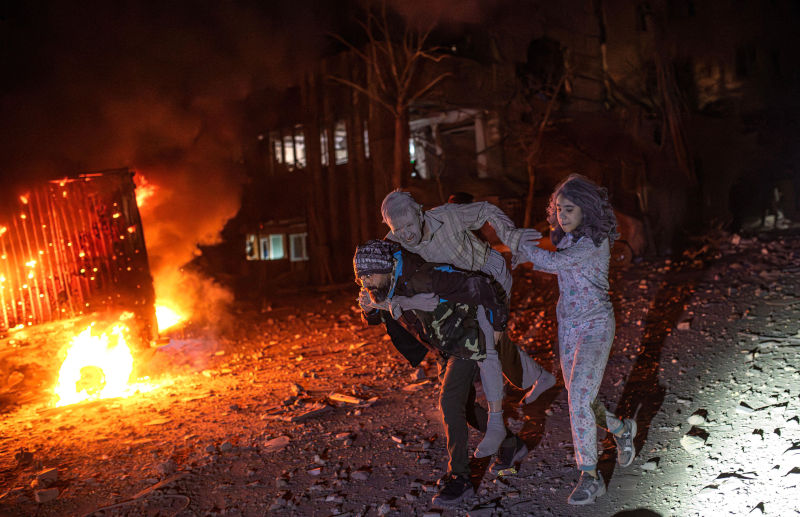
A few days ago, that distance collapsed. An explosion in eastern Tehran, where I live, shattered the windows of our home. Glass fell across my books and laptop, damaging it beyond repair. For a moment, the abstract language of conflict became immediate and physical.
And yet, almost as quickly, life resumed. The city has not stopped functioning. Shops still open, people go to work, families gather. However, everything is slightly altered, as if daily life is being lived alongside an awareness that something larger is unfolding just beyond reach. That awareness shapes even the smallest decisions.
For me, as for many others, the disruption is not only physical but informational. Internet access has become unreliable to the point of near absence. I find myself spending parts of the day trying to connect through unstable VPNs, sometimes for just a few minutes, enough to send an email or check headlines. The gap between external narratives and internal reality is widening.
Within my own circle of family, friends and colleagues, conversations have changed. A relative recently insisted on buying extra essentials, not because they are unavailable today but because there is no certainty about tomorrow’s prices. A colleague described adjusting work around brief windows of connectivity rather than fixed hours.
What is striking is not the breakdown but the continuity under strain. People are not reacting as if everything is collapsing; instead, they are recalibrating daily life.
This lived reality contrasts sharply with how the conflict is often framed internationally. Much of the focus remains on military exchanges, missiles, air operations and tactical developments. But from within, it is increasingly clear the conflict is no longer defined primarily by battlefield outcomes. Its effects are felt more directly through infrastructure, markets and economic systems.
In recent weeks, escalation has increasingly targeted e nergy infrastructure and regional economic nodes across the Persian Gulf. This has introduced a different kind of risk: less visible, but more consequential globally.
The Strait of Hormuz is often discussed in strategic terms, but from here its significance is no longer theoretical. For more than three weeks, flows through the strait have been severely restricted. In practice, access has become highly selective. Iranian authorities have signalled that vessels linked to the United States, Israel and their partners are not permitted to transit, while only a limited number of ships associated with countries seen as friendly are allowed passage.
The result is not simply a threat of disruption, but disruption itself feeding directly into higher costs, inflationary pressure and uncertainty that now extends far beyond the region. At the same time, perceptions of stability are shifting. Cities such as Dubai, Doha and Riyadh – long seen as predictable economic hubs – are now viewed through a different lens of risk.
From within Iran, the conflict is increasingly understood not only in military terms but as a test of endurance. The question is more than who controls territory, it is who can absorb sustained pressure across interconnected systems of energy, trade and finance. Scenarios such as limited ground operations are often seen as insufficient to resolve the deeper dynamics at play.
As the Persian New Year, or Nowruz, is being observed, I have found myself in gatherings that would normally be defined by celebration, but conversations have taken on a different tone. What stands out is both concern and a particular kind of expectation.
Some people openly question why, in previous years under heavy sanctions, Iran did not make greater use of its leverage over the Strait of Hormuz. Others argue this moment should not end quickly without tangible gains. The sentiment one hears repeatedly is that if the country is already bearing the costs of conflict, the outcome should fundamentally change its position.
These are not official positions, but they reflect a current of opinion shaped by years of economic pressure. In this view, control over strategic choke points is a military consideration, a potential economic counterbalance and a way to offset past constraints and deter future ones.
For now, life continues in a dual reality. On the surface, continuity; beneath it, constant recalibration. What this moment reveals is that the consequences of the conflict are already extending far beyond its geographic boundaries. The gap between how the war is discussed and how it is lived reflects a deeper shift from battles over territory to struggles over interconnected systems.
From energy flows to financial expectations, the effects of this shift are already being transmitted across borders, shaping decisions in markets, governments and households far removed from the immediate conflict.
It is within that shift, experienced both in strategic calculations and in everyday conversations, that the real significance of the current moment lies.
Republished from the _South China Morning Post_, 26 March 2026