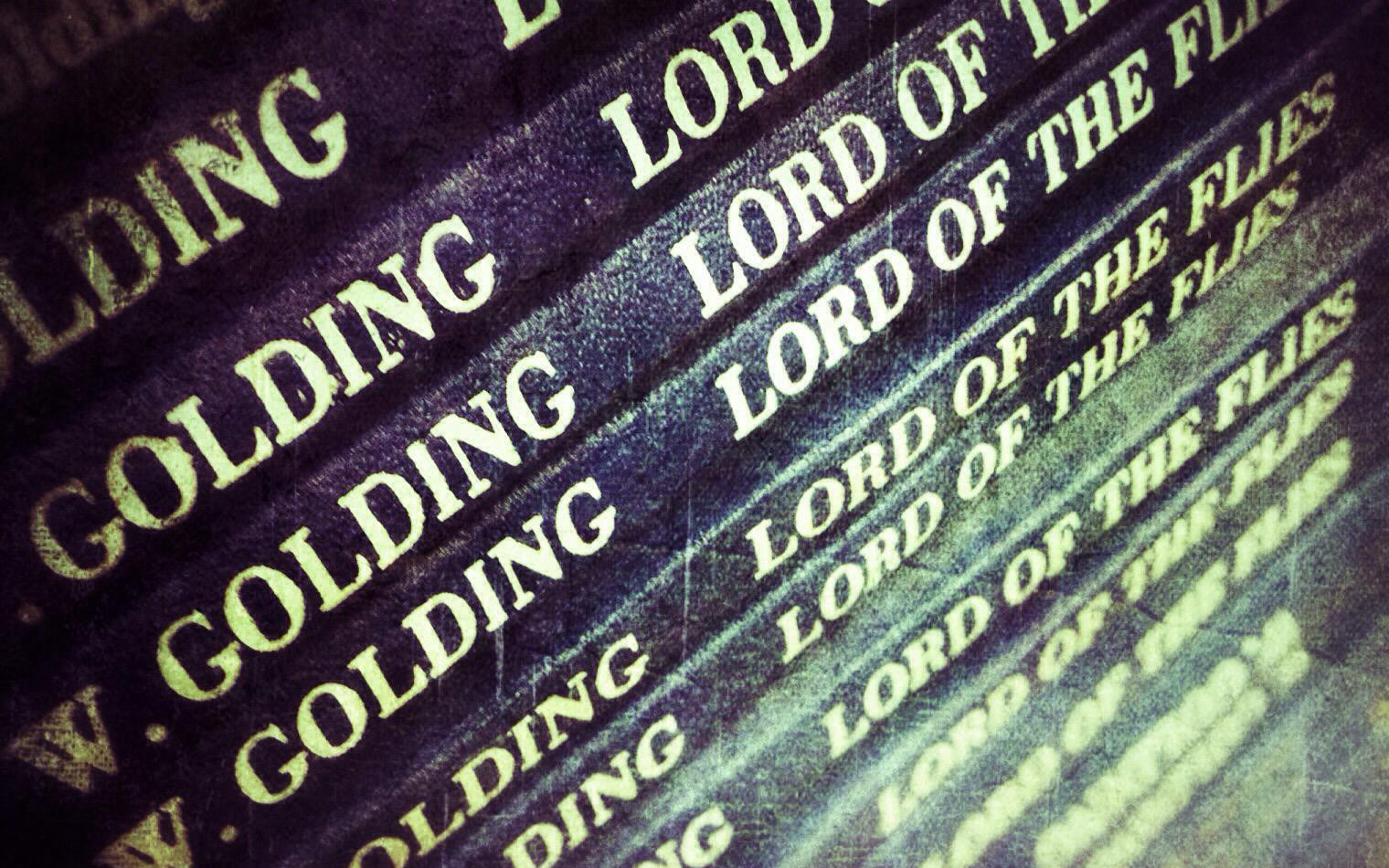
Lord of the Flies in the age of Trump
March 1, 2026
William Golding’s Lord of the Flies remains a bleak meditation on power, fear and civilisation. In today’s politics, its allegory feels newly unsettling.
Lord of the Flies, a parable for our times is now a television series – it can also be seen as an allegory for Trump’s America.
William Golding’s 1954 novel was originally rejected by 21 publishers. When released it was simultaneously lauded and condemned for racism, sexism, violence and profanity, and continued to be so from the 1970s to the 1990s.
Golding was a teacher at a reputable boy’s grammar school before and after he fought in World War 2. Lord of the Flies was the first book in his subsequent writing career. The novel offers a bleak, pessimistic view of human beings, showing how, without the constraints of civilisation and the rule of law, a group of grammar school educated British boys, on their own, descended into savagery, violence and war.
About 30 boys, young’uns and early teens survive a plane crash on an isolated island. Two potential leaders emerge, Ralph, a popular boy, and Jack, head of the choir boys, who remain as a pack. Ralph is elected leader and Piggy, a fat boy with spectacles, never named, ridiculed and laughed at as the perennial outsider, is the voice of reason and practical advice. They agree with Ralph, following Piggy’s advice, they need to set rules; to set a fire in hope they will be found, look after the young’uns, build shelters and find food. “That’s what grown-ups would do.”
Jack, who is peeved he wasn’t elected leader, wants to hunt, have fun and look for the pigs to kill. Gradually order disintegrates. The young’uns are scared at night of noises and a monster, “a beastie”, one claims to have seen. Loyalties shift and Jack leads growing numbers of former rule-followers, to come to his side by intimidation. They paint their faces which liberates them as savages and run wild chanting. “Kill the beast! Cut his throat! Spill his blood.”
Piggy’s voice of reason is mocked, and through threat, fear and paranoia, those compliant side with Jack, who is becoming unhinged and sociopathic through his power and weaponry. The pack descend into barbarity and killing – from pigs to peers.
The novel is an allegory, questioning whether evil is innate in human beings. Golding’s book was a deeply personal exploration of the “terrible disease of being human” and the potential for evil that he witnessed during World War 2, based on his war experiences and his knowledge of the boys he had taught.
Artists have reinterpreted Golding’s story on radio, on the stage and in three films. Now there is a television mini-series written by Jack Thorne, the co-creator of Adolescence (the award-winning mini-series of 2025), returning to the theme of the origins of violence in the young. The book, a literary classic, remains in print, studied in schools worldwide and has sold over 25 million copies so far.
In time Golding regretted writing his novel which he considered “boring and crude”. Its classic status struck him as “a joke” and he grew weary of the varying, and often contradictory interpretations of his work. He resented the fact that it overshadowed his later works for which he earned the Nobel Prize in Literature in 1983.
The questions raised by Lord of the Flies have been debated since man could think. Are we born evil? Is violence innate? Can we be socialised into civility and live together by the imposition of social rules? How should we be ruled and by whom?
Augustine (Confessions 397-398 CE) believed in original sin and thought reason alone could not find good in men without the help of God – that man was too in thrall to his vices to govern himself.
Thomas Hobbes, in his work Leviathan (1651), also argued that human beings are inherently evil, innately self-interested, lacking any moral compass; their primary instinct is survival, and they are driven by fear of death, to seek power and quest for glory.
Hobbes’ answer was to form a social contract with the Leviathan (The sovereign) who must have absolute, indivisible power to be effective. Once the contract is made, it cannot be revoked, as doing so risks a return to chaos.
Subsequent philosophers, notably John Locke (1632-1704) and Jean-Jacques Rousseau (1712-78) argued that humans are innately good, compassionate, and cooperative in their natural state, but are corrupted by civilisation, inequality, and society. The modern debates focus on whether morality is evolutionary, learned, or situational, but the debates go on and we are no wiser.
At the end of Lord of the Flies – at the point of absolute anarchy and chaos with the jungle foliage in flames around them – Ralph is confronted by a British naval officer who has come ashore to investigate the smoke.
The officer takes in the scene of painted, bedraggled, filthy, young savages wielding spears and says, “What have you been doing? Having a war or something… I would have thought that a pack of British boys – you’re all British aren’t you – would have been able to put up a better show than that."
The boys are saved by adults, but it seems today there are no grown-ups around to save us, to bring Trump, our Leviathan, to heel, for ripping apart the social contracts put in place before him. Cowardice is on display in the underlings servicing his machinations, as were the followers of Jack.
I have heard none say what follows in our current state, better than Alistair Campbell on the podcast The Rest is Politics, reflecting on the fallout in the UK, Trump and our state of national and global politics.
“That because of the nature of our politics, the quality of our politicians and the political gene pool, the nihilism of much of the mainstream media with dissonance, hypocrisy, short termism, naivety, industrialised rage, and wilful ignorance off the scale, that we are becoming ungovernable.”
Is Trump, who has assumed the role of Leviathan, leading us to a state where we are ungovernable?