Off to war in West Asia we go (again)
March 12, 2026
Deploying an RAAF Wedgetail to West Asia risks making Australia a co-belligerent in the US-Israel war against Iran while exposing the country to serious strategic and economic consequences.
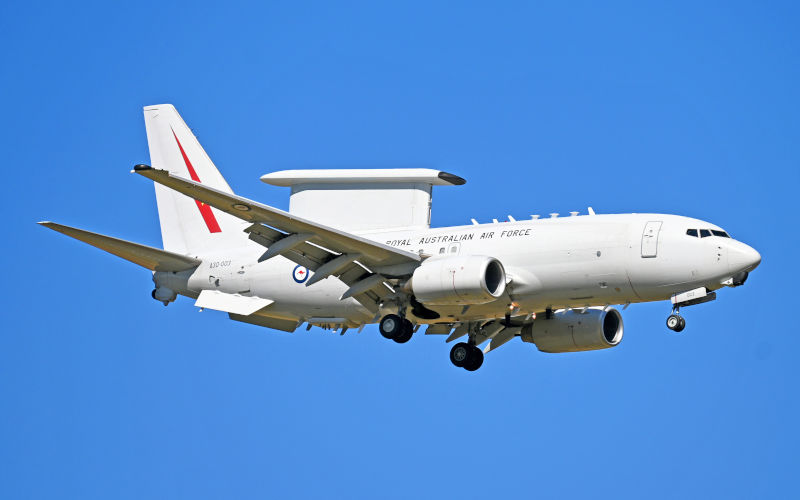
Surprising no-one, the Prime Minister has announced the deployment of a Royal Australian Air Force E-7A Wedgetail and associated operational and logistic support capabilities to West Asia. As noted by the Air Force, the Wedgetail has the “ability to coordinate a joint air, sea and land battle in real time.”
Whilst justified as a defensive operation – whether the government means that or not – Australia is now effectively a co-belligerent to the Israeli and United States war of aggression against Iran. To use terminology that the reader may be familiar with from political statements about another ongoing war, we have joined an ‘unprovoked, illegal and immoral’ war of aggression.
For it matters little what the Australian government states with regards to the nature of the deployment, whether we are a co-belligerent is in the eye of the beholder. In this case Iran.
Being the first world leader to support the US and Israeli war of aggression was but the latest example of Australian hostility towards Iran. As but one example, it was only six months ago that the Iranian Ambassador was unceremoniously sent packing on what was the flimsiest of arguments. As I noted at the time:
“The decision [to expel the Ambassador] by the Albanese Government is potentially also an indicator. An indicator that the next phase of the war against Iran is on the horizon.”
Clearly, we have reached that horizon.
Iran has been preparing for this war for decades. It openly described to the world how it would respond if it were to be attacked. And it has responded as it said it would.
Iran is not merely defending itself. It is not lashing out in spasms of uncontrolled violence. It appears to be implementing a well thought through strategy that seeks to evict the United States from West Asia.
The first phase of this strategy was the destruction of much of the command-and-control system of the United States and Israel. It appears to have been quite successful in that regards with four, billion-dollar, radar systems that support the THAAD (Terminal High Altitude Air Defence) and other systems already being confirmed as destroyed. Combined with the depletion of air defence interceptor stockpiles (which are expensive, have slow production rates, and have minimal stockpiles due to the war in Ukraine) and Iran likely to retain a large arsenal of missiles (including its most advanced systems) and drones, the environment in which the Wedgetail will be deployed to is extremely dangerous.
Being a country perceived by Iran to be hostile, that makes the Wedgetail a worthy target.
As is the Australian way, this deployment continues our long history of strategic folly. For whilst effectively making Australia a co-belligerent, the deployment is too small to make any noticeable difference to the outcome of the conflict. In other words, the cost benefit ratio of the deployment is tiny, if not negative.
Yet the costs of the war to the Australian economy are likely to be dire. Iran is the gatekeeper of the Strait of Hormuz. It has announced that it will enable vessels from friendly nations pass (e.g. China), however for most countries, and particularly those that are hostile, the Strait is effectively closed through a combination of insurance (or lack thereof) and possible military strikes.
To take just one example of the impacts that this could have on Australia, two thirds of our urea fertiliser comes from West Asia. It is quite possible that Australia will receive no urea fertiliser from that region for many months, perhaps longer depending on how much damage to infrastructure occurs.
With Australia’s old, weathered, and typically infertile soils, without fertilisers such as urea, yields will plummet. This will affect most of our agricultural industries – dairy that requires urea for the high protein pastures required to produce milk, fruit and vegetables, broadacre crops such as wheat and sorghum and even meat supply (much of the grain sorghum grown in Australia feeds the cattle in feedlots that ultimately ends up in Coles and Woolworths).
Food security, the most basic fundamental of human needs, is at risk over the coming months.
This example highlights the enormous disconnect, a chasm if you will, between the Australian government’s response to the war of aggression launched by Israel and the United States, and the likely impacts upon our economy and society. This war is likely to have extremely disruptive effects not only on the economy, but how our society functions, a possibility which to this point, no member of the government has either comprehended, or is willing to broach publicly. The idiom fiddling while Rome burns springs to mind.
The United Nations Charter makes it explicitly clear that all nations have a responsibility to end conflict by peaceful means. But yet again we find ourselves in a situation where the government, having made no observable effort to bring about peace through diplomatic means (a consequence of being beholden to both the United States and Israel), resorts to the use of military force. Unfortunately, the deployment of the Wedgetail could well just be thin end of the wedge.
The deployment of the Wedgetail is at best likely to have limited impact, at worst cost the lives of Australian service personnel and drag us into another forever war. It is the wrong decision at the wrong time.
Instead, the Australian Government should be focusing on diplomatic efforts to bring about peace by learning to use the leverage that it has (cancelling AUKUS and repealing the Force Posture Agreements as two examples) and focusing on how to minimise the harm from the economic fallout of this cataclysmic war of choice by Prime Minister Netanyahu and President Trump.