Selective compassion in Australia’s refugee policy
March 12, 2026
Australia’s decision to grant humanitarian visas to Iranian footballers highlights how refugee policy often rewards cases that fit convenient political narratives.
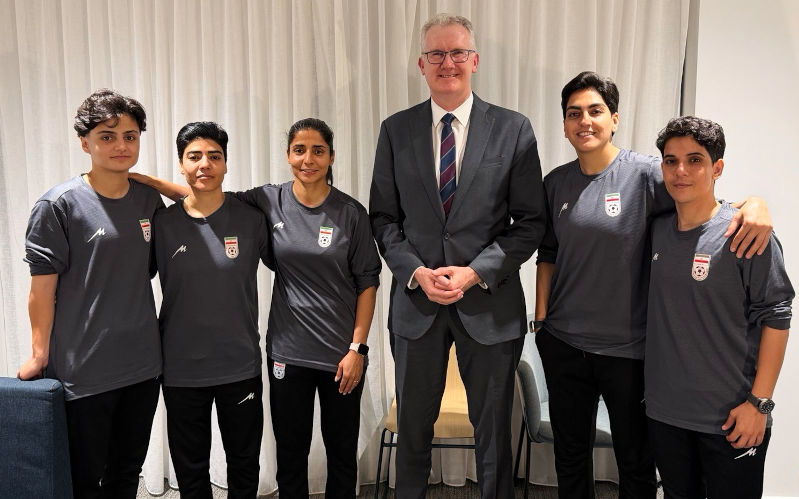
When Immigration Minister Tony Burke granted humanitarian visas on 10 March 2026 to a group of Iranian women footballers, the announcement was framed as a triumph of humanitarian compassion. Australia, we were told, had stepped up to offer refuge to women facing repression in Iran.
Few would dispute that people facing persecution deserve protection. But the decision raises an uncomfortable question: why does humanitarian urgency sometimes appear selectively in Australia’s refugee system – often aligning neatly with political narratives that reinforce western moral virtue?
This case highlights a pattern that deserves some scrutiny and reflection – what is often described as a white superiority complex in western politics. It reflects a tendency for western institutions to position themselves as heroic rescuers of oppressed people abroad, while overlooking similar suffering when it does not fit prevailing political narratives or policy priorities.
Within this framework, stories of individuals escaping authoritarian regimes – particularly in Muslim-majority countries – are often highlighted as proof of the moral strength of liberal democracies, reinforcing the long-standing image of the west as the world’s refuge for the oppressed.
But when governments spotlight certain victims while ignoring others, humanitarianism risks becoming performative. It shifts from consistent principles to reinforcing a worldview in which western governments appear morally superior. Too often, the focus moves away from those seeking protection and toward validating the moral image of the rescuing state itself.
This sudden humanitarian urgency demonstrated by Canberra stands in stark contrast to the indifference often shown toward other groups facing equally dire circumstances.
Consider the broader landscape of Australia’s humanitarian response. Refugees fleeing war zones from Afghanistan to Gaza, and Sudan to Yemen continue to face lengthy visa delays, bureaucratic hurdles and political opposition. Many wait years in limbo. Some remain in offshore detention facilities. Others are left navigating precarious temporary protection arrangements.
Where is the same urgency for them?
The contrast is striking. When a case aligns with the west’s geopolitical storytelling, the system can move quickly and generously. When it does not, bureaucracy slows and political caution prevails.
When humanitarian action is shaped by political storytelling, compassion becomes selective. The suffering of some groups is amplified and celebrated, while the suffering of others fades into the background.
Australia’s refugee policy has long represented a political conundrum between moral aspiration and selective application. For more than a decade, successive governments have justified harsh refugee policies as necessary for border protection. Asylum seekers arriving by boat – many fleeing genuine conflict zones – have been detained offshore or turned back at sea. Entire families have spent years in legal and psychological limbo.
Yet when a group of athletes arrives whose story aligns neatly with current political narratives about gender oppression in Iran, the system suddenly demonstrates remarkable flexibility.
A genuinely principled humanitarian system would apply the same urgency and compassion to all those fleeing persecution, regardless of whether their stories fit a convenient political narrative. It would resist turning refugee protection into a stage for national self-congratulation, where the act of ‘saving’ becomes little more than political theatre.
Which brings us back to the Iranian footballers.
No reasonable observer denies that women in Iran face significant challenges, particularly in areas like sport and public participation. Their struggle is real. But their story also fits neatly within a familiar and politically convenient western narrative: women escaping an authoritarian Islamic state in search of freedom.
There is another dimension to this dynamic. When western governments frame their actions primarily as rescuing Muslim women from Muslim societies, complex social struggles are often reduced to a simplistic binary: ‘good west versus bad east.’
Such framing may generate some political points for certain groups, but it can also reinforce cultural stereotypes and deepen divisions within multicultural societies.
Minister Burke’s decision may well have been motivated by sincere concern. But in the broader political context, it also reflects a recurring feature of western politics: humanitarian gestures that simultaneously affirm a sense of moral superiority.
Until we confront that issue, Australia’s humanitarian moments will continue to raise an uncomfortable question: are we protecting the vulnerable or protecting our own self-image?
Australia is capable of better.