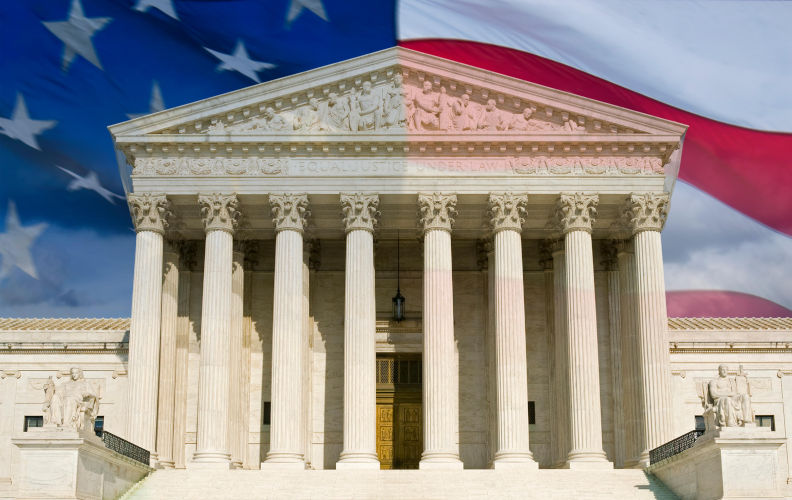
The $175 billion question: will the US Supreme Court stop the war fund?
March 7, 2026
A US court order forcing the refund of $175 billion in tariff taxes has triggered a constitutional confrontation over whether a president can bypass Congress to fund global conflict.
As the world watches the growing conflict in the Middle East, a decisive battle is unfolding in the US courts over who controls the money. For a year, the Trump administration has bypassed the US Congress to seize billions in trade taxes from private companies.
On 20 February, the US Supreme Court in a 6-3 decision ruled the tariff taxes that it had otherwise been allowing were in fact illegal. On 2 March, 2026, a US Appeals Court finally signalled a “Red Light,” ordering the immediate refund of $175 billion of this seized money. As the administration prepares a desperate appeal to the Supreme Court, the outcome will determine if the US President must follow the law, or if he can continue to fund a global conflict using money that isn’t his.
The American experiment is currently witnessing a collision between an ancient concept of unchecked executive power and a 250-year-old framework of constitutional restraint. Following the launch of Operation Epic Fury to attack Iran on 28 February, the administration’s reliance on the ‘Power of the Purse’ has transitioned from a policy preference to a desperate necessity. However, the path to funding this kinetic ambition, a $175 billion war chest built on illegal International Emergency Economic Powers Act (IEEPA) tariffs, just hit a judicial wall.
The unanimous, accelerated mandate from the US Court of Appeals for the Federal Circuit on March 2, 2026, which found “no reason whatsoever” to delay tariff refunds to 300,000 American businesses, is more than a trade ruling. This serves as the preamble to a definitive Shadow Docket course correction. It signals that Justice Kavanaugh will likely abandon his previous ‘red herring’ dissent, shifting from a 6-3 split to join a 7-2 majority against the administration.
To understand the gravity of this watershed moment, one must look at the unprecedented ‘Enabling Era’ of the Supreme Court between January and October 2025. During this window, the Court maintained a 90 per cent success rate for the administration on the Shadow Docket.
By repeatedly staying lower court injunctions, the Court has essentially provided the President with the functional latitude of a monarch.
This period of judicial deference was supercharged by the legacy of Trump v. United States (2024), which granted broad immunity for “official acts.” This created a dangerous feedback loop: the Executive believed it could flaunt the law with impunity while the Legislature remained silent.
By the end of 2025, the administration operated under the delusion that it could treat the US Treasury as a private endowment for unauthorised global interventions.
The tide began to turn in late 2025. As substantive cases moved to the merits docket, the Court’s support for the administration’s law-flaunting dropped to approximately 75 per cent. The Justices began doing something the administration did not anticipate: they began following the letter of the law.
This culminated in Learning Resources v. Trump (Feb. 20, 2026), where a 6-3 majority ruled that the International Emergency Economic Powers Act (IEEPA) does not grant the President the power to unilaterally impose taxes. While the majority focused on the “Major Questions Doctrine,” Justice Kavanaugh penned a dissenting opinion focused on a practical “exit ramp.” He argued that the Treasury would be “wrapped around the axle,” incapable of processing refunds to companies like Costco and Federal Express without years of chaos. Kavanaugh bought the administration’s primary deception: that the “messiness” of the refund justified the illegality of the tax.
The administration’s “logistical nightmare” argument died on 2 March, 2026.
In an extraordinary move, the Federal Circuit issued an immediate mandate to the Court of International Trade (CIT), denying the government’s request for a stay. The court was blunt: the appeals court declined to pause the litigation any longer.
This ruling exposes the fallacy of Kavanaugh’s dissent.
The Automated Commercial Environment (ACE) system used by Customs and Border Protection is a digital ledger that, as of 6 February 6, shifted to fully electronic refunds via Automated Clearing House (ACH). The “complexity” cited by the Solicitor General (SG) was a forensic fraud designed to buy time for the Iran buildup. By stripping away the 90-day delay, the appellate court has forced the administration into a corner.
We predict the Solicitor General will imminently file an emergency application with the Supreme Court to stay the CIT’s reliquidation orders. The SG will undoubtedly recycle the “Kavanaugh Red Herring,” pleading that the immediate payout of $175 billion constitutes “irreparable harm” to a nation at war.
However, the ‘Gestalt’ has shifted. Justice Kavanaugh now faces the prospect of being the lone defender of a proven falsehood. To maintain his institutional standing, he must distance himself from an administration that used his own concerns to justify constitutional defiance.
When this reaches the Shadow Docket, expect a denial of the stay without dissent. In our opinion, Kavanaugh will likely join the original six-justice majority, signalling that even the most deferred-to President cannot override the Power of the Purse. After 20 years of legislative enabling, $8 trillion in unauthorised treasure spent, and five million lives impacted, the Supreme Court is finally poised to reclaim its duty.
The immaturity of thinking an ancient culture like Iran, or a foundational law like the Constitution, will simply fold is about to meet the cold reality of a 7-2 judicial shutoff.