The Albanese controversy shows how universities have lost their way
March 10, 2026
A cancelled venue for a UN rapporteur’s appearance highlights how universities are increasingly restricting debate about Israel and Palestine under pressure over antisemitism.
On Thursday night I was on the stage of the Norwood Concert Hall in suburban Adelaide in front of an enthusiastic audience of at least 700 and alongside the celebrated international lawyer Chris Sidoti and Dr Lana Tatour, sociologist from the University of New South Wales. But the main attraction was the appearance by zoom from Tunisia of Francesca Albanese, UN Special Rapporteur for the Occupied Palestinian Territories.
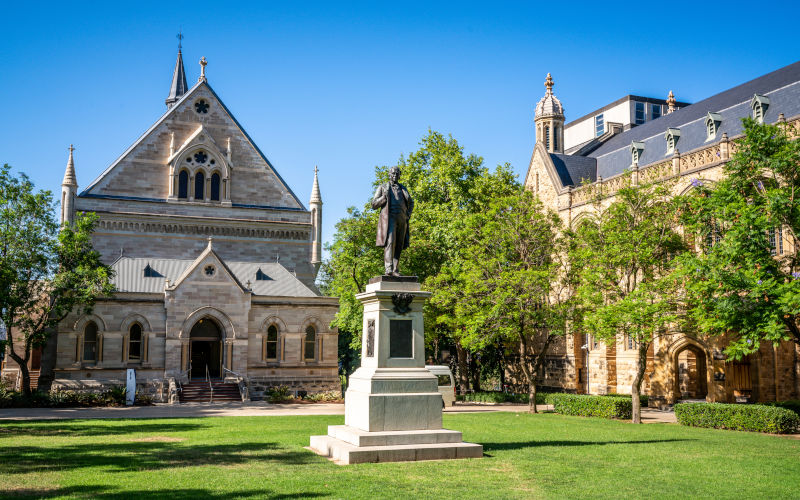
It had been organised by the Association for the Promotion of International Law, and a member of the law school had booked Adelaide University’s famous Elder Hall on North Terrace as the venue.
But late on the Monday the university announced that the hall was no longer available. An unnamed spokesperson explained that the application in question had not “gone through the required review and approval process” and that, as a result, the university could not “ensure the safety, respect and comfort of those attending.”
The organisers had no idea what all this meant or why a quick consultation could not have corrected any anomaly in the application which had, after all, been originally approved. And whatever was the meaning of the respect and comfort that had to be promised in advance?
The absurdity of the university’s behaviour was emphasised by the ease with which the Norwood Municipality had, at short notice, hosted a highly successful public meeting with no one complaining about a lack of “respect and comfort.”
It was the university that had completely lost the respect of the audience at Norwood. Obviously every-one knew what had happened. The overwhelming reaction was how could the university do it again after the complete collapse of Writers Week? And the circumstances were so similar. As everyone knew, writers had boycotted Writers Week when the invitation to novelist, Dr Randa Abdel-Fattah had been rescinded.
It is reasonable to assume that what the university found the appearance of Francesca Albanese too controversial.
If that was the case the behaviour of the university was even more egregious. As an official UN Rapporteur she has the status of an international diplomat. Her tenure was recently extended for a further three years. She represents the UN’s Human Rights Council which is made up of the elected representatives of 47 nation states from all parts of the world.
You have to wonder if the Adelaide University officials even know what a rapporteur actually is.
There is the further question – did the university set out to officially insult the UN itself and by implication illustrate a contempt for international law? Does the Law School approve of the behaviour towards Albanese? It is an old law school which is very proud of its alumni who have had distinguished international careers. And all this at the very moment that the amalgamation of Adelaide University and the University of South Australia was finally consummated and a new Vice Chancellor was installed.
As many local people remarked the Albanese affair was not a distinguished beginning for a new era. They wondered if the fledgling Vice-Chancellor was personally involved.
What we can be sure about is that the behaviour towards Albanese was determined by her globally respected criticism of Israel’s onslaught on Gaza and the continuing pillage of the West Bank. She is the declared enemy of Zionists everywhere, including Australia.
This is where the campaign against antisemitism has been so effective. Promoted as a response to prejudice here in Australia and a challenge to social harmony it is also an extremely effective defence against criticism of Israel. It represses any free discussion of Israel’s war crimes, ethnic cleansing, apartheid and genocide.
Australia’s universities have shown themselves to be highly susceptible to demands to suppress discussion that could make Jewish students feel they would not be treated with “safety , respect and comfort.” When receiving the inevitable and well organised criticism from Jewish leaders about attacks on Israel, university administrators respond with either cowardice or complicity – or even a mixture of both.
The reaction of the Australian National University (ANU) to the Albanese event shines a light on some of the powerful forces operating just below the surface on national life. One of the members of the Association for the Protection of International Law worked at ANU and the earliest publicity about the Adelaide event included the ANU logo. But not for long as The Australian explained on Thursday 26 February. When the logo was drawn to the attention of the Vice-Chancellor’s Chief of Staff she acknowledged the seriousness of the issues involved and confirmed that the Albanese zoom was not an ANU event and that the university was “unequivocal in its opposition to antisemitism.”
The paper also explained what had happened. A leading member of Sydney’s Jewish community and an alumni of ANU had warned that because the Trump government had sanctioned Albanese the university was in danger of losing all US funding. Whether warning or threat is hard to say. But it worked instantly. So there we have it – Albanese was an antisemite and the university took its obligations to comply with US sanctions seriously.
We can at least say that the ANU was far more honest than Adelaide University. Our national university has, like so many others, tied itself down when it accepted the Government’s sense of urgency about antisemitism, sacrificing, along the way, its autonomy and traditional commitment to freedom of speech.
Having spent a long career in Australian universities I now look back with a sense of disappointment. While being involved in many contentious questions and campaigns I was always confident that senior staff would provide me with protection against critics from outside who every now and then demanded that I be sacked or disciplined or silenced. I worked for 30 years in a quite new, small sized University in provincial North Queensland – more than half of that time during the authoritarian rule of Jo Bjelke Petersen. But the belief in institutional autonomy and free speech prevailed.
The events surrounding the Albanese visit leaves me with a conviction that this generation of university leaders have, in many cases, lost their way. We all suffer as a result. It is a national tragedy.