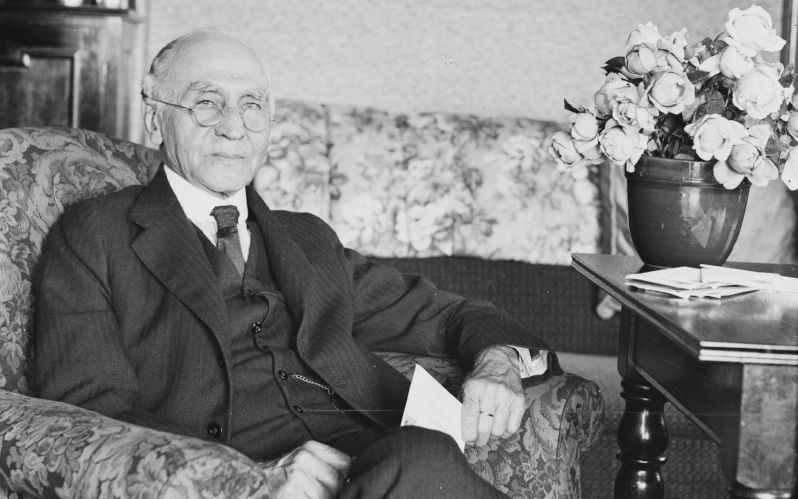
The anti-Zionism of Sir Isaac Isaacs
March 21, 2026
Sir Isaac Isaacs warned in the 1940s that Zionism risked deep and lasting conflict. Decades on, those arguments about justice and prudence remain sharply relevant.
In the mid-1940s there was a significant debate in Australia about Zionism, with Sir Isaac Isaacs (Governor-General, 1931-1936, and a Jew) taking a strongly anti-Zionist position. Are the arguments of Isaacs still relevant today?
Background
Anti-Zionism was the dominant perspective among Jewish Australians before the Second World War, reflecting the majority position within British Jewry. Zionism received a major boost when the British government in the Balfour Declaration of 2 November 1917, promised a ‘national home’ in Palestine for Jews alongside the local inhabitants. By the early 1940s sentiment among Jewish Australians had become more favourable towards Zionism, especially with increasing numbers of Jews coming to Australia from Eastern Europe and with the onset of the Holocaust.
The British government had assisted Zionism with the ruthless suppression of the Arab uprising in 1936-1939. By 1939, however, there was a shift in the British position, with the white paper of that year arguing that Britain had fulfilled its obligations relating to the promise of a ‘national home’ for Jews and that henceforth Jewish immigration should be limited consistent with the willingness of the ‘Arabs of Palestine’ to accept such immigration. Up to 1944 immigration of 75,000 Jews would be allowed but not beyond that without Arab consent. Palestine should be independent within ten years under Arab-Jewish partnership.
The anti-Zionism of Isaac Isaacs
Isaacs’s anti-Zionism was grounded in principles of justice and prudence.
From the perspective of justice, Isaacs had three main points. First, the establishment of a Jewish national home required the consent of the Arabs of Palestine as the long term residents of the land. This stipulation also applied to allowing Jewish refugees into Palestine. Jews had an ancient connection but that did not count in Isaacs’s view because it was too long ago. Second, dispossession of the Arabs of Palestine was contrary to the principles of justice that were integral to Judaism. Third, the Zionist course would lead to a negative reaction against Jews in Australia and other western countries, undermining their ability to be full citizens in those countries.
On the question of prudence, Isaacs foresaw the implementation of political or extreme Zionism (to use his terms) as exacerbating conflict in the Holy Land, also leading to conflict affecting other countries in the Middle East and as far afield as India, with its large Muslim minority. In the specific circumstances of World War II, Zionism weakened the British war effort.
The Zionist argument: Julius Stone’s response to Isaacs
Professor Julius Stone, Challis Professor of Law at the University of Sydney, argued vigorously against Isaacs, affirming that the ancient connection of the Jews with Palestine legitimised Zionist claims.
Contrary to Isaacs, Stone saw Jewishness as a matter of culture rather than religion. Clearly, despite Isaacs arguing that Western countries such as the United States and Australia should take the lead in accepting Jewish refugees from Europe, the Holocaust boosted support in the Jewish Australian community for the Zionist argument that Palestine should be the main destination. Stone was an influence on Dr Evatt, the Labor foreign minister, adopting a pro-Zionist position at the United Nations, although Evatt never explicitly acknowledged this.
Isaacs died on 11 February 1948, aged 92. Following British withdrawal from Palestine, the Jewish Agency in Palestine proclaimed Israel as an independent state on 14 May 1948, leading to the first Arab-Israeli war.
The relevance of Isaacs’s anti-Zionism today
While Isaacs foresaw conflict in Palestine, the Middle East and in western countries where Jews resided, he could not have foreseen the extent of that conflict. His principles remain relevant today, but the context has changed.
Looking at the post-2023 Gaza war and the wars centred on US-Israeli attacks on Iran in 2025 and 2026, it is difficult not to despair. In relation to Palestine the argument that justice must centre on restitution for the Palestinians is central.
In _Israel on the Brink_, the revisionist historian, Ilan Pappe (a Jewish Israeli based in the United Kingdom) argues in favour of the principle of transitional and restorative justice being applied to Palestine. According to Pappe, key issues such as the right of return, the fate of Jewish settlements in the West Bank, and the future of the ‘Jewish collective’ are not insuperable, with many historical and contemporary examples to assist in the transition to a one state Palestine in which all people living there would have equal rights.
The Aristotelian virtue of prudence, also foremost for Isaacs, is also sadly lacking in current circumstances. Extremism is most evident in current Israeli and US behaviour, leading to a more radical response and sometimes extremism by those who oppose Israel and its US backers. Polarisation encourages militancy on both sides of a conflict, in turn making compromise or reconciliation more difficult. However, there are examples of reconciliation, such as South Africa in 1994, and Northern Ireland in 1998.
Isaacs foresaw a more difficult situation for Jews in Australia as a consequence of Zionism. It is difficult for the royal commission on antisemitism to do anything about Palestine, but it should at least assess the salience of this issue.
As far as Palestine is concerned, the contemporary context is very different from that prevailing in the mid-1940s. From the River (Jordan) to the (Mediterranean) Sea (mandatory Palestine), there are approximately 7.5 million Palestinians and the same number of Jews.
Isaacs’s three principles of justice remain relevant in my view but one cannot tell how he would apply those principles to the current situation. He would no doubt be shocked to see the extent to which his premonitions were realised, in fact going much further. Prudence, also commended by Isaacs, suggests the wisdom of assessing the likely consequences of any policy prescription, including those based in the first instance on the demands of justice.
