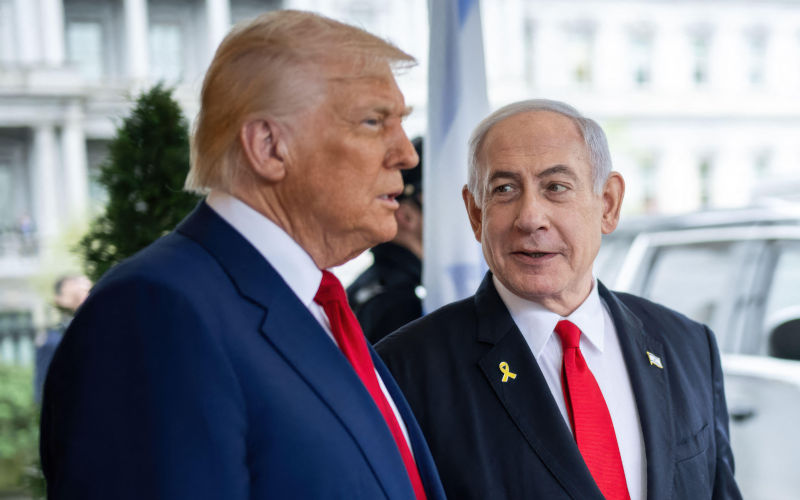
A war without clear objectives is turning against Trump
March 19, 2026
With no clear objective and mounting economic and political costs, the case for ending the Iran war is becoming overwhelming.
Common sense and the lessons of history tell us that a country should not start a war without a clear objective and a strategy for winning that war. But it would seem from the available evidence that Trump had neither when America joined with Israel in attacking Iran on 28 February.
Trump’s excuse could be that Israel effectively forced Trump’s hand. According to Marco Rubio, Trump’s Secretary of State, America only acted after learning that Israel planned to strike Iran – a move that Rubio said threatened to put American bases at risk. True to form, however, Trump has denied this explanation, although many Americans believe it.
In any event, the war is now in its third week, and we are still waiting to be told exactly what America’s objective is in continuing to strike Iran. Further, without knowing that objective we cannot tell with any certainty how and when it might be achieved and the war could be brought to an end.
The reality is, however, that the cost of the war is mounting. First, there are the deaths and destruction in the Middle East. But closer to home, the impact of Iran’s blocking oil shipments is already significant and could increase much more over time.
Two weeks after the war started the price of oil was roughly US$100 a barrel compared with US$73 the day before the war began on 27 February. But oil prices peaked at US$120 on 9 March, and analysts are predicting that oil prices could reach $150 or even $200 a barrel if oil supplies from the Gulf are still missing by the end of this month.
These oil price increases will have an immediate impact on inflation and the cost of living, but with time shortages of oil will damage productive capacity generally and the economy. A global rule of thumb from the IMF is that a 10 per cent rise in the price of a barrel of oil cuts global GDP by 0.15 percentage points and raises inflation by 0.4 percentage points in the following year.
The International Energy Agency has said that the supply shock ignited by Iran’s effective blockade of the Strait of Hormuz means that the world is facing a deeper crisis than after the Yom Kippur war of 1973 and the 2022 outbreak of war in Ukraine.
If the war goes on for a few months, crude oil prices may well exceed $150 a barrel, putting the world in a situation similar to the 1973 oil crisis which took years to recover from. The stagflation would mean significant reductions in global GDP.
The immediate impact of Iran’s closure of the Strait of Hormuz to shipping is greater for Asian countries and Australia. But it is still significant for Europe and even America, notwithstanding that America is self-sufficient in oil production.
Even before the Iran War started, US inflation was higher than its target and employment was falling, and the US economic outlook is now decidedly worse. Trump’s popularity ratings were low and have fallen further since the war started.
A substantial majority of Americans do not support America’s involvement in the Iran War. Just before the war started, an Economist-YouGov poll found that only 27 per cent of Americans thought that the country should attack Iran, and since then there has been little sign of rallying round the flag, with support for the war only increasing by five percentage points.
Thus, if the war continues the economic impact alone would very likely mean that the Republicans will lose control of Congress in the November elections, and the Trump Administration would then lose much of its power to set the policy agenda.
There are therefore very good domestic political reasons for Trump to pursue a peace settlement now. But that brings us back to what is Trump’s objective in this war so he can say (once again) that he has won.
It seems very likely that Israel’s objective has always been regime change in favour of a new regime that would work cooperatively with Israel, and that may well have been America’s objective initially too. But Iran has shown that it is well prepared for finding substitutes if leaders are assassinated, so regime change that way is not likely. Equally, while Trump has urged the Iranian people to rise up, that is not likely either.
Instead, regime change would require a military defeat of Iran that imposed a new regime on the defeated country. Similarly finding and destroying Iran’s stockpile of 440kg of enriched uranium can only happen at present if Iran is totally defeated. However, there is widespread expert agreement that a military defeat to achieve either of these objectives could only be achieved by putting “boots on the ground” for quite some time.
But American boots on the ground is not something that is realistic. Even if Trump has not completely ruled it out, past experience of boots on the ground in Iraq and Afghanistan has shown that it comes at a considerable cost and often does not work in the long run.
In the meantime, as long as the war continues the economic cost is mounting. Trump is now trying to assemble naval escorts to help reopen the Strait of Hormuz to shipping, but that is unlikely to restore sufficient oil and other cargoes to meet the world economy’s needs. Although convoys might stop oil prices rising much further, these convoys if they work are unlikely to bring oil prices back down to where they were.
On the other hand, Trump can say that Iran’s military capability has been seriously degraded. Iran’s air defences have been battered, and it has not shot down a single American or Israeli jet. Iran’s navy has also been destroyed.
Instead, Iran is now totally reliant on missile and drone attacks to pursue its military objectives, but there are signs that this capability has also been massively reduced too. As reported in The Economist, on the first day of the war Iran launched around 180 missiles at Israel and 259 at the Gulf, but by day four those numbers had fallen to the low dozens, and even further since.
In addition, America’s and Israel’s bombing of Iran has destroyed much of Iran’s military industrial base, and it will take years to fully repair. This destruction will also delay any capacity by Iran to prepare nuclear weapons for some time.
Trump himself now says that “we’ve won”, and that “the war is very complete, pretty much”. For example, the US has totally demolished Iran’s critical military capability on Kharg Island at the head of the Persian Gulf, and that “further strikes are just for fun”.
Furthermore, time is not on Trump’s side. History suggests that US wars without clear objectives that are allowed to run on, rarely end well. Sooner or later Trump will need to cut his losses, and the sooner the better. Netanyahu may well oppose ending the war any time soon, but that should not deter Trump, who is notorious for ignoring his allies.
So, if Trump wants to assure his political position with the American electorate he would be well advised to seek an agreement with the Iranian authorities to end the war on condition that the free flow of shipping in the Persian Gulf is resumed. That would be the best possible outcome now for all concerned.