The government is sanitising Australia’s involvement in the Iran war
March 19, 2026
Australia’s support for US and Israeli action against Iran highlights a growing reliance on military responses over diplomacy and international law.
Australia’s support for the US and Israeli attacks on Iran highlights yet again the dire need in this country for a focus on peace. Not the ‘peace through strength’ myth that is leading us towards further major wars, but peace through the rules-based order which is so selectively invoked by our government, and through a host of other available measures.
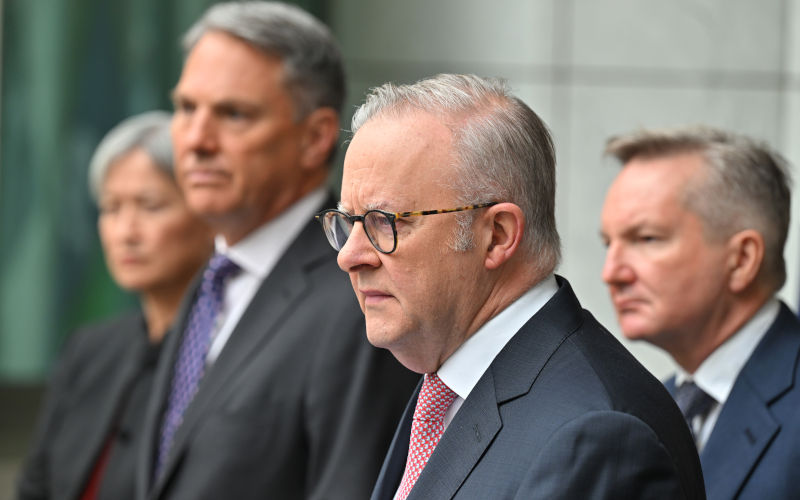
The current disastrous war on Iran lacks legal basis or consistent and legitimate objectives, and was instigated by US and Israeli self-interest. Prime Minister Albanese eagerly and almost instantly gave unqualified support to it.
With the commitment now of Australian Defence Force equipment and personnel to “defensive action” in the UAE, the Prime Minister insists there will be no Australian “boots on the ground in Iran”. But the distinction between ground forces and other forms of involvement is misleading. In modern warfare, intelligence sharing, surveillance, logistics and interoperability between allied forces are central, not peripheral, to war-fighting.
It is very likely that Australian operations in the UAE will operate under US authorities – who show little interest in the distinction between offensive and defensive actions. Regardless, ADF personnel in the UAE will be combatants under international law, and Australia is now a party to this conflict.
In emphasising a narrow defensive role, the PM seeks to minimise and sanitise Australian involvement – just as John Howard did with Iraq and Afghanistan. Other parallels with 2003 include the commencement of bombing when international inspections (2002/03) or negotiations (2026) were making progress and needed more time. On both occasions, there seemed a determination to start a war before peace broke out.
The head of the International Atomic Energy Agency himself, Rafael Grossi, could not have been clearer when on 2 March he called for a return to negotiations. He reaffirmed that “armed attacks on nuclear facilities should never take place and could result in radioactive releases with grave consequences within and beyond the boundaries of the State which has been attacked”.
The loss of thousands – perhaps many more – innocent Iranian and other lives in this war is predictable. Clearly these people are all regarded as expendable. Atrocities such as the attack on an Iranian girls’ school, and the bombing of oil facilities with resultant palls of toxic black smoke over Tehran, are becoming increasingly common in modern warfare. Both the US and Israel have a history of repeated violations of the laws against such human and environmental devastation.
Meanwhile, the ongoing suffering in horrific wars elsewhere is overshadowed. In Gaza, it’s much easier to conduct genocide away from the spotlight.
Crimes committed against the Iranian people by their own leaders cannot justify further crimes against them by other nations. ‘Regime change’ imposed militarily by external force does not deliver respect for human rights. Iranians must determine their own future.
So much of this war is driven by double standards and contradictions, including on nuclear non-proliferation and disarmament. The United States possesses more than 5,000 nuclear weapons, and Israel – the only nuclear-armed nation in the Middle East – around 90. Both states have consistently resisted good‑faith efforts for a Middle East Nuclear Weapons Free Zone under the NPT framework.
The 2015 Joint Comprehensive Plan of Action (JCPOA) had successfully constrained Iran’s nuclear program through strict verification, but was abandoned unilaterally by President Trump in 2018.
We’re told, for good reason, that Iran must not develop highly-enriched uranium (HEU) because it’s nuclear weapons fuel. And yet HEU is the very fuel that will be powering the AUKUS submarines if they ever eventuate.
Immediately after the AUKUS announcement in September 2021, severe warnings (for example here and here) emerged about the dangerous precedent this was setting. Iran has cited interest in nuclear-powered submarines as a justification for its HEU program. Yet again, Australia’s position is a matter of “do as I say, not as I do”.
Australia has lost its way as a supposedly peace-loving nation when the only thing we can think of to help oppressed people is to support the illegal bombing of their country.
Here are just a few of many better ideas, all of them vastly cheaper than making war and – unlike making war – likely to strengthen security for all people:
- Reaffirm commitment to the UN Charter and its opening words “We, the peoples of the United Nations, determined to save succeeding generations from the scourge of war…”. They are not an anachronism, but our means of surviving together on this small planet.
- Reaffirm commitment to the rule of law, apply it consistently regardless of who is violating it, and demand accountability for violations. The laws that protect us all apply either to all nations or to none.
- Demand the resumption of negotiations with Iran. In Churchill’s words “Jaw, jaw, not war, war”.
- Prioritise the development of peace-building rather than war-building skills, including diplomacy, negotiation, mediation and arbitration skills.
- Restore funding for peace research in our universities. If all we know is how to make war, how can we work for peace?
- Rein in the power and influence of the weapons industry. A nation that profits financially from war will not be interested in peace.
- Provide transparency around Australia’s export of weapons and weapons parts, and cease exports to human rights abusers, as required by the Arms Trade Treaty.
- Demonstrate genuine concern for the nuclear weapons threat by signing the Treaty on the Prohibition of Nuclear Weapons.
Australia’s engagement in a war with no legitimate cause or aims, and no clear path to resolution, is repeating the terrible mistakes of the past. We have set back the causes of peace and nuclear non-proliferation and disarmament.
It is time for our nation to stand up for peace.
The author thanks Elise West for contributing text to this article.