The meltdown of the Trump presidency: his oath was a betrayal - part two
March 23, 2026
The presidential oath is a binding constitutional obligation – but Trump’s actions raise fundamental questions about what happens when that obligation is ignored.
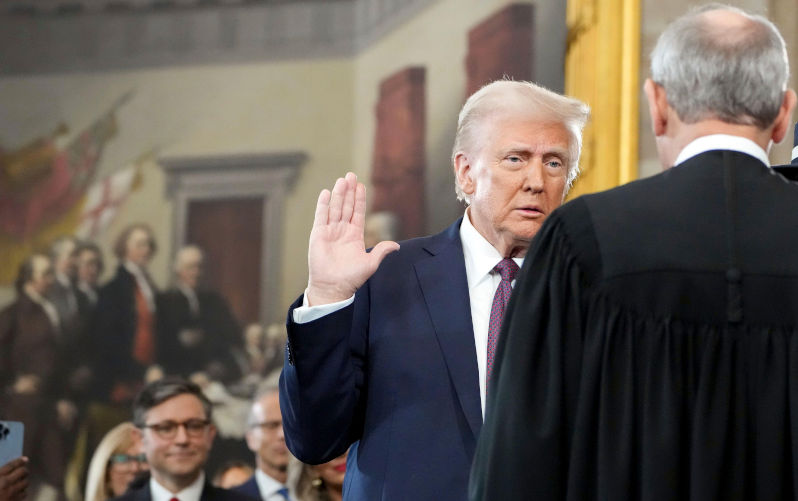
On 20 January, 2025, Donald Trump recited words prescribed by the United States Constitution: to ‘preserve, protect and defend the Constitution of the United States.’ Those words are not ceremonial. They are a legal obligation – the hinge upon which the entire constitutional order turns.
The case that they were spoken without genuine intent is not a partisan argument. It is a constitutional one, grounded in the founding texts themselves and amplified by the most credentialed legal voices of our era.
The architecture of that betrayal was completed six months before the oath was taken. On 1 July, 2024, the Supreme Court issued Trump v. United States, granting broad immunity from criminal prosecution for official acts. Former Acting Solicitor General Neal Katyal called it “a betrayal of first constitutional principles” – the very grievances against unchecked executive power that animated the Revolution. Berkeley Law Dean Erwin Chemerinsky challenged anyone to “make a plausible argument that the framers of the Constitution, who distrusted executive power, meant to bestow such immunity upon the president.”
That ruling did not change the plan. It completed it.
Project 2025 – the 900-page governing blueprint written by former Trump officials – was publicly disavowed during the campaign. “I know nothing about Project 2025,” Trump stated. Its core recommendations: dismantle civil service protections, fire inspectors general, centralise all executive power under direct presidential control. Every one was implemented within days of the inauguration, by the same people who wrote them.
The disavowal was not a policy disagreement. It was liability management – deliberate concealment of intent from the electorate whose consent was required to obtain the oath.
The oath itself was not the beginning of the story. It was the activation of a pre-built apparatus. Cabinet appointments were made on the explicit criterion of personal loyalty to the man rather than the Constitution – confirmed by former Chief of Staff John Kelly. Staff were required to sign Non-Disclosure Agreements – instruments of private commerce with no legitimate place in public government. Public promises of vengeance against political opponents were announced before a single word of the oath was spoken – an intention to use the powers of office for private factional purposes — the precise corruption the Preamble’s ‘general welfare’ clause was written to prevent.
This was not the first oath Trump violated. Alexander Hamilton wrote in Federalist No. 65 that impeachment exists for “the abuse or violation of some public trust – injuries done immediately to the society itself.”
Cornell Law confirms that both Trump impeachments charged oath violation on exactly this foundation. Reagan-appointed federal judge J. Michael Luttig – among the most credentialed conservative jurists in American history – has declared that Trump “refused to faithfully execute the laws, and waged war on our Constitution.” In August 2025, Luttig stated plainly: “America is on its way to absolute power resident in this president.”
The financial record completes the portrait. The _New Yorker_ documented $3.4 billion flowing to Trump and his family directly because of the presidency – cryptocurrency ventures, a $2 billion Saudi fund, a $400 million Qatari jet, a Vietnamese resort approved as punitive tariffs were quietly reduced. This is not offered as proof of any single crime in isolation. It is evidence of where presidential attention has actually been.
New York's courts found Trump liable for fraud spanning a decade. When New York’s Attorney General pursued those findings, the Department of Justice indicted her in what senior career prosecutors said ‘did not merit presentation to a grand jury.’ California’s Attorney General led 21 other state AGs in condemning it as retaliation.
The constitutional teeth to address all of this exist and always have. California has filed 54 lawsuits, won 35 injunctions, and protected $168 billion in federal funding. The Trump administration has lost more than 70 per cent of cases where courts have ruled on the merits. The tools work when they are picked up.
What is missing is not the legal architecture. Hamilton built it in 1788 and it remains intact. What is missing is the collective political will to treat the presidential oath as what it has always been: not a ceremony, not a ritual – but a binding legal covenant with the people of the United States, living now and not yet born. When a president takes that oath having already violated it once, having built the machinery to violate it again, and having spent six months accumulating the legal architecture to do so with impunity – the republic is not facing a political controversy.
It is facing the precise moment Benjamin Franklin described when he left the Constitutional Convention in 1787.
Read part one of this article