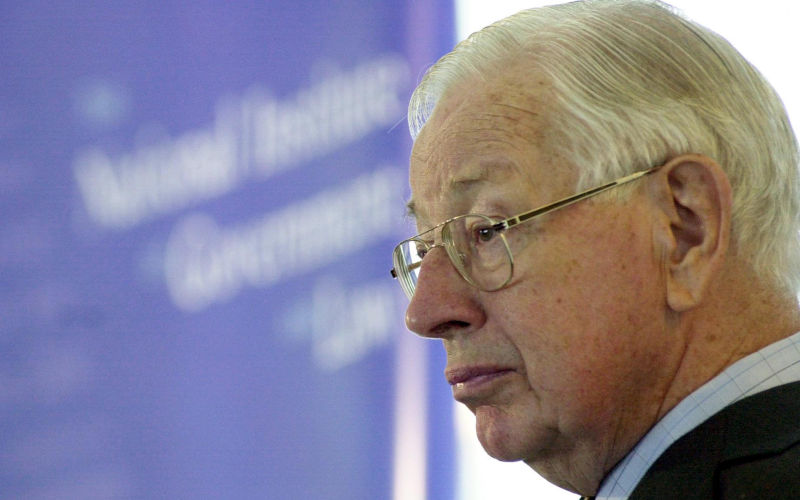
The most liberal of Judges – Anthony Mason
March 24, 2026
Beyond his landmark judicial legacy, Anthony Mason’s later advocacy for a bill of rights and a republic remains a powerful challenge to Australia’s political conservatism.
“Whom the gods love dies young” wrote the historian Herodotus in 445. Well not always, and certainly not in the case of the former Chief Justice of this nation Anthony Mason, who died last week just short of 100.
The extent of Mason’s jurisprudential innovation is manifest in a book published four years ago in which there are 23 essays penned by legal scholars, lawyers and judges writing about this most liberal of judge’s contributions – not only to development of the Constitution, but contract law, criminal law and other areas of the legal landscape. (Barbara McDonald, Ben Chen and Jeffrey Gordon (eds), _Dynamic and Principled: The influence of Sir Anthony Mason_, Federation Press 2022).
But as important as what he did on the bench is the work Sir Anthony Mason did when he became an advocate for an Australian Bill of Rights. He also saw no danger in this nation having its own head of state. Because of his experience as a judge in New South Wales, the High Court, along with his stint as Commonwealth Solicitor-General, his views on these subjects should be given great weight.
In an eloquent speech of impeccable logic given at a 2009 conference in Canberra dealing with a bill of rights and cultural and religious freedom, Mason politely but firmly put down the opposition of political, legal, media, religious leaders and others to an Australian bill of rights or charter.
“They mainly represent the voice of authority”, Mason said. And as to this phalanx of conservatives’ argument that “a Bill of Rights will weaken the democratic process and transfer power to unelected judges,” Mason retorted: “It may well be, however, that their real concern is that a Bill of Rights will expose the exercise of power to greater scrutiny and lead to a possible erosion of authority.”
Seventeen years later and the point is as potent today as it was then.
Sir Anthony was less polite about media opposition – the Murdoch press in the main, he said. He rightly called out their gross hypocrisy on this issue.
“There has also been strong opposition from the Australian media, notably the Murdoch press,” Mason said. The Australian media “has concurrently been waging a self-serving campaign for increased recognition of freedom of expression and freedom of information and, at the same time, opposing recognition of a right of privacy.” This hypocrisy remains today.
In his speech Mason took apart, with the precision of a top flight surgeon making a delicate incision, all of the right wing arguments against a bill of rights. As to the idea it would politicise judges, he said the risk of judges being politicised by a bill of rights “is far less than the risk that has always existed, and still exists, under the Australian Constitution when the High Court of Australia is called upon to decide politically divisive constitutional disputes about the extent of Commonwealth and State powers.” Remember the hysteria over the 1992 Mabo decision?
And as to the notion that a bill of rights will transfer power from the parliament to unelected judges, Mason savaged it with this: “The suggestion, so extreme that one might well think it was the brainchild of Humpty Dumpty or the Mad Hatter.”
On the republic Mason decided that while he had reservations about the model which was adopted by the Constitutional Convention in 1998 those problems were “not sufficient reason for opposing the move to a republic. These are problems which can be considered after a republican system has been adopted. They are essentially matters of fine tuning,” Mason wrote in a 1999 article published in Public Law Review.
Sir Anthony Mason, unlike a lot of lawyers, developed his thinking and therefore his position on issues like a bill of rights and a republic changed over the years. A lesson for those who are profoundly incapable of seeing the world as anything other than it is.
He was also a man who recognised that judicial officers need to face up to the fact they have backgrounds like everyone else, and that those backgrounds and life experiences influence their decision-making.
Of course, it could be said Mason understood that the law is political. You don’t need to be a Marxist to recognise that fact. And judicial officers should be always on the look out for ways to advance the society they live in, in a positive way. Put aside their biases.
But above all, in proving the power of longevity, Mason showed that with age can come the ability to embrace the future and use experience to knock on the head those who think the sky will fall in if constitutional change occurs. We need more like him.