The sinking of IRIS Dena: will hubris meet nemesis? Part 1
March 24, 2026
In a new three-part series, Ramesh Thakur examines the dimensions of the Iran war. In part one, he analyses the legal issues surrounding the sinking of the Iranian warship Dena.
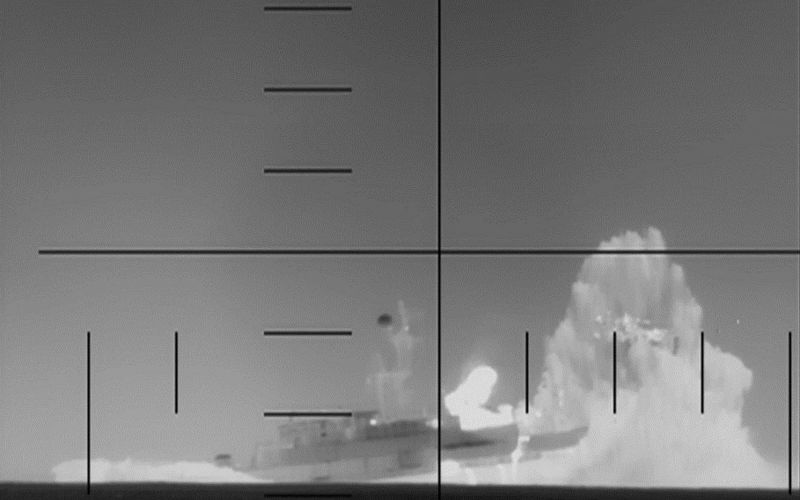
In the early morning of 4 March, the IRIS Dena, a frigate of the Iranian Navy, was sunk 35km off the coast of Sri Lanka by a torpedo fired by the nuclear-powered submarine USS Charlotte with a loss of over 100 lives.
Article 2(4) of the UN Charter obligates all states to ‘refrain… from the threat or use of force’. US justifications have ranged across multiple objectives including an imminent attack, regime change, degrading Iran’s military capability and terminating its nuclear program.
The claim that Iran has been in a continuous state of war against Israel and the US for 47 years since the Islamic revolution in 1979 seems more than a bit of a stretch, especially when we add in the long history of hostile acts directed by Israel and the US at Iran. Even Tulsi Gabbard, the US director of national intelligence, refused to say the threat was imminent, deflecting the question during a congressional hearing to say that only the president could make that determination. None of the other justifications withstands critical scrutiny.
Two further features of this war are beyond extraordinary. One, Israel has been picking off top Iranian political, military and intelligence leaders for decapitation one by one. Two, on 5 March Trump even claimed the right to decide who should be Iran’s replacement leader after the assassination of Ayatollah Ali Khamanei.
Even if the war is held to be lawful, hostile actions are still subject to the laws of armed conflict. Dena is the first vessel to be sunk by a US naval vessel since World War II and only the second to be sunk by a nuclear submarine after the General Belgrano was torpedoed by the Royal Navy’s HMS Conqueror during the Falklands war in 1982.
Under international humanitarian law, warships of states engaged in armed conflict are lawful military objectives and targets of attack when in the territorial waters of the combatant state or on the high seas. However, Dena had taken part in the Indian Navy-hosted International Fleet Review (IFR) 2026 and the multinational naval exercise Milan in Visakhapatnam (15–25 February). It sailed into international waters before the war began. In normal circumstances, it would have been armed with torpedoes, anti-ship and surface-to-air missiles, and guns and cannons. Because it was operating under a ‘ peace protocol’ for the exercises hosted by a friendly country, it would not have carried a full combat load of live munitions.
This would have been known to the Americans whose ships had participated in the same exercises. Former Indian Foreign Secretary Kanwal Sibal sharply criticised the US attack as a ‘premeditated’ attack on a ‘defenceless’ ship. Another strategic analyst said “the strike looks less like combat than a premeditated execution" of an unarmed, or lightly-armed guest ship heading home from a cooperative exercise “tracked and destroyed by the world’s most sophisticated underwater warfare platform.”
Second, Dena was well away from the theatre of war. A US official told Reuters it wasn’t given any warning before being hit. Defence Secretary Pete Hegseth boasted that the war is being conducted without “ stupid rules of engagement" and wasn’t meant to be “a fair fight”. Instead, the US strikes are “bold, precise, and designed to unleash American power, not shackle it… We are punching them while they’re down.”
Iran’s Deputy Foreign Minister Saeed Khatibzadeh said on 6 March that Dena had gone to an international exercise as a "ceremonial", "unloaded", and "unarmed" vessel. Iran called the attack on Dena "an atrocity at sea". The US Indo-Pacific command issued a terse fact check: ‘False’ against the claim it was unarmed. The US military no longer has the global credibility for this to suffice without additional, independently-verified evidence.
🚫 Iran claims IRIS Dena was unarmed - FALSE ✅ Law of Armed Conflict authorized the use of force to target and destroy valid military targets - TRUE ✅ U.S. forces planned for and Sri Lanka provided life-saving support to survivors in accordance with the Law of Armed Conflict -… pic.twitter.com/DdY5RNFUYf
— U.S. Indo-Pacific Command (@INDOPACOM) March 7, 2026
On receiving a distress call at 05:08 hours on the 4th, Sri Lanka’s navy and air force rescued 32 survivors and recovered dozens of bodies. Indian naval and air vessels assisted in these efforts. Their operations ended four days later.
Article 12 of the Second Geneva Convention (1949) stipulates that there exists ‘ an undisputed moral obligation that the shipwrecked must be rescued in all circumstances’, even enemy personnel from stricken warships. In practice, however, submarines are exempted from a strict application of this because of ‘ military exigencies’. Severely constricted deck space limits their ability to rescue survivors. Surfacing to do so exposes them to extra military risks, although this was not a relevant consideration in context.
Mark Nevitt, a former US Navy lawyer, warns that the failure to honour the “affirmative duty to rescue” survivors invites future mistreatment and death of Americans who are shipwrecked or captured. It is not known whether the Charlotte at least informed other ships, aircraft and coastal authorities of the location of the stricken Dena.
Canada’s Prime Minister Mark Carney said in Davos on 20 January that the global crisis triggered by Trump had ruptured the world order. He acknowledged the fictional elements of the rule-based international order narrative, but said the fiction had helped to maintain open sea lanes, a stable financial system, collective security and support for dispute-resolution frameworks. That bargain has been thrown aside and all countries had to develop greater strategic autonomy in energy, food, critical minerals, finance, supply chains and national security.
On 15 August 1945, Emperor Hirohito explained Japan’s surrender by saying that “the war situation has developed not necessarily to Japan’s advantage”. After a similar experience, Trump in his various comments to the press and on Truth Social has belittled, disparaged, disrespected and humiliated several friendly and allied leaders but when things started unravelling, he demanded their assistance.
The war on Iran is a stark consequence of the breakdown of the rules-based order with an abandonment of "even the pretence of rules and values". We exist on great-power sufferance in the darkling dusk of a new might-is-right age. Unless, of course, there is a course correction because, on the one hand, Russia is stubbornly stalemated in Ukraine and, on the other, Iran has hit back with the full range of capabilities. It has struck Israel and US interests and facilities, curtailed shipping through the Strait of Hormuz choke point and disrupted global energy markets.
The supposedly weak enemy gets to have a voice, vote and veto in a war of choice – who knew?
Read part two
https://johnmenadue.com/post/2026/03/crippling-or-buttressing-irans-nuclear-ambition-part-2
And part three