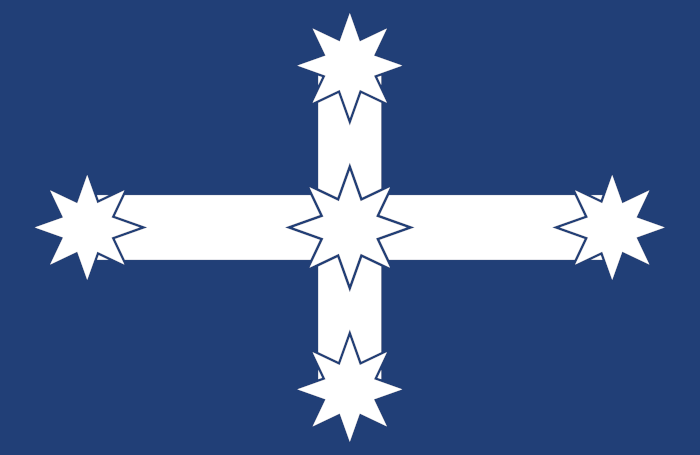
Taking back the Southern Cross
March 8, 2026
Once a symbol of unity, equality and democratic rights, the Eureka flag is increasingly being appropriated by extremist groups seeking to legitimise racism and exclusion. Reclaiming its precious original meaning may now require protecting it from misuse.
During an interview last month former Prime Minister Tony Abbott declared that core Australian values include respect for the flag. Abbott went on to describe Australian society as essentially Anglo Celtic Judeo-Christian.
At the march for Australia on Australia Day this year in Brisbane Pauline Hanson draped herself in that flag. In an interview she said that there are no good Muslims.
Speaking to The Guardian in February the UK artist Dame Tracey Emin noted that Nigel Farage’s Reform party now run Kent County where she resides and the UK flag is everywhere, much to her concern.
In Yorkshire, Rotherham council recently offered £500 grants to community groups willing to erect flagpoles and fly the UK flag. Rotherham was the scene of the attempted fire bombing of an asylum seeker hostel in 2024.
In Alice Springs it appears that the Country Liberal party government has also recently encouraged the flying of the Australian flag. Its prominence noted by visitors who, no doubt, also see the shocking Aboriginal disadvantage, ill health and poverty on the streets of that city.
Neo Nazis in Australia now also proudly display the Southern Cross or Eureka flag as their patriotic symbol. It flew on the stage at a rally in Sydney on Australia Day this year as a Neo Nazi delivered a hate speech that led to his arrest and criminal prosecution.
Following his election as Opposition Leader Angus Taylor used the Australian flag to promote himself by declaring that support for the flag is a pre condition to a migrant being welcome here. He will soon announce a race-based immigration policy directed at the most disadvantaged people on earth.
The evidence is growing – the hard right is again using national symbols such as the Australian and Eureka flag to advance an agenda of racism and white supremacy. This is not surprising, national flags are often used by extremists as propaganda to suggest that their repugnant opinions are acceptable to us all. It is a convenient disguise.
The Australian flag has long been the subject of criticism and dispute. But not so the Eureka flag. Some years ago I had it spray painted on a new surfboard as it was, for me, a symbol of all the freedoms surfing then stood for.
In 1854 Melbourne the spirit of the age was liberty and equality. On the goldfields of Ballarat and Bendigo diggers who sought liberty and equality were finding payment of their licence fees, used to pay the expenses of the colonial governor, insurmountable. The commissioner of the goldfields, Robert Rede a member of the Melbourne Club, enforced the licence fees relentlessly.
On 17 October 1854 a meeting of diggers took place on the Eureka lead outside the Eureka Hotel in Ballarat to discuss their concerns and the killing of a digger which occurred in the hotel. The owner of the hotel was seen to be in the camp of Rede. At the meeting, the Ballarat Reform League (BRL) was established. After the meeting the Eureka Hotel was set ablaze: a sign of the growing tensions on the goldfields.
Another meeting took place on 11 November during which the BRL resolved that it was the right of every citizen to have a voice in the laws they were required to obey. Negotiations with Rede failed. On 29 November and as soldiers marched from Geelong to Ballarat, the diggers gathered in a large meeting on Bakery Hill. Above them flew the Southern Cross flag crafted in wool and cotton by three women committed to their cause. The flag was designed as a symbol of unity for the diggers who, for the most part, were migrants from across the world. Ballarat was a diverse community not unlike the Australia of today.
The following day Rede announced that mounted police would inspect the mining licence of every digger then gathered in protest. The diggers decided to return to Bakery Hill and to call that place Eureka. The Southern Cross flag that flew over their meetings went with them. A stockade was built there in two days and the diggers swore allegiance to their revolutionary flag, the Eureka flag.
On 3 December 1854 260 police and soldiers stormed the Eureka stockade killing 24 diggers. Five soldiers were also killed. The flag was torn from its pole by police officer John King, used as evidence in subsequent treason trials and subsequently returned to King. The diggers who stood trial for treason were all acquitted. The King’s family gave the flag to the Ballarat Art gallery in 1895.
The flag became the defining symbol of a free, united and egalitarian Australia.
On 3 December 1973, then Prime Minister Gough Whitlam spoke at the launch of the restored flag at the Ballarat Art Gallery. He identified the flag as an enduring symbol of our national identity. In his speech Whitlam warned that it is in the nature of an event like Eureka, with all its potent symbolism, to lead to nationalist extremism. He then spoke of a healthy nationalism that Eureka represented, an independent Australia that protected Aboriginal culture and traditions as the most authentic expression of our identity. He said the flag also represented multiculturalism from immigration and social equality.
The values that Whitlam spoke of at that launch are at the heart of the Australia we must now defend.
The flag now resides at the Eureka Centre in Ballarat. Recently I decided to visit the centre to see how the flag is represented today. The essential theme of the centre is unity with the restored flag at its core. The staff at the centre told me that the flag moved many visitors to tears with the visitor stating that they could not explain why. A film of Gough Whitlam’s speech in 1973 plays on a screen below a photo of school children protesting about climate change with the flag displayed on their podium. Peter Lalor’s call for justice is prominently displayed too.
The power and scale of the restored flag is impressive. The beautiful sewing of the white cotton stars onto the Prussian blue wool suggests the determination of the diggers and their commitment to their cause. The theme of unity is depicted by the Southern Cross that they all saw in the night sky above Ballarat.
But the staff also explained to me that a change has emerged at the centre. An interactive panel in the centre states: “In recent years, Eureka has been increasingly appropriated by exclusionary and fringe groups to lend legitimacy to divisive political and social views.” Visitors are now reluctant to buy Eureka memorabilia because of its use by those groups. What was once a symbol of national unity and hope has been destroyed.
In 2016 Catherine King, the Federal member for Ballarat and now Minister for Transport and Infrastructure, introduced a private members bill into the House of Representatives to protect the Eureka flag from being used for bigotry and intolerance. The bill was defeated but perhaps the time has come again for this symbol of national unity to be recognised as such and protected.