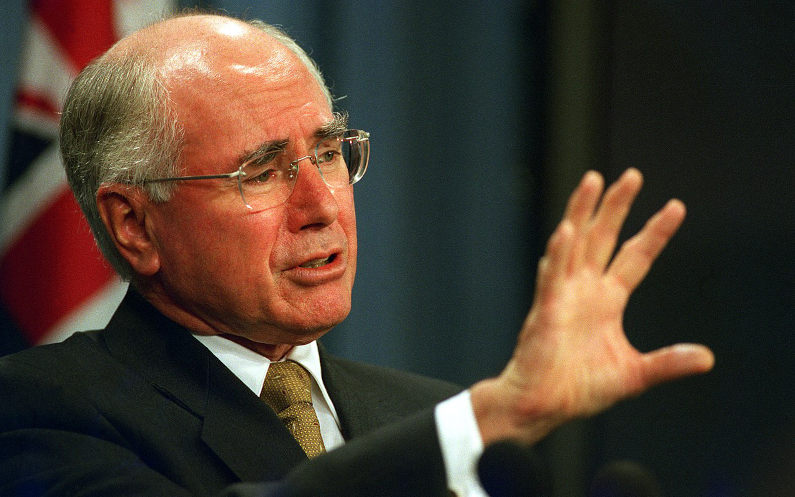
Thirty years on, the Howard legacy still defines our limits
March 4, 2026
John Howard marks 30 years since the Coalition’s 1996 victory with a familiar story of stability and economic management. But the deeper legacy is the set of political and economic defaults both major parties now treat as common sense.
“Today marks 30 years since we won the 1996 election.”
With that opening line, John Howard (or his office) offers Liberal supporters the familiar benediction: security, prosperity, opportunity. It’s not a memoir so much as a ledger – debt repaid, GST delivered, unions tamed, alliance re-hardened, East Timor invoked, guns controlled, jobs created, inflation halved. A neat account of national uplift.
But political legacies are never only what a government did. They are what it normalised, what it postponed, and what it made easier for the next wave of governments – of all stripes – to do. Thirty years on from the Coalition’s March 2, 1996 victory, the Howard years shape Australia less as a bundle of policies than as a set of defaults. And it is those defaults quietly inherited by both major parties that now matter most.
Howard’s letter is a skilled example of how to tell a story of government without telling a story of the country.
The letter’s governing moral claim is that competence equals virtue. “Responsible financial management” becomes an almost spiritual category of debt repaid, AAA restored, the Future Fund created, taxes reformed.
Yet the deeper truth of the Howard era is not that it worshipped the economy, but that it treated the economy as something to be administered not transformed. That approach worked during a long global expansion and an extraordinary commodities upswing. But it bred a fatal habit: the idea that Australia can live indefinitely on macro-prudence while dodging the harder work of building a more productive, more equitable, more resilient and sustainable national development model.
In other words: the Howard story is the story of a country that grew wealthier while narrowing its imagination.
Howard’s admirers present him as the great corrective to Hawke and Keating. But structurally he was also their inheritor – and, in important ways, their consolidator.
Hawke and Keating opened the economy, deregulated finance, embraced competition policy and global market discipline, and began the long shift away from collective wage-setting. They did it in the language of national modernisation.
Howard took much of that architecture as given – and translated it into something more culturally fluent and politically durable: aspiration, reward, “choice,” and the quiet moralisation of the market as common sense.
This is the Australian rhyme with Britain’s Blair-after-Thatcher moment. Blair did not overturn Thatcherism; he made it socially presentable and therefore harder to dislodge. Howard did not simply reject Labor’s reform era; he normalised it – then tilted it further, especially where labour power and public provision might have tempered inequality.
When both major parties operate inside the same macro-economic frame, politics becomes less a contest over the distribution of power and more a contest over management, symbolism, and who can sound most “responsible.” The bill arrives later: in weaker bargaining power, in housing-as-asset-class supremacy, in public capacity that can police and procure but struggles to build – and in a national imagination trained to treat structural outcomes as weather.
Howard’s rhetoric is classic: coercion vanishes and “choice” appears. Abolishing compulsory unionism becomes “more choice”. Industrial conflict becomes “lawlessness on building sites”. The old social settlement – collective bargaining, institutional counterweights, an assumed legitimacy to worker power – fades, and the new settlement arrives wearing the friendly mask of consumer sovereignty.
But “choice” in politics is often a solvent. It dissolves solidarity into individual transactions. It reframes structural power as personal preference. And it disarms criticism by implying that objection is merely a dislike of freedom.
This is the quiet genius of Howardism: it could drain the moral language out of public life – solidarity, equality, common purpose – and replace it with administrative language – choice, incentives, efficiency – while still sounding warm, practical, and Australian.
If you want to know why Australia now struggles to speak seriously about wages, inequality, housing, and the care economy without being dragged back into a technocratic argument about “settings”, you can trace the accent back to this period.
The letter gives us Howard’s worldview in miniature: the US alliance is “crucial”; the UK link is “traditional”; Japan, Indonesia and China are part of the region; and the Coalition “never sought to draw a distinction between Australia’s history and her geography.”
It’s a well-worn line, flattering itself as realism. But it also reveals how the alliance was treated less as a strategic instrument and more as a civilisational identity – a reassurance that Australia belongs to an English-speaking security archipelago even as it trades in Asia.
That identity move has costs. It makes independent strategy feel like disloyalty. It makes ambiguity feel like weakness. It turns foreign policy into a moral theatre – mateship, gratitude, obligation – rather than a cold assessment of national interest in a changing world.
And it helps explain why, decades later, Australia ties itself into knot after knot.
East Timor is where the Howard story is most morally revealing. Yes, Australia’s leadership of the 1999 intervention helped stop a campaign of terror after the independence vote, restored basic security fast, and opened the way to a UN-administered transition and eventual sovereignty. That matters. Lives were saved; a small nation got a fighting chance.
But it is not a chapter of uncomplicated virtue. Australia’s long pre-1999 posture was shaped by the imperatives of managing Jakarta, and what followed independence exposed the harder underside of “good neighbour” rhetoric: Timor-Leste’s oil-and-gas future became a site of relentless bargaining, and the later spy-and-treaty scandal culture left a lasting bitterness in Dili. East Timor remains one of Australia’s proudest security achievements – and one of its starkest ethical contradictions: we helped a new nation be born, and then behaved, at key moments, like a rich neighbour intent on keeping the best room in the house.
That contradiction matters because it reveals what the Howard letter keeps narrowing “security” to mean: strength, allies, deployments, hardware. Yet real security in our region is also trust, good faith, and the willingness to treat smaller neighbours as partners rather than as terrain – especially when resources and strategic advantage are in play.
Howard’s letter includes two policy areas where his government’s record is widely praised: firearms control and aspects of drug policy. The National Firearms Agreement after Port Arthur is among the most important acts of bipartisan national leadership in modern Australia, and the evidence of reduced firearm deaths is strong.
But even here the letter is instructive in what it chooses. It selects the chapter that says “we used government power to reduce harm,” while most of the story is told as “we stepped back to create choice.”
This is not an accident. It reflects a deeper tension inside liberal conservatism: the state is strong when it disciplines the disordered, and small when it might equalise the advantaged.
Near the end comes a curious flex: not only prosperity and confidence, but “a reversal of the long-term decline in our birth rate.”
Yes, Australia’s fertility rate lifted in the 2000s. But the larger arc since then is decline again, and the long-run drivers – housing costs, insecure work, the price of childcare, the stress of modern life – are not solved by nostalgia or tax tweaks. They are solved by a different social contract.
The birth-rate line is revealing because it’s not really about demography. It’s about moral self-image: the claim that this government helped restore the family as a stabilising unit. That is classic Howard. But 30 years on, the “family question” is being answered not by culture-war speeches but by the housing market, the cost of living, and the collapse of time.
If the Liberal Party wants to speak about families again, it has to speak about rent.
The most important sentence in the letter is the one that pretends to be modest:
“Although strong economic management is part of the Liberal Party’s DNA, we know it is not an end in itself.”
And yet the Howard era helped make economic management an end in itself across both parties – because it changed the definition of what counts as “serious.” Serious became: surplus, incentives, deregulation, “flexibility,” policing, alliance loyalty, private provision “choice,” and a permanent suspicion of collective institutions.
That is the consolidator’s trick: what begins as a contested reform program ends as a bipartisan boundary of the thinkable. This common sense has outlived Howard. It shapes Labor as much as Liberalism. It is why Australia struggles to mount big, confident public projects without being told it is “reckless.” It is why productivity is discussed as a cultural defect rather than an investment problem. It is why housing is treated as an asset class first and a human need second. It is why we keep building a nation for profits rather than for people.
Howard’s supporters see a golden age of stability. Critics see the beginning of a long age of managerial politics – high on reassurance, low on transformation – whose bill is now arriving in exhausted public services, stressed households, and an economy richer in paper wealth than in productive complexity, inclusion, equity and sustainability.
The letter ends with a rallying cry: “our values are timeless… our Party – and our country – is worth fighting for.”
True. But what is worth fighting for in Australia today is not the restoration of a party’s self-confidence. It is the restoration of the idea that government can do more than manage markets and police borders. It can shape an economy that rewards work rather than speculation; a society that values care as much as capital; and a national security strategy that treats climate and cohesion as seriously as submarines.
Thirty years after 1996, we can grant Howard his achievements without surrendering to his story. Because the real question is not whether the Coalition balanced the books.
It’s whether, in doing so, it helped unbalance the country.