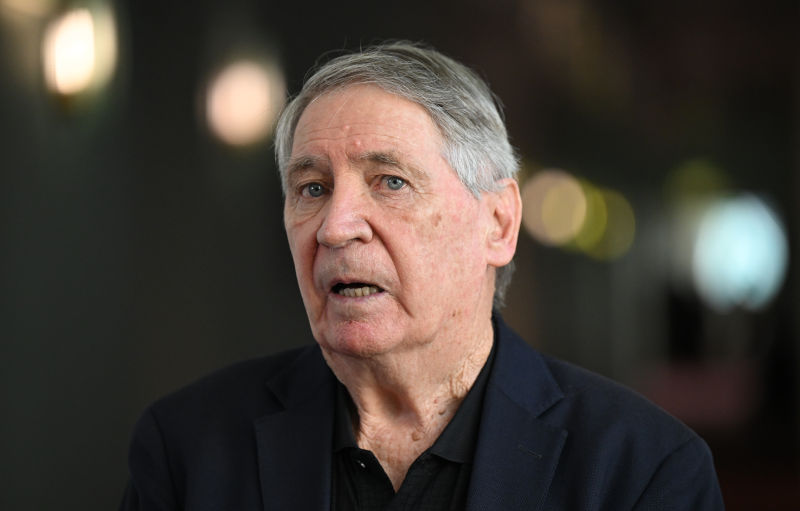
Why did Dennis Richardson walk away from the antisemitism commission?
March 18, 2026
Dennis Richardson’s resignation from the antisemitism royal commission has been widely portrayed as a setback, but the episode raises deeper questions about the inquiry.
Much is being made of the resignation of Dennis Richardson from the Royal Commission into antisemitism. Without exception commentators are painting his departure as a negative for the Commission, just as public submissions roll in. Our media, ever reliable for damaging unprofessionalism, have been anxious to join in – showing little understanding of the role that Richardson was expected to play.
The Albanese government set up the Bell Commission after the Bondi attack to comprehend the cause of antisemitism in Australia and methodically deal with it. That priority is reflected in the first element of the government’s terms of reference:
i. investigating the nature and prevalence of antisemitism in institutions and society, and examining its key drivers in Australia, including religious and ideologically motivated extremism and radicalisation, including in the lead up to the antisemitic Bondi terrorist attack on 14 December 2025;
Only with a genuine understanding of these basics can a response be properly crafted. Richardson’s input would not have been central here.
Richardson himself said he felt “surplus to requirements”. Obviously, Richardson felt marginalised because what he was meant to assess is a second-order matter. At first, he seemed jocular in acceptance of reality. He appeared to pretend he could have come up with the same overall outcome as Bell doing things his way but “the interim report that will now be done by the royal commission .. will be very different to the one that I would have done when I was doing the review, prior to the royal commission being announced”.
Clearly the Albanese government is looking at a far bigger canvas than Richardson was offered. His career background, while high level, is limited to defence, foreign affairs and intelligence, as Michelle Grattan points out: Richardson, 78, has a stellar public service career behind him. As a former head of ASIO and former secretary of the defence and foreign affairs departments, who also served as ambassador to Washington, Richardson has plenty of experience in handling complicated assignments and relationships. But he’s also willing to say when enough is enough.
If we dig a little, we find that Richardson’s long time at the top has seen Australia’s geostrategic sovereignty screwed: through intergovernmental agreements which cede Australia’s sovereignty to the United States for its war planning against China. That began with the visit to Australia of President Obama planned for 2010, which was the culmination of Richardson’s five years as our ambassador in Washington.
Thereby Prime Minister Gillard agreed to US marine soldiers being based in our north. Then followed intense years of Richardson leading our Defence Department, as Australia was shed of its geostrategic independence to accommodate US war plans, culminating in the Force Posture Agreement of 2014 – granting US “unimpeded access” for war operations, materials and personnel on certain facilities across Australia. Richardson has a deep US-centric geostrategic pedigree. We don’t know whether that extends to Israel.
So, one wonders why such a public figure chose to make such a spectacle of himself, on a matter he says he felt sure the Commission would handle well without him. Entirely out of character. When has Richardson taken to publicly complaining about anything he has been privy to? Richardson knows that silence is critical to making things happen and, conversely, that our media can be relied upon to spread doubt, damaging any Royal Commission.
And he protesteth that the Commission will succeed without him. A day later Richardson had changed his mind and decided to tell his story to ABC’s David Spears.
Richardson told Spears in a live interview that his real worry is about the safety of Australia’s Jewish people – measures need to be put in place urgently. He played the old “public safety” card: what could be more important than public safety? He doubted the Royal Commission can be counted upon to advise the government in a timely way. By now he protesteth too much about the virtues of the Commission, its personnel etc.
Yet he offered no square answer to why these avowedly admirable people in the Commission would not act appropriately on the safety of Australians when presented with the information Richardson himself relies upon.
Richardson’s behaviour seems extraordinary. His claims challenge rationality.
The Australian reported that Richardson was “considering recommending a major security funding boost for Jewish institutions”. His departure raised fears in the Jewish community that protective measures will be delayed. If that is so, it indicates that Richardson was amenable to specifying and dispensing major taxpayer funds without a disciplined assessment of the nature of antisemitism in Australia. Knockabout stuff, but he would have been accustomed to that in dealing with governments for years. The Commission is right to demand justification on its terms.
However, that hardly seems to warrant Richardson’s public tantrum.
Something else is afoot, big.
We can safely say that Richardson knows his public actions will harm the Royal Commission. And he acts as if to continue. Why might Richardson want the Commission destroyed?
The government should not discount the prospect that practised forces exist which would benefit from preventing a genuine inquiry into the source of antisemitism in Australia.