
Australia’s school system is driving inequality – not fixing it
April 20, 2026
Australia’s school system has become a self-reinforcing cycle of inequality, and without structural reform, the divide between advantaged and disadvantaged students will continue to widen.
It seems that the Albanese Government is contemplating better policy ideas than those found amongst the usual low hanging fruit. Advocates for policy breakthroughs, including those seeking structural reform of our framework of public/private schools, are almost certainly paying close attention.
Collectively, our schools are characterised by unfairness, segregation, and growing achievement gaps, problems which impact other areas of social policy and contribute to multiplying costs. Schools should certainly be in the queue for policy attention.
Given the scale of existing problems, it seems odd to restate why action is needed. Individual schools aside, our evolving school framework has created the most wicked of social problems. Worse, it exists within a vicious circle, captive to an enormous regressive feedback loop. The casualties among young people, schools and communities, continue to mount. It is now possible to argue that schools are the nurseries for social inequality.
This is illustrated in the diagram below, which shows how the key drivers are found in the way the whole framework operates. Yes, schools have never been equal, but much of the current inequality, especially the unlevel playing field on which schools operate and compete, derives from both policy and negligence going back to the 1970s.
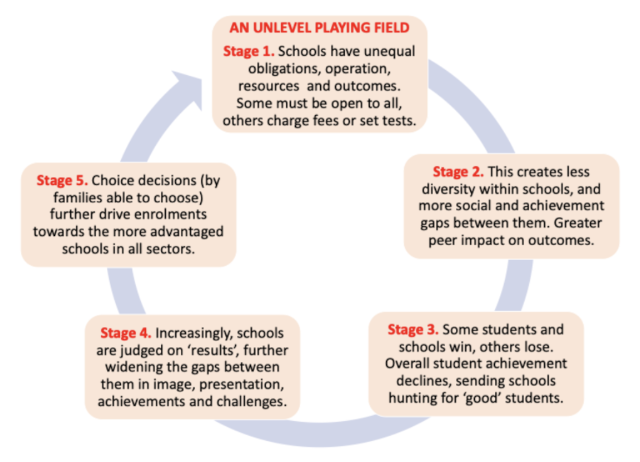
Our equity and fairness problems have changed as governments have come and gone, but what is described at each stage around the cycle is enduring – and will be familiar to those with even a passing interest in schools. After half a century, the problems depicted are now too big to ignore.
The sequence illustrated in the cycle hasn’t been lock-step, many stages overlap. Any stage can be a starting point – what matters is that the flow continues.
The cycle helps explain what we have created, and understand what went wrong – and why reforms to date haven’t fixed it. The resulting drama, with multiple impacts on families, schools and communities, plays out in full view in just about every Australian community. It includes the stress within some families over school choice, and the discontent in others without any choice. The fallout from our dog-eat-dog system impacts on family well-being, health and housing, urban transport and quality of life.
Well-known is the dollar cost of exercising school choice. With each passing decade even more public and private funding is found to feed a process and structure which has always been highly contested and which clearly doesn’t deliver. Families have looked to the bank of grandma and granddad, to cashed-in superannuation – or have just become resigned to more family debt.
It all further distorts the schooling system. An entire industry of coaching is available for those who seek access to any low-cost test-entry school. Well-resourced schools offer scholarships, effectively ensuring that the school is available to … some students. Higher-income families might relocate to the drawing area of a preferred public school, almost without exception located in a high SES suburb.
The distortions don’t end there. The fact that high test scores have become the go-to measure of school quality means that the most influential actors/stakeholders in school education focus on that – at a cost to everything else schools achieve for their students, including high-engagement and a secure post-school pathway.
Unsurprisingly, the winning schools are not interested in broadening the rules of the game, including measures of school achievement. Their voting families are unlikely to support any change which might even seem to reduce their advantage – and the various school authorities are unwilling to risk their purpose (and careers) by pushing for essential structural reform.
A range of vested interests – including school, system and industrial peak groups –have gained a disproportionate influence over policy. Self-interest and financial challenges also ensure that structural change is usually not on the radar of think tanks and the philanthropic sector. Many school reformers confine their concerns to what happens within schools, preferring remedies which will attract political and funding support.
These groups haven’t kept up with the growing scale and impact of the regressive cycle. The enrolment divergence between high and low SES schools, mainly but not only between the school sectors, is no longer a steady linear drift. Since around 2017 it has become exponential, a compounding acceleration.
This difference matters. Incremental deterioration might be addressed by the familiar within-school reforms. Their advocates make a lot of noise and attract superficial media attention, but the external problems created and driven by the regressive cycle can only be slowed and reversed by structural reform.
There are glimmers of hope. Governments around Australia have committed to better understand and provide advice to Education Ministers on socioeconomic diversity, its impact on schools and student learning and approaches to addressing these impacts.
It’s too little, too late. Anyone equipped with a computer, the data and the research can complete the task in a few days. As it currently stands, the commitment looks like a proposal to slowly do very little, while ignoring possible solutions.
The timidity of governments stands in contrast to the impetus now being generated by outsiders. The work undertaken by Australian Learning Lecture is illustrative. Its _Choice and Fairness, a common framework for all Australian schools_, presented the problems and the solutions. In response to the interest, the next step was to send a team to Canada to research the possibilities, best encompassed in their report Lessons from Canada: an equal school system is possible.
These are not the first or the only efforts to shift thinking – but a global search for best practice is a timely admission that we got it wrong – and we must now reach beyond our shores for a viable pathway to something better.