Albanese and Anwar align behind Pope’s call for peace
April 20, 2026
Australia and Malaysia have signalled support for a diplomatic path through escalating global tensions, backing Pope Leo’s call for peace and restraint.
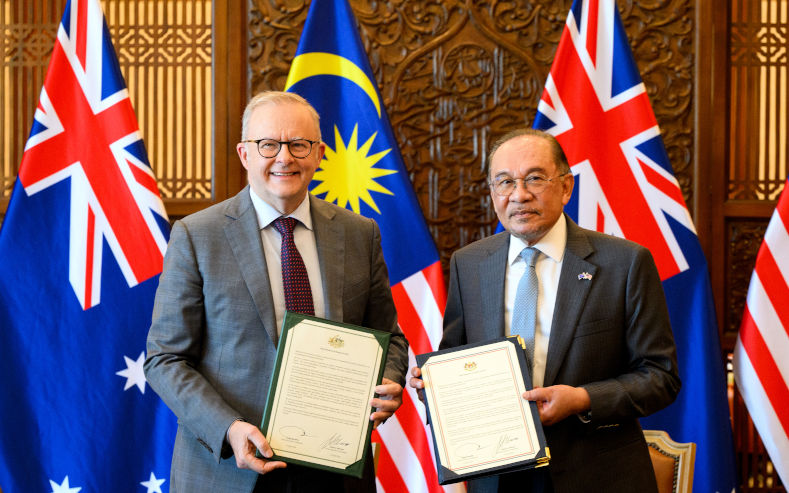
Amid growing global unease over escalating conflicts, Australian Prime Minister Anthony Albanese and Malaysian Prime Minister Anwar Ibrahim found common ground in Kuala Lumpur on Thursday 16 April, uniting behind Pope Leo’s forceful call for peace, justice, and an end to ongoing attacks on Iran and Lebanon.
The meeting comes against the backdrop of intensifying conflict involving the United States and Israel in Iran and Lebanon, alongside a worsening global energy crisis linked to tensions in the Strait of Hormuz. While both leaders navigated complex geopolitical sensitivities, their joint stance reflected a clear endorsement of moral leadership over militarised responses.
Speaking at a joint press conference, Albanese praised the Pope as a “thoughtful, dignified, and extraordinary person” whose voice carries global significance. His remarks were widely interpreted as an implicit rebuke of Donald Trump, who recently launched a public attack on the pontiff, accusing him of being “weak on crime” and “terrible for foreign policy,” even sharing an AI-generated image depicting himself in religious imagery.
Anwar Ibrahim framed his support for the pope in both moral and interfaith terms highlighting a convergence between Muslim-majority Malaysia and Australia’s Catholic-rooted leadership by saying, “I think any reasonable or sane person, and even I as a Muslim and Malaysians generally, certainly support the position taken by the Pope.”
The Pope’s remarks, delivered during a visit to Cameroon, have resonated globally. Condemning what he described as a world “ravaged by a handful of tyrants,” he criticised leaders who spend billions on war while neglecting education, healthcare, and reconstruction. Without naming specific countries, his message was widely seen as a critique of the US-Israeli military campaign and broader patterns of global militarism.
“Peace is not something we must invent,” the Pope declared. “It is something we must embrace by accepting our neighbour as a brother and sister.” His words stand in stark contrast to escalating rhetoric from Washington, where Trump has defended the war as necessary to counter Iran’s influence.
The conflict has disrupted global supply chains, with fears mounting over access to oil, fertiliser, and food. Anwar confirmed that Malaysia would prioritise domestic needs but could provide Australia with preferential access to surplus fuel through its state energy giant, Petronas.
At the same time, Malaysia defended its continued economic engagement with Iran and Russia, rejecting unilateral sanctions not endorsed by the United Nations. Anwar emphasised that his government’s primary obligation was to protect national interests, even as it uses diplomatic ties to advocate for de-escalation and freedom of navigation in critical waterways.
On Gaza, the two leaders found further alignment. Anwar praised Australia’s recognition of Palestine and its calls for humanitarian relief, describing Canberra’s stance as meaningful within the region.
Beyond immediate policy implications, the symbolism of the meeting may prove more enduring. In an era marked by polarisation and conflict, the sight of two leaders – separated by faith but united in principle – standing together in defence of a global religious figure’s call for peace carries weight.
As war rhetoric intensifies and alliances harden, the joint message from Kuala Lumpur signals a quieter but significant countercurrent: a push for dialogue over destruction, and a reminder that moral authority still holds power on the world stage.
Republished from AMUST, 17 April 2026