Allies are learning the cost of relying on the US
April 4, 2026
US alliances are exposing partner nations to conflict without giving them control over decisions. From the Gulf to Australia, the risks of strategic dependence are becoming clearer.
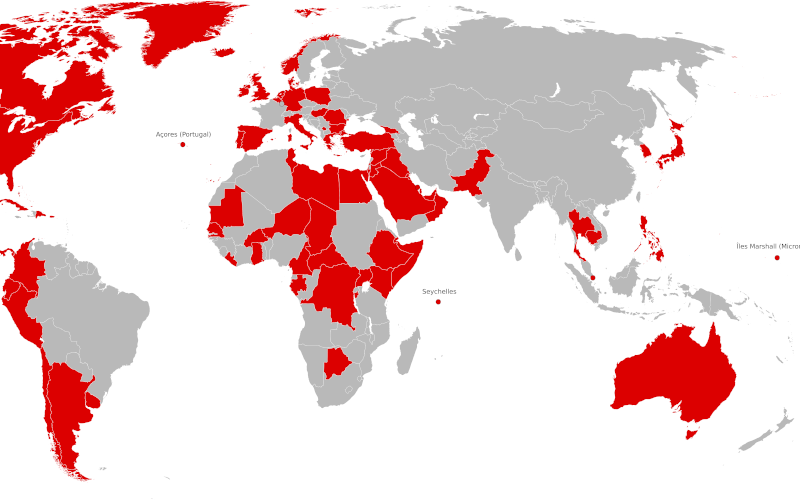
Until a month ago the gulf states of Qatar, Bahrain, Kuwait, the United Arab Emirates and Saudi Arabia may have felt that hosting US military bases, made them safer.
But they’ve now had a rude awakening. These bases simply make them a target.
Nobody should be surprised by the Iranian strike on Saudi Arabia’s Prince Sultan Air Base which reportedly destroyed a $270 million Boeing E-3 Sentry AWACS surveillance aircraft, damaged multiple refuelling aircraft and injured a dozen American troops.
Once attacked by the US, how could Iran ignore the air base which hosts an array of aircraft supporting US operations against Iran.
Similarly, Qatar hosts Al Udeid, the largest US military base in the region and the forward headquarters for US Central Command. And the UAE is home to the Al-Dhafra airbase which hosts F-22 Raptor stealth fighters, surveillance planes, drones and airborne warning and control systems.
There was no US consultation with Qatar, Bahrain, Kuwait, the United Arab Emirates or Saudi Arabia before Israel and the US launched their attack on Iran which would inevitably place these states in a retaliatory firing line.
Like the gulf states, Australia hosts US facilities and under the AUKUS agreement we are committed to hand over billions of dollars to fund the construction of US shipyards to bolster production of US nuclear-powered submarines.
No doubt the US President Donald Trump views us – like the Gulf states – as a US client state. This unpleasant truth was revealed most dramatically last week with Trump’s most derogatory comment about Saudi Arabia’s de facto ruler, Crown Prince Mohammed bin Salman.
Referring to a conversation with the Crown Prince, Trump said the Crown Prince had said: “One year ago you were a dead country. Now you’re the hottest country anywhere in the world.” Trump then said: “He didn’t think this was going to happen. He didn’t think he’d be kissing my ass….. He thought he’d (sic) be just another American president that was a loser, where the country was going downhill. But now he has to be nice to me_._”
Given US military actions in a number of countries, under different presidents, over recent decades, how likely is it that a future US administration would consider Australia’s viewpoint before going to war with – let’s be blunt – China?
And given the US bases here, how likely is it that China would not view Australia as part of a threatening US alliance?
Current US president, Trump is erratic and no outsider can predict what might come out of his summit meeting with Xi Jinping rescheduled for May 14-15 in Beijing.
Trade, the war on Iran and the fuel crisis will be on the agenda, but there can be no doubt Taiwan will be a priority item for China.
For some years a number of commentators in the Australian mainstream media have done their best to incite a war with China, arguing for an increased military build-up and Australia’s participation in US exercises off China.
Time and time again their predictions have been found sorely wanting.
Five years ago, on 13 March 2021 in The Weekend Australian, under the heading China Arms for War as Quad Fights Back, Greg Sheridan opened with the sentence: “Military conflict in the Pacific, which would certainly involve Australia, is becoming more likely.”
Perhaps sensing readers’ scepticism, he immediately followed with the line: “Those are not hysterical words” and then claimed that his comment was the implicit message in the statement by China’s President Xi Jinping at that week’s National People’s Congress. Sheridan also said it was the explicit message of the then US Indo-Pacific commander, Admiral Philip Davidson.
Despite Sheridan’s spruiking the predicted military conflict in the Pacific did not happen.
But others kept trying to make it so.
In March 2023 the Sydney Morning Herald and The Age splashed with a major series Red Alert, with the Herald headlining its show, Red Alert: War Risk Exposed and The Age going even further with its hysterical headline, Australia ‘must prepare’ for threat of China war.
The series told us bluntly, “Australia faces the threat of war with China within three years – and we’re not ready.”
Well those three years have now passed too and the war has not erupted.
Xi’s statement to the National People’s Congress five years ago was much the same as those of his predecessors going as far back as 1949 and the effective end of the civil war when the Nationalist Kuomintang government retreated to Taiwan. Taiwan is a province of China and the People’s Republic of China is the sole legal government of China. The PRC is seeking peaceful reunification under the one country two systems model.
At this stage, there is no sign that China is moving militarily to take advantage of the US being occupied by the war on Iran. But the administration in Taiwan must now be re-considering its position. Taiwan is one of the world’s most energy-insecure economies, relying on maritime imports for the vast majority of its oil and natural gas. The Taiwanese economy is also intertwined with China which is a major buyer of Taiwanese goods.
For the moment, Trump is preoccupied with the Iran war and has stepped away from his anti-China tariff campaign. Most extraordinarily he even begged China to join western countries to provide warships to escort tankers through the Straits of Hormuz.
Summits are not usually arranged without advance agreement on some outcomes. So we might expect the Xi-Trump meeting was intended to, at the very least, arrive at some sort of agreement on tariffs and trade.
But Trump is not a normal leader. And cannot be trusted either during negotiations, (ask the Iranians about that) or even after they have been concluded.
Israel continues to wag the Trump dog, and now appears intent on doing to Southern Lebanon what it did to Gaza, where more than 70,000 people have been killed and the objective is to make the land uninhabitable for the Palestinian people.
Meanwhile, the Ukraine war grinds on with little coverage in the mainstream media and Russia enjoying the benefits that flow to it from the Iran war. Increased oil prices, the lifting of sanctions and the consequent boost to exports and revenue are only the start.
The huge consumption of US weapons in the Iran war and the depletion of stocks of both offensive and defensive weapons, will cut supplies to Ukraine, even those Europe was to buy from the US to deliver to Ukraine.
Russia is poised for a Spring offensive and from a Ukrainian perspective the current situation is grim. Over winter the Russians have steadily gained territory, as shown by the Ukrainian generated Deepstate map.
For example, a few months ago the media was reporting the battle for Pokrovsk. Now the battlefront has moved well west of that strategic Donetsk city. For months, the daily updates on the Deepstate site have reported the Russian advance with brief notes like: “The enemy occupied Svyato-Pokrovske and Vasyukivka and advanced near Riznykivka and Bondarne.”
The Russians will enjoy the fact that US and western attention is focused elsewhere.