China’s response to war is strategy, not opportunism
April 12, 2026
As war disrupts the Middle East, China is focused on stability and long-term strategy – but much of the commentary in Australia continues to misread its intentions.
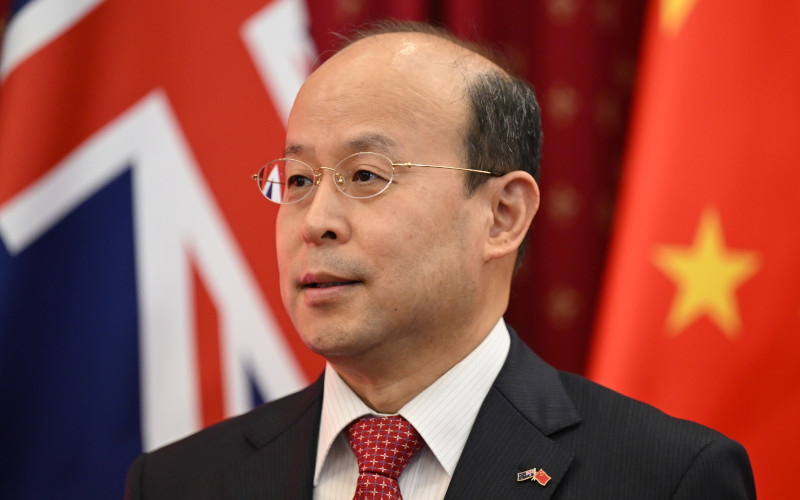
China’s ambassador Xiao Qian visited Sydney last month shortly after the joint attack on Iran by Israel and the United States. Speaking at the Australia China Relations Institute, UTS Sydney, Ambassador Xiao was asked whether China could help to end the war by mediation between the two sides. He was quite blunt:
“For the United States and Israel to attack Iran, which is a sovereign state, and to kill its leader, that’s an action, that’s a violation of the UN charter, international law[s], international rules. And secondly, it’s creating tremendous chaos in that region and also bringing very, very negative spillover effects to regional even global economy. And both China and Australia, we’re feeling already the side effects of that situation…
“But whether or not China can play the role as a mediator … For a third party to mediate between another two parties, you need to have, number one, the permission or agreement or endorsement, acceptance of those two parties.
“Because when you accept mediation, it means both sides are ready to compromise, to listen to the advice from the mediator and compromise on some of the issues. But I do not see right at this moment that either the United States or Israel or Iran are ready for showing the flexibility or compromise to make a deal….
“We need peace, we need stability. We can focus on development inside of the ROA realm, but we continue to make our efforts and we’ll see how (the) situation develops. We’ll continue to engage. We’ll send our special invite to the region to talk with relevant parties to see what we can contribute. We’ll continue to make our efforts.”
These remarks have to be quoted in full because the Sydney Morning Herald’s Peter Hartcher argues that China is taking advantage of the war to prepare to invade Taiwan. Sixty Minutes has suggested that China is an active participant in the war through supply of military hardware. The Australian has noted that China is profiting from global supply shortages that boost its exports of electric cars.
The general line is that whatever China is up to, it must be something nefarious.
China is in fact deeply affected by the war. Ambassador Xiao’s remarks make it clear that, although it has limited ability to affect the outcome, the Chinese government would like to end the conflict as quickly as possible. Speaking at the Ministry of Foreign Affairs press conference on 8 April, spokesperson Mao Ning said that China had worked actively to bring about an end to the conflict. Foreign Minister Wang Yi had spoken to 26 of his counterparts and the earlier five-point peace initiative had been jointly proposed by China and Pakistan.
These actions should be welcomed by all Australians. Every family is suffering from higher prices at the pump and in the supermarkets. All those planning holidays or business trips, whether at home or overseas, hope against hope that the international crisis can be resolved quickly. Australia will be more deeply scathed than China, for one significant reason – that China’s economic and defence strategies are long-term, not dependent on the outcome of elections every few years.
Those of us who have long memories remember the years when China and the United States were locked in Cold War hostilities. The US imposed an embargo on trade with China for 20 years from the 1950s. In response, Mao Zedong proposed national policies of “self-reliance” zili gengsheng (regeneration through one’s own efforts). Although largely abandoned following the economic reforms of the 1980s, zili gengsheng has been revived by President Xi Jinping in response to geopolitical frictions and trade wars. The slogan was not inspired by the Iran War, but the events of the last month have simply underscored the need for such strategic planning.
“Self-reliance” lies behind China’s current “dual circulation” economic strategy. Self-reliance applies to the accumulation of substantial reserves of vital materials and the development of its own critical technologies such as semi-conductors. Xi Jinping has embraced not only the material but also the psychological strands of this policy, encouraging the turning of crisis into opportunity. This is at the heart of the fifteenth Five Year Plan. It is not a plan for world domination but a reaction to foreign aggression.
The plan, adopted last month at the National Party Congress, states that the “top strategic task” is to build a modern industrial system and strengthen the foundation of the real economy”. It does, however, conceal a basic contradiction. Technological innovation depends on openness to data, ideas and global trade and interaction, and these in turn depend on peace and stability.
Little wonder then that China is working to bring an end to the conflict in the Middle East. This is not simply a local dispute. It is inextricably linked with the fractious relationship between the two superpowers – China and the US.
For the future prosperity of the people of China, of America, of the Middle East, and of Australia, the war in Iran and Lebanon must end now.