
Reform requires trust – and trust requires openness
April 7, 2026
Economic reform depends on public trust – and that trust is being undermined by declining transparency, weak accountability and limited public engagement.
Many Labor supporters, including me, have been disappointed by what they see as Albanese’s timidity when it comes to adopting a significant policy reform agenda.
But in fairness to Albo, perhaps he felt a bit inhibited by the decline in public trust over this century; a decline which is common to most liberal democracies. As the OECD has observed, there is a connection between the level of trust in government and the capacity of government to address complex policy challenges.
Unless people feel confident in the capability of their government and generally trust it, many will oppose reforms that inevitably will involve changes for them. Indeed, this public resistance to change can be seen in the rise of One Nation.
In this context, it is interesting to note that according to ANU election studies, in modern times trust in the Australian government peaked in the early years of the Hawke Government. Most probably this reflected the Hawke Government’s consensus approach to economic policy-making, which was based upon the sharing of information.
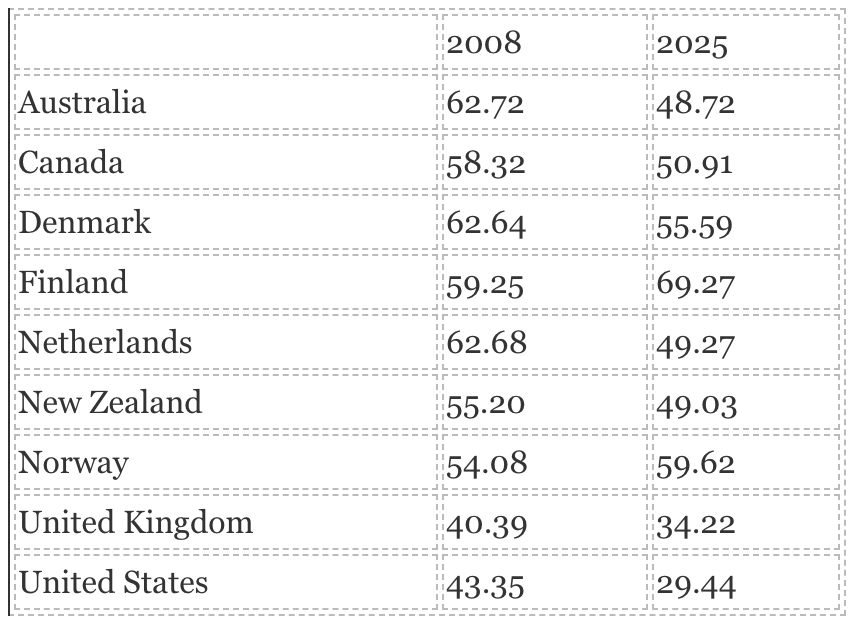
However, trust in government in Australia started falling in the 1990s and according to OECD data, public trust in government in Australia fell from 62.72 per cent of the population aged fifteen or over in 2008 to 48.72 per cent in 2025. Interestingly, the Australian experience was not very different from other similar countries (see Table 1), although the Nordics have done much better, and the UK and US have experienced the biggest loss of popular trust in government, especially the US under Trump.
Table 1 Trust in government
percentage of population aged 15 and over
So the starting point for any reform program is that unless a significant degree of trust in government can be restored, the likelihood of that reform program being adopted and succeeding is worse than in the past. Nevertheless, despite the likely difficulties in gaining popular support for a significant reform program, Albanese has recently indicated that he may be up for the challenge.
In a speech at the National Press Club just before Easter, Albanese said that in times of uncertainty such as this, economic reform that drives growth, boosts productivity, helps tackle inflation and lifts living standards, is not only necessary, it is urgent. Albo then went on to say that “next month’s Budget … is our Government’s most important Budget to date and it will be our most ambitious. It has to be”.
But if the Prime Minister is really fair dinkum, it will be equally important to gain public support for those reforms and that requires restoring public trust in government. And to that end, nothing can be more important than restoring public transparency, which has not been good under this government. But without amplifying peoples’ engagement in the political process, it will be difficult to ensure that decisions to significantly change policies are seen as being legitimate.
Public transparency and engaging with the public
One of the key ways of destroying public trust is through secrecy and half-truths. This is why Freedom of Information (FOI) legislation was introduced by the Fraser Coalition Government in 1982, just before the election of the Hawke Labor Government.
As a Departmental Head back then, I recall my fellow Secretaries’ fears about what FOI would mean for good government. But our experience is that in fact FOI improved the quality of government.
These days, however, the Albanese Government has the worst record of any government in producing public documents for public scrutiny. Research by the Centre for Public Integrity found that FOI requests granted in full dropped from 59 per cent in 2011-12 to just 25 per cent in 2023-24. Outright refusals nearly doubled during the same period, and the wait times for FOI appeals have more than doubled, increasing from six months (2016) to 15.5 months (2024).
Indeed, the Albanese Government’s record on transparency is even worse than the Morrison Government, with higher rates of outright FOI refusals and lower compliance with Senate document production orders.
Equally important, the Albanese Government has a huge backlog in its response to Parliamentary Committee Reports. For the House of Representatives, parliamentary records show that 50 reports have not been responded to within the required six-month period, and more than half of these have been overdue for over a year, with perhaps the most famous delay being the report on gambling advertising which the Government finally responded to last week after more than 1000 days.
In the case of the Senate, more than 80 reports have received no response in the required three-month period, and as many as 169 reports have yet to receive a complete response.
But when it comes to generating public support for policy changes what is even worse in some ways is the failure of the Government to supply public information that allows a proper assessment of the performance of government programs and the evaluation of that performance. Without that information it is difficult to justify and thus generate public support for policy changes.
Program budgeting was introduced by the Hawke Government which meant that the purpose of each and every government program was identified, progress towards meeting that objective was measured, along with the costs, so the cost-effectiveness of each program could be assessed. Furthermore, this information was published each year as part of the Budget.
That information helped enormously in identifying where program improvements were needed and in convincing the public of the need for changes. Today, however, while in principle the same program information is published, my examination of Budget documents is that it is no longer anything like as useful as back in the Hawke-Keating era.
Equally important, evaluation has fallen into disuse. When the Hawke Government introduced evaluation, all government programs had to be evaluated in depth every three to five years. Departments had to submit their evaluation plans to the Cabinet, with Finance having the opportunity to comment on priorities and terms of reference, and to seek more substantial involvement in any evaluation where it wished.
These program evaluations were the basis for identifying program improvements, but they also assisted Departments to improve the policy advising capability of their staff. However, today evaluation is no longer systematic, and too often it is contracted out, where the contractors feel under pressure to provide “good news”, rather than identifying flaws that need fixing.
The Albanese Government is under considerable pressure to find savings in its forthcoming budget, not least so it can fund the new demands on government in a troubled world and surging cost of living pressures.
Significant savings are never impossible, but they do require major program changes. For example, the Hawke Government made major program savings in its three budgets for 1986-87, 1987-88 and 1988-89, and total real budget outlays fell in each of those years – the only time in Australia’s history that occurred.
These savings involved tighter targeting of welfare payments and increased user charging. However, these savings also financed improvements to income and other support for those people most in need. As a result, Australia had the most target-efficient benefit system in the OECD. Australia and Denmark were the two OECD countries redistributing most to the poorest 20 per cent of their populations, but Denmark had much more churning, spending 80 per cent more relative to average household income to achieve the same amount of redistribution.
These outstanding results were only made possible by a government that readily made the relevant information available and consulted heavily with relevant interest groups, led by the then Minister for Social Security, Brian Howe, and his Department.
If the Albanese government really wants to rise to the present challenges and make a difference it could learn a lot by adopting the transparency and consultation practiced by the Hawke government.
Unfortunately, however, the present lack of transparency and engagement with the public is leading to a loss of public trust which will make it much more difficult to achieve the savings and/or the revenue increases required to balance the budget and support an economic reform program more generally.

