Louise Adler on Howard Jacobson’s Howl – a novel overtaken by ideology
April 21, 2026
The review that the mainstream media would not run – Louise Adler on Booker-Prize winner Howard Jacobson’s latest novel Howl.
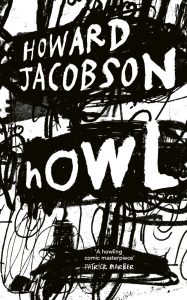
_Howl_ is a jeremiad, a 300-page essay on the immutability and inevitability of antisemitism thinly disguised as a novel.
Howard Jacobson admits to being half-mad after Oct 7th, but empathy, reason and fact have been swept aside in this, his 18th novel. It is sad that this myopia, a condition of collective narcissism, has blinkered one of Britain’s finest contemporary satirists. But it was Jacobson who once observed that Jews are smitten with our own tragedy.
A line from Allan Ginsberg ‘s 1960’s poem Howl provides the novel’s epigraph “I saw the best minds of my generation destroyed by madness”. Set in suburban London, Jacobson’s protagonist, Dr Ferdinand Draxler, is the headmaster of a primary school. With a predilection for grammar, he has a lot to contend with – his deputy is a recent convert to Judaism who sports an ostentatiously oversized yarmulka, his brother – once a follower of the Haredi sect – has become an atheist, his Oxford educated daughter, Zoe, now specialises in antizionism, and his formidable Mutti survived Belsen.
The narrative, frequently alluding to actual events, is fuelled by half-truths and myths. It is surprising to read a writer of Jacobson’s fierce intelligence so determined on prosecuting the case that Jews are exceptional, so bound by moral laws that he can’t untangle facts from propaganda.
In an article criticising the BBC’s “anti-Israel bias“ he argued that “genocides don’t leaflet the population they want to destroy with warnings to stay out of harm’s way”. One can only wonder whether the Palestinian parents of 20,000 murdered children agree. Jacobson and his protagonist are so preoccupied with antisemitism that they are inured to atrocities committed in their name.
Jacobson was never one for the cool calmness of perspective – writers who have a talent for the riff rarely are. He has lost much of his sense of humour; but then he would say that this is not a time for jokes and he’s right. We are all now at the mercy of autocrats, grifters and hacks, and in these dark times Howl offers readers a polemic disguised as a novel.
I thought Jacobson’s subject was men but I was wrong – his subject has always been Jews and Jewish identity with masculinity as an entertaining side order. As he pointed out in his Booker prize winning novel, Finkler, “talking Jewishly about being Jewish was being Jewish”. I don’t begrudge Jacobson his obsession, indeed I am susceptible to it too. However, in Howl his vision is so severely circumscribed as to create a world where justice and humanity succumb to collective self-absorption.
Jonathan Swift wrote to Alexander Pope “the chief end of my labours is to vex the world rather than divert it”. Jacobson is as vexed as the world he inhabits. He is beside himself, but as Danny Kaye would say, it’s his favourite position.
Draxler, channelling Jacobson, is arguing for uncertainty, viewing the demonstrators as dogmatists easily led by lefty academics who have taken over the grove of academe, “ ignorant armies (who) pitched their encampments of know-nothingness across the lawns of learning”.
According to Jacobson our people were chosen “to be standard bearers of ethical refinement, discrimination, reason and law”. It is hard not to give a hollow laugh, when reminded of the Star of David being carved into a Palestinian face and Tik Tok memes of IDF soldiers looting Gazan homes or torturing Palestinians in Sde Teiman prison.
In the past Jacobson has written about holocaust porn, a catalogue of wildly inaccurate, often obscene fictionalised narratives about concentration camp life – the dressmakers, the librarians, the musicians and the tattooists. Howl’s protagonist prodding his resistant Mutti about her time making cakes for the Beast of Belsen veers uncomfortably close to voyeurism, caressing the horrors of the past in the service of a political project.
Draxler sees antisemitic graffiti everywhere, hears people shouting gas the Jews, reading Roald Dahl on the tube. Yes, antisemitism has flourished since Oct 7th. Some explain it as an eternal hatred, others as a 19th century phenomenon, the result of Catholic teachings, or the consequence of diaspora Jews almost universal allegiance to the Zionist project.
The novel is a disturbing testament to the effect of Zionist identification on the minds of those afflicted by this allegiance.
Jacobson has produced a narrative that wouldn’t be out of place among the submissions to the royal commission, where, in similarly harrowing accounts, narrator-victims describe the experience of total psychic decompensation resulting from the mere sight of a Palestinian flag on a university campus. This is histrionics in the service of political propaganda. Stories like these of “victimhood” are disturbing, certainly; but they don’t make for compelling literature.
Jacobson says Howl is a novel, not a march. It is, in reality, a march in prose.
