
On asylum, the Coalition is offering old fixes to problems of its own making
April 16, 2026
The Coalition’s asylum plan repackages familiar measures that have failed before, while sidestepping its role in creating a large and growing backlog of unsuccessful applicants.
The overwhelming focus on the Australian Values aspect of Angus Taylor’s Coalition policy announcement means relatively little attention has been given to the asylum policies Taylor announced. Sadly, these are predominantly a re-hash of old ideas and an attempt to deflect from the Coalition’s role in the situation we now face with a record number of unsuccessful asylum seekers who have not departed Australia.
Taylor’s asylum policy is to “shut the door to unauthorised migrants by implementing decisive measures to deter unfounded claims and enforcing Australian law. The Coalition will:
● Introduce a Safe Country List to fast-track the refusal of unfounded protection claims from those places deemed safe countries. ● Restore Temporary Protection Visas and Safe Haven Enterprise Visas as the dominant forms of onshore protection visas for people who come here unlawfully or under false pretenses (sic). ● Provide extra funding to law enforcement to identify, deport and remove unlawful non-citizens who have exhausted their legal avenues but stay in Australia illegally. ● Stop taxpayer money funding legal aid appeals of visa cancellations.”
In announcing these policies, Taylor will want the Australian public to forget that he was Assistant Law Enforcement Minister when Australia experienced the start of the biggest labour trafficking scam abusing the asylum system in our history. The scam started with Malaysian nationals (Chart 1) and spread to Chinese nationals (Chart 2).
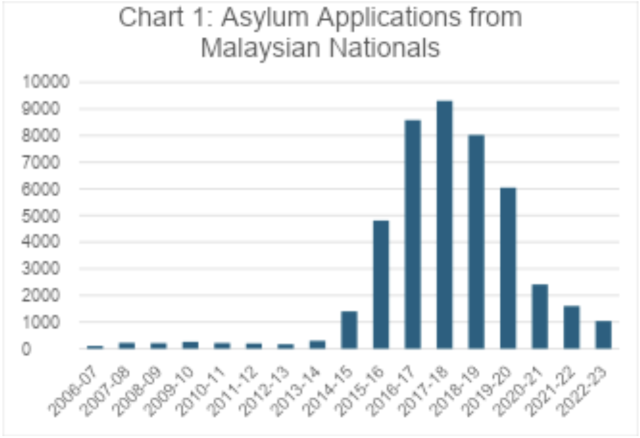
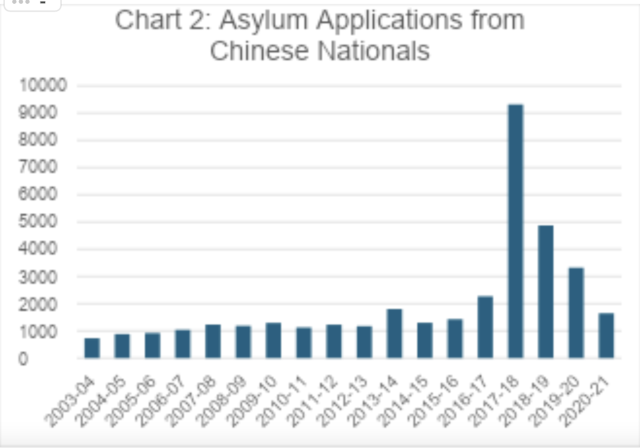
The people who were brought to Australia under that scam are now a very large portion of the 65,000 unsuccessful asylum seekers Taylor now wants to deport. The scam was assisted by a significant reduction in immigration compliance resources and indeed a general reduction in immigration integrity under Peter Dutton.
While the trafficking scam appears to now be over, overall asylum applications continue to run at a higher level than before the scam started in 2015. Before the start of the scam, annual asylum applications (non-boat arrivals) were at less than 10,000 per annum. These peaked at 27,931 in 2017-18. In 2024-25, these were at 23,576.
At the change of government in May 2022, there were 26,405 asylum applications in the primary backlog and 36,708 at the Administrative Appeals Tribunal (AAT)/ Administrative Review Tribunal (ART). Sone 67,855 had been refused at the primary stage and not departed while another 31,147 had been refused at both primary and appeal stages and not departed.
The Albanese government sought to address the situation by allocating an additional $160 million over four years into faster processing of asylum applications. This has meant that more applications are now being processed at both primary and appeal stages than there are new applications. Backlogs at both stages are falling.
However, relatively few unsuccessful asylum seekers are departing or being removed. As a result, the number of asylum seekers refused at both primary and appeal stages and not departed have increased to 65,927. It is these people Taylor now wants to deport.
Use of a list of countries that have been assessed as safe for asylum seekers to return to have been employed by a number of European nations. This mechanism has been subject to legal challenge and requires agreement of the countries involved.
Assuming the relevant legislation can survive legal challenge in Australia, it may be possible to include a small number of countries with an exceptionally strong human rights record on this list. This would enable marginally faster processing and may also deter asylum applications from these countries.
The idea is worthy of further investigation in the Australian context but it is unlikely that it could be applied to major asylum source nations such as China and India due to their respective human rights records.
Like Pauline Hanson, Taylor also wants to resurrect TPVs.
Australia has experimented with TPVs for over 40 years. We have learned that these add significant costs to the visa system but do very little to deter either boat arrivals or other asylum seekers. Almost every person who has ever been granted a TPV has now become a permanent resident. Many are Australian citizens with Australian citizen children and grandchildren.
TPVs have become totemic for the Coalition even if they achieve very little that is positive. It’s more about appearing as tough as Hanson.
Extra funding for law enforcement to deport failed asylum seekers
There is no question we need to reduce the number of unsuccessful asylum seekers in the country. Additional funding to increase location, detention and removal of unsuccessful asylum seekers is essential. But two questions arise from Taylor’s announcement.
First, it’s not clear why the funding would be allocated to law enforcement agencies such as the AFP. These agencies have little knowledge of the visa system. Any effective measures to reduce the number of unsuccessful asylum seekers would need to be co-ordinated and run by the agency that runs Australia’s visa system such that the full breadth of options can be considered and a well-designed strategy implemented. This is not just a law enforcement operation. It’s not even primarily a law enforcement operation.
Second, allocation of the funding to law enforcement suggests Taylor wants to copy Trump’s mass deportation program rather than develop a carefully crafted approach suitable to Australia’s circumstances. Trump’s mass deportation program has a current price tag of around $US100 Billion; has led to massive numbers of wrongful detentions and deportations; but only a relatively small increase in actual deportations. The cost per deportation would be eye-watering.
Stop taxpayer money funding legal aid appeals of visa cancellations
The number of appeals of visa cancellations is a tiny portion of migration/asylum appeals to the ART. At end February 2026, there were 910 appeals against visa cancellations out of a total of 76,710 migration appeals and 38,865 asylum appeals. Only a portion of the 910 visa cancellations would be funded by legal aid.
Why Taylor wants to target legal aid for visa cancellation appeals is unexplained. Appeals to the ART that are unrepresented will only slow the resolution of these as the Tribunal will need to do more work to gather all the relevant facts on these appeals. That means the appellant remains in Australia longer. The opposite of what seems to be Taylor’s objective.
It highlights the overall superficiality of thinking in this segment of the policy.