Pope Leo reframes the moral language of war
April 13, 2026
Leo may help break a trend that has dominated American Catholicism – less religion as national glue, more faith as a critique of power._
_
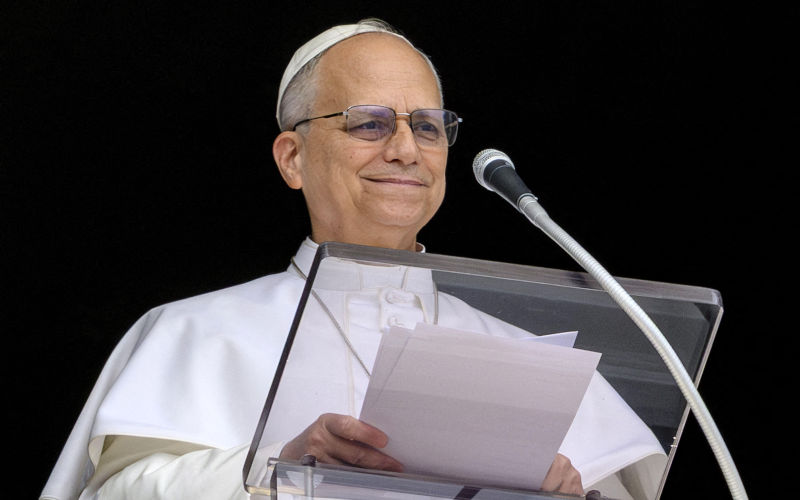
There is a way of speaking that consists of never raising one’s voice and, precisely for that reason, making oneself heard more than anyone who shouts. It is the register that Leo XIV seems to have chosen – and perhaps history has also imposed on him – in the weeks when the world is once again growing familiar with the language of total destruction.
While governments calibrate their nuclear threats with the nonchalance of someone updating a press release, and while the rhetoric of war settles into western democracies like furniture, the first American Pope in history is speaking about peace, shaped by the winds of war blowing from his country of origin.
In contemporary grammar, the word “peace” has undergone a peculiar process of semantic erosion. To utter it in public, especially in the context of an active conflict, often amounts to placing oneself in the realm of moral irrelevance: one is immediately labeled an idealist, a beautiful soul with no grasp of the reality of power.
Leo, however, has found a way to escape this rhetorical trap – not by raising his tone, but by lowering it to the point that the precision of his words becomes a form of authority.
His latest appearances – the Easter message on April 5 and the address at Castel Gandolfo on April 7 – mark a shift that warrants close attention. This is no longer a generic appeal for harmony among peoples. The focus has now tightened on two points as dense as reinforced concrete: one theological, the other moral and juridical.
The first: God cannot be invoked to bless war. The second: the threat directed against an entire people – the Iranian people, in this specific case – is “truly unacceptable”; attacks on civilian infrastructure violate international law; and the ongoing war has been called unjust by too many for anyone to keep pretending otherwise.
At Castel Gandolfo, Leo went further: he called for a return to the negotiating table and – something rare for a pontiff – urged citizens to press their political representatives to work for peace.
Those watching from the outside might be tempted by a simple reading: the Pope versus Trump. It is a narrative frame that has the merit of clarity and the defect of falsehood. Anyone who reduces Leo’s position to a personal duel commits two simultaneous errors. The first is analytical: they fail to understand what is happening. The second is political: they play directly into the hands of those who would like to turn the pontiff into a partisan adversary to be neutralised, a rival in the competition for American public opinion.
The Pope is not against a president: he is against war. More precisely, he opposes the mental, spiritual, and political mechanism that renders war thinkable, acceptable, and ultimately inevitable.
But the fact that Leo is American gives his words a weight no predecessor could claim in this arena. When an Argentine, Polish, or German Pope criticizes US foreign policy, the objection is always at the ready: he doesn’t understand America, he speaks from the outside, and he projects onto the superpower the resentments of the Third World or the neuroses of Europe.
With Leo, that shortcut is foreclosed. He knows the language – not only in the literal sense, but also in the reflexes, the temptations, and the deep structures of American discourse on power.
When he condemns the threat to destroy an entire civilisation or rejects the use of God’s name to justify force, he enters a zone that directly engages the rhetoric of deterrence, national exceptionalism, and the armed providence that runs through a significant portion of American public discourse.
And the fact that he does so without ever uttering Trump’s name – striking at his moral framework with surgical precision – makes his words, by a paradox classical rhetoricians would have appreciated, even more effective.
There is a theological principle that sustains the entire construction, and it is worth isolating because it is less obvious than it appears.
In Leo’s reading, Easter removes God from all violence: the Risen One does not return violence with violence. This is not a devotional statement: it is a bomb placed under the foundations of every political theology that claims to enlist the sacred to legitimise force.
Within the Christian tradition, there is a long, tortuous, and often embarrassing history of attempts to reconcile the Gospel with the sword: from Augustine’s just war to the Crusades, and from military chaplains to the blessing of cannons. Leo does not enter that history to correct it: he bypasses it, renders it irrelevant, and shifts the discourse to a plane where the very question – “is it permissible to wage war in God’s name?” – loses all meaning.
The comparison with Francis is inevitable and illuminating in its contrasts. Francis had a disruptive, almost detonating style of communication: images that shifted the narrative frame with the force of a controlled explosion.
“A third world war fought piecemeal” was one of those phrases that, once spoken, make it impossible to think about the world as before. His gestures – the visits to Lampedusa, washing the feet of prisoners, embracing the war-wounded – pierced the screen with a theatricality that was anything but theatrical, because it sprang from an authentic urgency.
Leo operates on a different register. He is less explosive, but no less sharp. His is a more sober word, almost austere, yet endowed with a political intensity that deepens with each public appearance. In an era when war propaganda feeds on simplification, a pope who complicates – who insists on the distinctions between threat and defence, between deterrence and aggression, and between legitimate security and the will to dominate – is, in his own way, subversive.
Leo’s message is not so much noble as it is unsparing. It dismantles the moral grammar of war: he does not merely say that war is evil but calls into question the cognitive and spiritual premises that make it possible. He also does not lean on the classical lexicon of the “just war,” the conceptual framework from medieval scholasticism onward that has furnished Christian consciences with a theologically sophisticated alibi for accepting organized violence. Francis had opened the path in this direction.
Then there is the question of American Catholicism, perhaps the most significant for its long-term consequences. The relationship between Rome and Catholics in the United States has always been complex – marked by structural tensions between the Church’s universalism and the nation’s particularism, and between obedience to the magisterium and loyalty to the flag.
With Leo, this tension does not disappear but changes shape. For the first time, the pope speaks from within that world: he knows its codes, civic liturgies, and contradictions. He is not an outside observer who judges; he is a son who questions.
This produces a twofold effect. On the one hand, it intensifies the relationship: Leo’s words reach American Catholics without the filter of cultural distance, without the possibility of filing them away as yet another European or Latin American misunderstanding. On the other hand, it makes the relationship more selective, because it highlights with merciless clarity a fault line that has been visible for some time.
On one side stand bishops and cardinals – Broglio, with his experience as Military Ordinary and president of the bishops’ conference; Coakley, who amplified the papal call against escalation; and Cupich, McElroy, and Tobin, who since January had been speaking of the deepest debate since the end of the Cold War over the moral foundations of American action in the world – who read the current crisis as a question of fundamentals. On the other side, there are ecclesial and political circles that seek to depoliticise or downplay the scope of papal words, treating them as pious exhortations devoid of operational consequences.
Leo may help break a trend that has dominated American Catholicism in recent decades: its transformation into a purely political grammar, a cultural identity aligned with the fault lines of the American culture wars. The very figure of the pope shatters the mold: he is American, yet he cannot be confined to America. He carries with him Peru, the missionary experience, proximity to the poor, and an ecclesial sensibility that is irreducibly international. In this sense, his pontificate could inaugurate a season in which the relationship between Rome and American Catholics becomes less ideological and more demanding: fewer culture wars, more moral conscience; less religion as national glue, more faith as a critique of power.
Leo says that God does not stand on the side of any army.
And yet the diplomacy of the Holy See does not seek the spotlight, but it is never absent. This became clear when the Apostolic Nunciature in the United States confirmed a 22 January meeting between Cardinal Christophe Pierre and Pentagon officials. At a time when international discourse is increasingly dominated by the logic of force, deterrence, and security, the quiet presence of Vatican diplomacy in places of power takes on particular significance.
That unusual meeting at the Pentagon signals that Vatican diplomacy can enter the very spaces where that logic is shaped to introduce – discreetly – another grammar. It is not spectacular diplomacy but a diplomacy of presence: listening, dialogue, persistence.
It is also a signal addressed to American Catholicism. The Holy See does not present itself as a counterparty but as an interlocutor. It does not shy away from engaging with institutions, including even military ones, but seeks to orient that engagement toward what it calls “areas of mutual concern.” In a context marked by deep polarisation, this approach avoids both alignment and frontal opposition.
In the end, coherence emerges precisely here: a public voice that rejects war and a diplomatic presence that does not renounce speaking with those who prepare for it – seeking, as far as possible, to prevent its inevitability.
Republished from UCA News