Pope trumps Hegseth and his doomed crusade
April 7, 2026
Clashes between church leaders and Trump highlight tensions over religion, power and the justification of war.
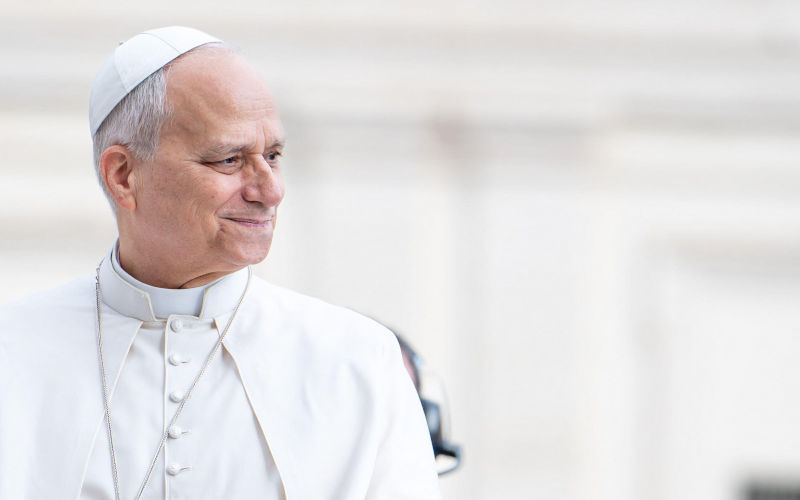
This holy week saw the Catholic Pope, Leo, clash sharply with the American Secretary of War, Peter Hegseth, and by implication his master, Donald Trump about prayers for “overwhelming violence” against the Persians and their allies. God didn’t listen to people calling for violence, said the pope, who has long made clear a general disapproval of Trump actions, including his partnership with Israel in the slaughter of Palestinians, his war against the environment, and his policy of indiscriminate mass deportations against non-citizens from the United States.
Leo has not only attacked the mass deportations by Trump’s department of immigration and customs enforcement – ICE, equivalent to Australia’s Border Force – against immigrants and their children. He, and soon after, the American Catholic bishops in a joint pastoral letter, also attacked what they call “dehumanising rhetoric and violence” and the creation of a climate of fear and anxiety.
Leo, of course, is a true-blue American from Chicago, even if he spent much of his early career as a missionary in South America. His familiarity with the ways of American politics, and the structural deficiencies of US Catholic leadership has not endeared him either to many American bishops, or to Trumpites.
To Leo, the US does not get any moral credit for the belief, held by some, that America was especially selected by God as a sanctuary, much as the garden of Eden before the Fall. This belief is usually known as American exceptionalism. It holds that white protestant settlers had a God-given licence to kill native Americans, enslave black Africans, make peons of Latinos and burn witches. Leo may think instead that the US is especially blameworthy, or that it may have special duties to mankind because it has been given, or has taken, so much.
Leo has seemed to think that America ought to set an example of a Christian culture based on the Sermon on the Mount rather than the Old Testament. He is not attracted to the Hegseth Christian warrior ethos, seeming to have its origins in the crusades and mass slaughter of Jews and Muslims a thousand years ago.
The pope’s criticism irritated Trump, who called Leo “beyond woke”. But at this particular moment of his Thousand Year Reich, Trump is not looking to make fresh enemies among people who voted for him in 2024. America’s House of Representatives has its two-year elections in about seven months, and early opinion polling suggests that Trump could lose control of the House of Representatives, and even possibly the senate. That would spell the end of legislative control by the Republicans, or the Trump Republicans, over the president’s agenda. It could enable Democrats to repeal some Trump legislation, and perhaps to restore some legislation that Trump had effectively repealed, for example important parts of Barack Obama’s health insurance legislation. It could permit the introduction of impeachment actions against Trump himself and some of his officials.
Alienating Catholics could cost Trump control of congress
Control of Congress could give Democrats charge of the investigation agenda, whereby it could launch embarrassing investigations into associations between Republican donations and favours to donors. It could enable further pursuit of the Epstein allegations. If the Democrats got a majority in the senate, it could put an end to deeply partisan judicial appointments and perhaps impeach some supreme court judges over plain and obvious ethical violations, such as the receipt of favours from litigants before the court.
It is far from uncommon for incumbents to lose ground in mid-term elections, but Trump has such a narrow majority in both houses that virtually any loss of seats would deprive him of control. A president without control is a lame duck, virtually unable to promote an agenda, sometimes unable even to preserve in place any achievements already accomplished. Given the partisan bitterness of the Trump terms, how much more delicious than usual it would be for Democrats to make miserable and impotent the end of Trump’s term. Indeed, although it sometimes appears that modern Democrats such as Hillary Clinton and Kamala Harris can hardly help alienating members of the American working class, it could even provide the stage from which the Democrats could sit in the White House in 2029.
Most American Catholics tended to vote strongly for Democrat causes. It was partly a cultural thing, with many Catholics coming of Irish, Italian and Latino stock who learnt quickly the benefits of being organised politically, of trading as voting groups with machine politicians, and, originally at least, of having a clerical leadership dyed in Democrat wool, and angry about centuries of material disadvantage, discrimination and open protestant discrimination against Catholics and Jews.
By the 1960s, however, able Republicans began to find ways of separating some Catholics from the herd. As often as not, it involved stoking resentment among working class Catholics about the “liberal” agendas of some of the well-established Democrat politicians. Liberal, once a word characterising many republicans as well as Democrats, was worked over until it became, for some, a synonym for communist, elitist and anti-American.
Richard Nixon worked over working class resentments about civil rights laws, including school bussing, and crime to claim that he represented a patriotic “red neck” constituency, sick of being bullied by progressive activists seemingly obsessed with identity politics, sexual freedoms and groups claiming victim status.
Ronald Reagan carried on the traditions of mean, in particular decrying the value of collective action rather than individual responsibility, as well as developing smaller government, lower taxing and anti-welfare policies. Bush family presidents may have been somewhat more patrician but had activist operators such as Karl Rove strongly focused on wedging groups around issues based on resentment, and the popular American taste for meanness against those regarded as worse off than thou. In more recent times, the Republican Party fell under the influence of the Religious Right, Tea Party small-government groups, and cultural warriors particularly exercised at a perceived loss of power and status by men, old men, and white men.
It was a part of Trump’s MAGA genius that political strategists such as Steve Bannon and media operators, such as Roger Ailes and Rupert Murdoch were able to create whole constituencies from groups who saw themselves, in Pauline Hanson’s words, as “having had a gutful” of traditional politics, particularly from the Democrats.
Bishops led Catholics away from the Democrats
For a long time, the Republican reach out towards Catholics was assisted by the developing hostility of Catholics bishops towards the Democrats. As in Australia, the animus came in part from the sense that left-of-centre parties were obsessed with rewriting Catholic norms on matters of sexuality, homosexuality and abortion. Their manner of forming new political coalitions based on identity and victimhood were breaking down old tribal obligations.
It did not help that Catholic organisations were being convulsed by scandals of clerical sexual abuse of minors, allegations of cover-up, abuse of power, and putting the material interests of the institution ahead of the needs of victims.
The clerical personalities had long been accused of being more focused (and not very successfully) on personal sexual behaviour ahead of social justice issues such as racism, poverty and public malfeasance. Increasingly, some of these leaders were also in open conflict with Rome over the direction of general church reforms. Some, (in a manner similar to the late Cardinal George Pell in Australia) began talking openly of a Pope and a church that had lost its way, and which had fallen into heresy. The Catholic Church, which had spent most of the 19th and 20th centuries seeming to support local political establishments (including dictators such as Mussolini) and of being hostile to the needs of the poor was seeming to become a nuisance and enemy of the status quo, particularly over injustice, racism, institutionalised poverty, and, to the particular horror of the old farts, the environment.
Leo is by no means the only church leader, even in America, scandalised by the attitudes of some states towards the expulsion of immigrants, and the repelling of refugees. His predecessor, Pope Francis, was also much exercised by this injustice, and very uninclined to see either as a natural incident of political sovereignty, of nationalism, or of white Christian nationalism, the idea that the white “race” was being replaced and had a right of “self-defence” against an “alien invasion”.
Neither Leo nor Francis have disputed a nation’s right to deport, or to control access. What they contest is any idea of a right of indiscriminate deportation, and deportation based - as it obviously is in the US – on racial factors. It sits right alongside the Trump crusade to impose severe restrictions on the right to vote, based on the claim that there is widespread voter fraud. This is a policy, like the poll voting scandals of the 1960s, intended to discourage and deter groups unlikely ever to vote for Trump.
Like bishops everywhere, American bishops are rarely embarrassed about showing their preferences. One can usually take it that a bishop publicly agonising about allowing a Joe Biden to take communion in his diocese, on the grounds that Biden was in favour of a woman’s right to choose abortion, is urging his flock to vote Republican. We do not see many bishops attack the suitability of Republican criminals, tax-dodgers, bribe-takers or persecutors of immigrants, though this may be yet before us if only as a way of an ambitious bishop (they are nearly all very ambitious) to win preferment from Leo. The pope is no longer permitting clerics who are mortal enemies of his papacy to organise against him by stacking the nomination process for bishops.
Leo may have galvanised the American Catholic hierarchy and, perhaps, most Catholics generally against mass deportation policies. But he is strongly opposed by a host of people around Trump who proclaim themselves to be Catholics, and who proclaim that they are acting in accordance with Catholic social ideas.
Among these is the vice-president, JD Vance, a relatively recent convert who has in recent times been publicly reproved by successive popes over his assertion that traditional Catholic duties of charity were intended to operate among one’s own people, rather than to everyone.
Here in Australia, Tony Abbott, as self-proclaimed Captain Catholic, once suggested Catholics “suspend” for a time traditional views about a duty of charity in order to take up the urgent task of repelling and expelling waves of refugee immigration into Europe. It could not be, of course, that if policy urged by Abbott, a super devout ex-seminarian, was clearly against scriptural authority, it was probably wrong. It was not dissimilar to the manner by which Phillip Ruddock once asked the media to stop “humanising” asylum seekers, letting that create popular sympathy and “unreal” expectations. Ruddock is not a Catholic but comes from the religious mainstream.
Strains in the Christian right marriage of convenience
But much more is in question than violently differing views among people proclaiming themselves to be catholic. Some of those in the coalition of groups purporting to support Trump on religious grounds are finding themselves deeply uncomfortable in their marriages of convenience.
The Catholic church is, for example, increasingly ambivalent about so-called Christian Zionists, not least those who think that Israel should be supported because it seems to be mandated in the Bible, and fulfilment of prophecy. It may even, according to the beliefs of some, be part of a magical formula which will bring about the Divine thunderclap. The idea of an apocalypse along the lines of Revelations, let alone an imminent one, is not a mainstream Christian idea, except in the US, where it was invented about two centuries ago.
The Catholic church is also deeply suspicious of Christian nationalism, white Christian nationalism and the so-called Great Replacement theory – the idea that Good Old Christian Folk of European (but not Jewish) background, beneficiaries of European Civilisation, are being supplanted by Jews, blacks and Asians. To Catholics, these are not matters on which Catholics can have sincere but different views, as they might about capital punishment. They are ideas that have been specifically denounced as inconsistent with human dignity and with the message of the gospels.
Some of the ideas in Trump’s circle ought to challenge the conscience of any citizen of the world, let alone a Christian, a Jew, a Muslim, a Hindu, a Buddhist or a person of no religion at all. Consider, for example, both the prayer of Pete Hegseth, Trump’s secretary for war, and the organisation to which he belongs.
The Catholic church is now opposed to antisemitism, and in the modern era regards it, like ordinary racism, as a sin. Those who proclaim that Catholic, and Christian values and ideas are enduring and eternal, not subject to modern relativism, tend to skate around the fact that churches have been “flexible” about such respect for inherent human dignity. The Catholic church, for example, set no great example about segregation of its churches and congregations in the Jim Crow era. Over the past 100 years, it permitted hideous abuse of Jews through Catholic speakers such as Hilaire Belloc and Father Coughlin.
Not all protestants in Trump’s court are Christian Zionists. Some are, instead slaves to another tradition, of fierce antagonism to Jews, and, for many, Catholics as well. But a good many are openly antisemitic, and some adhere to tropes of Jews as Christ-killers. The Christian identity movement, a white supremacist organisation, teaches that Jews are descendants of Satan. This is quite separately from strong criticism of Israel’s conduct in Gaza, Lebanon and Persia, which is not necessarily antisemitic.
I should think that history will not be too kind to the Christians who have attached themselves to the fortunes of Donald Trump. Perhaps some of the dolts may be excused because the US is world headquarters of loopy religions and some – particularly those who have felt themselves attracted to the charisma of Donald Trump – may never have swallowed the fruit of the tree of the knowledge of good and evil. It is hard, however, to excuse the Catholic bromance even on Easter Day.