
Productivity, inequality and the rise of populism
April 1, 2026
The rise in populism in numerous advanced economies has been driven by cost-of-living pressures. To protect our democracy, we will need faster productivity growth and all wages to rise with productivity.
Just over a week ago Pauline Hanson’s One Nation Party came second in the South Australian election with 22 per cent of the vote. This was a major increase on One Nation’s vote a little less than a year ago in the Federal election, when the party only won 6.4 per cent of the vote for the House of Representatives. Nevertheless, that was already an improvement on the around 2 per cent of the vote that One Nation had been winning in elections over the previous decade.
One Nation has few specific policies, but its populist appeal comes from those who feel they are missing out. The One Nation vote is a protest vote by people who say they are fed up, and the lack of specific policies does not worry them unduly.
But why this recent upsurge in One Nation’s popularity now? After all, Australia had been pretty successful in avoiding the increase in polarisation and upsurge in populism that has plagued many other liberal democracies, such as America and some of the European nations for a decade or more.
The common factor that seems to have driven the rise of populism everywhere is “cost of living pressures”.
Until the Covid pandemic, real wages in Australia were increasing sufficiently to avoid cost of living pressures for most people. But today, on average real wages in Australia are lower than they were six years ago before the Covid pandemic. Furthermore, real wages have fallen slightly further since the Albanese Government came to power (See Table 1).
Table 1 Real wage and productivity growth
Average annual rate of change %

The obvious reason for falling real wages and rising cost of living pressures is that productivity is not increasing; even falling (see Table 1). Fundamentally in a market economy it is productivity that determines people’s living standards, and if productivity is falling then it is most likely that real wages and living standards are falling too.
No wonder productivity is at the centre of Treasurer, Jim Chalmers’, discussions about economic reform.
Following a request from the Treasurer, a few months ago the Productivity Commission released a series of reports on how to restore our rate of productivity growth, with recommendations covering:
- Corporate tax reform to spur investment and regulatory reform to promote business dynamism.
- Reforms to improve workforce skills and adaptability.
- How to better realise the productivity potential of data and digital technologies.
- The more efficient delivery of quality care services
- Investing in cheaper, cleaner energy and the net zero transformation.
These recommendations by the Productivity Commission generally make good sense, but whether they will be sufficient to restore past rates of productivity growth and improvement in living standards is, I think, quite uncertain.
As I have written previously, through history it has been the impact of major new technological breakthroughs that has been overwhelmingly responsible for productivity growth.
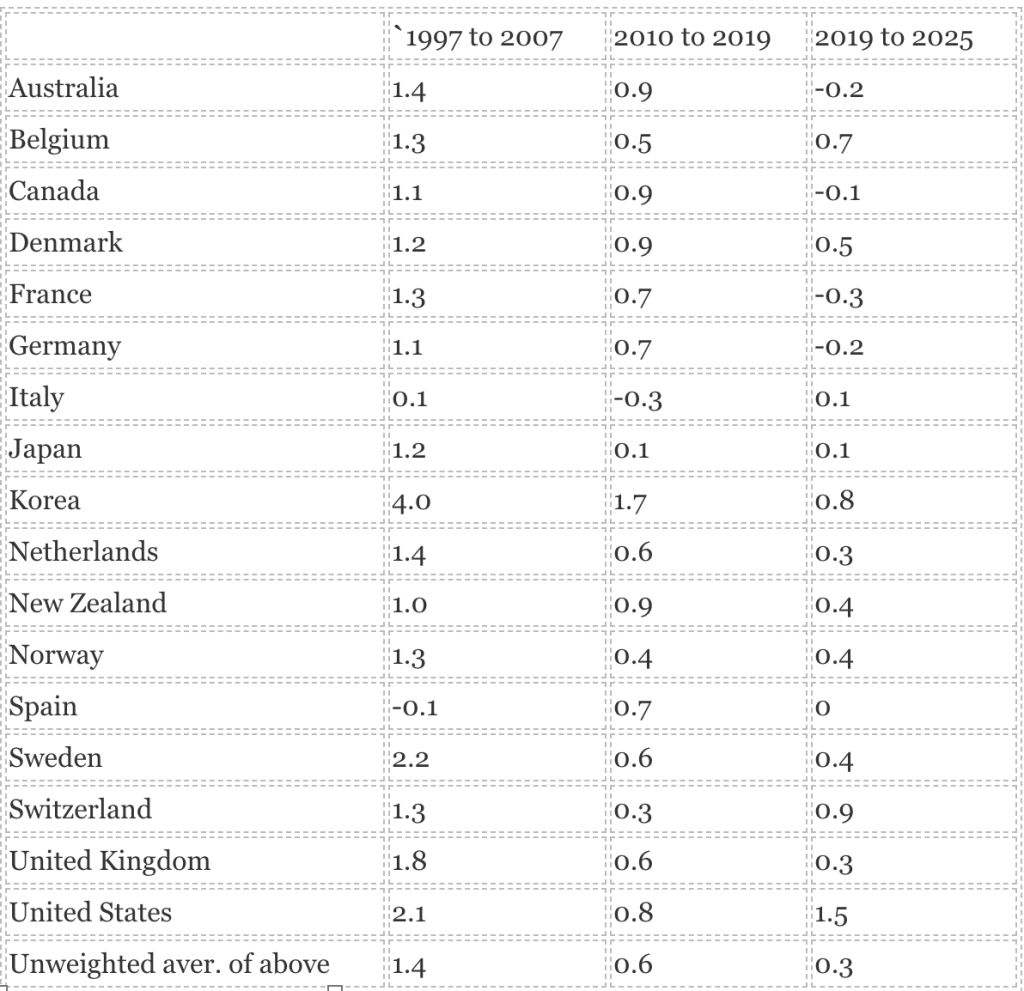
Furthermore, if government policies could make much difference to the rate of productivity growth then we would expect to see more difference between the experience of different countries. However, as Table 2 shows the slowdown in productivity growth since the Global Financial Crisis, with even less productivity growth in the 2020s, has affected all the advanced economies, including Australia, to much the same extent. And this common productivity experience is because all the advanced economies adopt new technologies at much the same time and rate.
Table 2 Labour Productivity Growth
Average annual percentage change
Nevertheless, if we are concerned about living standards, then there is one other important point to note besides the impact of the rate of technological innovation on productivity and living standards. As Nobel Laureates Daron Acemoglu and Simon Johnson have documented in their book, Power and Progress: “the idea that new machines and production methods that increase productivity will also produce higher wages is false”. In fact, “the last thousand years of history are filled with examples that brought nothing like shared prosperity”.
Instead, “How productivity benefits are shared depends on how exactly technology changes and the rules, norms and expectations that govern how management treats workers”. So, “shared prosperity gains emerge because, and only when the direction of technological advances and society’s approach to dividing the gains are pushed away from arrangements that primarily serve a narrow elite."
In this regard, it is interesting to compare the different responses of Australia and the US to the automation of production from the early 1980s to the 2010s. In both countries – as elsewhere – middle-level jobs were hollowed out, but Australia took a much more responsible attitude to reskilling workers.
Inequality increased as automation changed the distribution of jobs in both countries, with more high paying and low paying jobs and fewer in the middle. However, in the US relative wage rates also changed as the supply of skilled workers did not keep pace with demand.
The rising cost and limited opportunities within the US education system meant that the wage premium for US college graduates doubled over the next few decades compared to the 1970s. In contrast, in Australia over the same period relative rates of pay did not change much for most occupations over the same period, principally because tertiary education opportunities expanded rapidly.
As a result, the increase in inequality during the last couple of decades of the twentieth century was much higher in America than in Australia.
Furthermore, as Stephen Bell and I document in our book, Fair Share, the link between productivity and real wages broke down in the 1970s in the US. As a result, the typical American male had a lower real wage in the 2010’s than he (or his grandfather) had 45 years before.
By comparison, in Australia, and unlike most other advanced economies, in the long term the rate of real wage growth has broadly matched the rate of increase in labour productivity.
Thus, the pressure in America and some European countries on workers’ living standards started much earlier. This seems likely to explain why populism was a force much earlier in the US, with Trump being elected by his MAGA movement as far back as 2016 while One Nation hardly mattered back then in Australia.
Our problem is not so much a rise in inequality of incomes and/or a fall in the share of wages, but the fact that productivity is not increasing in Australia in recent years. In that case our best hope is that there is a new technological breakthrough, with AI being the best prospect.
Unfortunately, however, at this early stage we cannot be certain about the impact of AI on productivity and therefore on living standards. But what we do know from experience is that if we want to avoid a further fallout and increased cost of living pressures for the relatively unskilled workers, then as Acemoglu and Johnson say, we must ensure an institutional setup that induces “a direction of technology that creates new tasks and jobs for workers of all skill levels and an institutional framework that enables workers to share productivity increases with employers and managers."
While this requirement may seem like a diminishment of management authority and rights to some, Acemoglu and Johnson argue that managers could boost worker productivity by reducing the focus on automation and instead providing better information and platforms for collaboration and creating new tasks.
And most importantly, unless government actively supports this sort of collaboration in the workplace, we risk lower productivity and a biased distribution of the benefits, leading to a further increase in polarisation and populism that threatens our democracy.