Support first, questions later: Australia and the Iran war
April 1, 2026
Australia was quick to back US action in Iran. But as questions mount over strategy and legality, the risks – and consequences for allies – are coming into sharper focus.
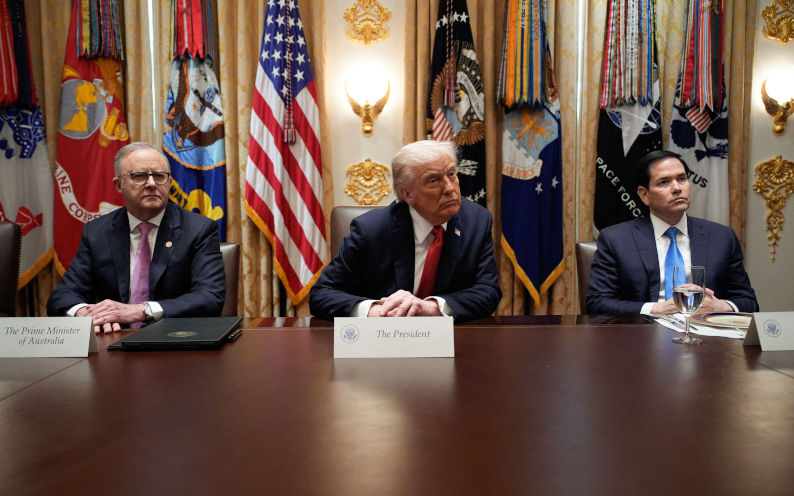
It is just a month since America and Israel unleashed their air assault on Iran. Prime Minister Albanese rushed to be the first global leader to support it. But he just appeared on ABC TV complaining about “uncertainty in US objectives”. What he is saying is that he regrets his vulgar haste and wants the US to stop.
Albanese has spent his political life creeping around with smoke and mirrors. When he tells us that Australia sent an AEWC aircraft to the Gulf for defensive purposes he really means that it is an essential part of that US and Israel air attack on Iran. Probably, he is now concealing a US request for a second aircraft, to replace one recently vaporised by Iran. But that would blow his cover, so America will be getting gobbledegook too.
Anthony Albanese is without peer amongst those Australian Prime Ministers who have sought to be first in line in supporting America in creating a disastrous conflict. The Iran war could be America’s most egregious adventure yet – one-sided as usual, but maximising that asymmetry with nuclear weaponry. As usual, allies will get shafted big time.
We were reminded by the visiting German Defence Minister last week (26 March) of how a responsible nation would approach this US war. He evaluated the Iran war as reckless, without any stated objective and lacking any coherent strategy for resolution. The German President declared that the US war on Iran violated international law.
It beholds us to examine these questions, ritually, just as Australians have done for over a century of other’s wars.
First, what could the US objective be in this war? Belatedly, Secretary of State Rubio advised us what he thinks: “the objectives of this mission have been clear from the very first night the President announced it. We’re going to destroy Iran’s navy, destroy their air force. We are going to basically destroy their ability to make missiles and drones in their factories. And we’re going to substantially – and I mean dramatically – reduce the number of missile launchers so that they cannot hide behind these things to build a nuclear weapon and threaten the world.”
Rubio says everything’s under control: “we are on or ahead of schedule in that operation and expect to conclude it at the appropriate time here, in a matter of weeks, not months, and the progress is going very well. Obviously, we have some work to do. We have to finish the job, and we are finishing that job.”
“When we are done with them here over the next couple of weeks, they will be weaker than they’ve been in recent history. And they will not be able to hide behind those weapons to break out and get a nuclear weapon, which would be crazy.”
So, there we have it – the objective is to disarm Iran so that it cannot develop a nuclear weapon, without dealing with its vast army. The US exit should begin in a few weeks.
Thereafter, America will take a back seat. Getting the oil rolling again will be left largely to the “allies” (including Australia of course) – “immediately after this thing ends and we’re done with our objectives, one of the immediate challenges we’re going to face is an Iran that may decide that they want to set up a tolling system in the Strait of Hormuz. ….it’s important that the world have a plan to confront it. The United States is prepared to be a part of that plan. We don’t have to lead that plan."
In a nutshell, the United States plans to be out of combat in Iran, having devastated its defences except for its exceptional army, within a few weeks. But Iran will still be functioning, collecting tolls on vessels passing though Hormuz. That’s where European and Asian allies come in – establishing and defending what’s required to make the oil flow out of the Gulf for free. While Iran’s vast army remains intact.
Never mind that a zillion other things don’t add up – like the US paratroopers and marines in transit who won’t be in place for combat for weeks. And what of the nuclear facilities deep underground in the Zagros mountains? The only way of tidying that up would be thermonuclear attack. Trump has raised it, and would be drawn to the image of a second proud Samson President. As former Secretary of State Madeleine Albright once asked: “what is the point of having such a powerful military force if one doesn’t use it?”
Too bad about the radiation cloud making its way across allies in Europe.
Trump will present new horrors daily – like the recent threat to obliterate Iran oil production on Kharg Island.
The upside is that it will be great conditioning for Australians when we join America’s main conflict with China. Every Australian government since Gillard has deepened our entrapment. What hope a quiet, out-of-the way continent with leaders like this?