The world acts for oil – but not for human life
April 13, 2026
Global powers moved quickly to end a war that threatened energy supplies, while years of mass civilian suffering in Gaza has failed to prompt meaningful action.
Forty days of direct confrontation between Israel and the United States on one side and Iran on the other were enough to make the entire world tremble in pain and fear, prompting an immediate and forceful diplomatic and military push for a ceasefire. This urgent mobilisation did not stem from a sudden awakening of conscience or a genuine desire to stop the bloodshed in the region. Rather, it was an instinctive response to a threat aimed at the very lifeline of both East and West.
Although those 40 days witnessed casualties, the cries of children, and immense civilian suffering, this anguish was not the true driver of international intervention. The bitter truth is that the world moved because its fuel reserves were at risk. The looming oil and energy crisis, threatening modern lifestyles and consumer comfort, compelled major capitals to exert serious pressure to end the war.
Global awareness awakened suddenly, not to defend the human right to live, but to protect the machine’s right to keep running, and the western citizen’s right to heat their home and drive their car without rising costs.
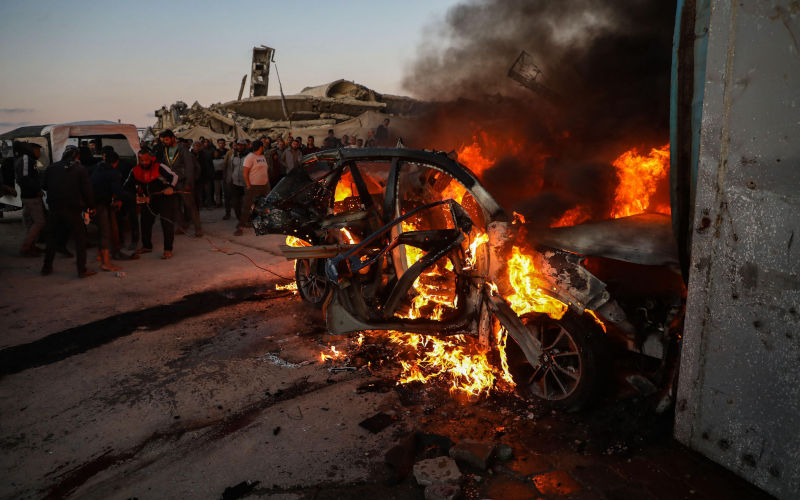
The global state of emergency to end a conflict lasting only weeks because it disrupted energy supplies stands in stark and shameful contrast to what is happening elsewhere. For over two years, Israel has waged a comprehensive war of annihilation against the Gaza Strip, reducing it to ruins and killing and injuring more than a quarter of a million civilians. Yet the world has failed to stop the killing machine.
For more than two years of systematic destruction, innocent blood has flowed on the streets of Gaza and Lebanon, and the world has stood by. The international system has limited itself to hollow diplomatic statements and pale condemnations that neither address the core of the crime nor produce real change on the ground. Experience has shown that Palestinian blood does not possess the viscosity needed to halt the gears of global politics, while oil has the power to mobilise armies and reshape alliances in an instant.
In Gaza, the United States and many of its allies blocked any binding resolution for a ceasefire. World leaders rushed in long lines to declare unwavering support. We saw President Joe Biden, followed by Donald Trump and his Secretary of State Marco Rubio, former British Prime Minister Rishi Sunak, German Chancellor Olaf Scholz, European leaders such as Ursula von der Leyen and Giorgia Meloni, as well as leaders from India and Eastern Europe. All came to grant Israel legal and political protection, supplying it with weapons, funding, and a veneer of moral justification, while children’s bodies were torn apart beneath the rubble and famine consumed those who survived.
At the heart of this tragedy lies the way global governance has redefined the concept of existential security. In today’s political mindset, existential security is no longer about safeguarding humanity from destruction, but about ensuring the uninterrupted flow of material resources. When the Strait of Hormuz was closed for several days, people in Paris, London, and New York felt their existence was under threat, not because their homes might be bombed, but because the machinery of capitalism that sustains their comfort might stall.
The world does not act today out of moral opposition to war, but because war has become economically costly. In Gaza, Lebanon, and Sudan, massacres occur in regions that global capitalism can isolate or ignore without affecting the Dow Jones index or the share value of major technology companies. The blood of these children does not halt a factory in Germany or disrupt an electronics shipment from China. Therefore, the global conscience can remain in deep sleep for years.
However, in a regional conflict that threatens energy sources, the equation changes completely – war becomes materially irrational because it undermines the existential security of the western citizen, who places supreme value on personal comfort. The frantic push to halt the Iranian Israeli conflict is not a victory for global peace, but a victory of the barrel over the soul, of the engine over the heart.
What we are witnessing today is a clear and complete shift toward a purely material world, where human beings no longer hold intrinsic value, but are valued only for what they consume or produce within this system. When a barrel of oil becomes more important than the lives of thousands of children, and when the comfort of the global north justifies silence over the hunger of civilians in the south, humanity effectively declares that it has shed the last threads of its moral fabric.
Israel has repeatedly drawn the world into endless conflicts, and each time the world has been willing to pay the price in innocent blood, so long as the cost remained distant from the pockets of major powers. Yet the moment an energy crisis cast its shadow, everyone stepped back and said, “This is not our war.” This retreat was not an awakening of reason, but the result of precise financial calculations.
The harsh lesson of the past two years, especially when compared to the last 40 days, is that the current global order suffers from a deep structural moral failure. Human rights are respected only when they do not conflict with interest rates and gas flows. A world that moves for oil but does not stir for blood is a world heading toward moral collapse. Even if it fills its tanks with fuel, societies that lose their humanity will find no machine capable of repairing their shattered consciences.
