
Overpopulation is pushing Earth past breaking point
April 13, 2026
Scientific evidence shows humanity has exceeded Earth’s long-term carrying capacity, placing growing strain on the systems that sustain life and increasing the risk of global instability.
The greatest threat to our children and grandchildren is… more people.
Planet Earth now has three times more humans than it can carry in the long term, according to a team of internationally-renowned scientists.
The human species is presently on track for a peak population of 11-12 billion by the 2070s – four or five times more that the Earth’s biological capacity can support, they warn. The maximum human population the Earth can maintain is around 2.5 billion.
“The Earth cannot sustain the future human population, or even today’s, without a major overhaul of socio-cultural practices for using land, water, energy, biodiversity, and other resources,” the study concludes.
The team, led by Australian Professor of Global Ecology Corey Bradshaw, included the late Professor Paul Ehrlich, who died last month aged 93, and Matthis Wackernagel, one of the originators of the Global Footprint Network which measures human impacts on the Earth system.
Their paper Global human population has surpassed Earth’s sustainable carrying capacity echoes numerous parallel conclusions over many years, starting with Ehrlich’s controversial _The Population Bomb_ (1968), with the Club of Rome’s _Limits to Growth_ report (1972), and William Catton’s book _Overshoot_ _(_1980). Most recently, the Potsdam and Stockholm Institutes have warned that humanity has exceeded seven out of nine ‘safe planetary boundaries’ essential to our future survival.
The common thread running through all these warnings is that having too many people destroys the living environment that supports them. That, put simply, is the definition of overpopulation: numbers and consumption that demand more from nature than it can furnish. Scholars argue whether overpopulation or overconsumption, or the two together, is most at fault – but the conclusion is the same. There are far more and greedier consumers than the Earth can carry – and that spells disaster for everyone.
This latest warning points out that humans as ‘the ultimate ecosystem engineers’ have managed to inflate the envelope of resources needed to support us by importing energy from the deep past (aka fossil fuels) – but the envelope is not infinitely elastic. At some point the balloon will burst and key resources, like water, soil, timber, fish, ecological or climate stability will crash.
“Fossil fuels have pulled the wool over our eyes by allowing us to go way beyond the natural ability of the planet to support us,” Professor Bradshaw observes.
“Earth cannot keep up with the way in which we are using resources. It cannot support even today’s demand without major changes. Our findings show that we are pushing the planet harder than it can possibly cope,” he adds.
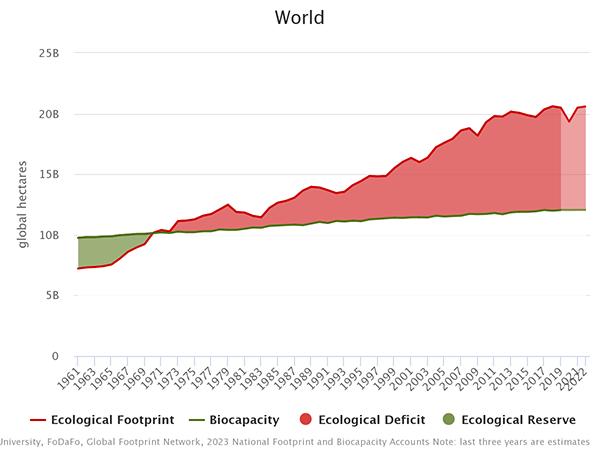
This is resulting in what the researchers term a ‘biocapacity deficit’ caused by our living beyond the Earth’s renewable biological resources. This deficit began in the early 1970s.
“We’re going to hit the wall no matter what we do – the only question is whether we hit it at full speed, or at a much slower speed,” Bradshaw says. “Either way, it will be a dreadful time: just how dreadful depends on the decisions we take today.”
That the process of breakdown is already underway was noted by the Global Challenges Foundation in its 2026 report on Catastrophic Risks.
Humans have already responded instinctually to the pressures created by overpopulation by halving the birthrate, which has fallen from 5 babies per woman to 2.3 since the mid-twentieth century. Today, only parts of Africa, the Middle East and Central America have birthrates above replacement (2.1 babies/woman) – everywhere else there is a strong tendency for births to decline. Many younger adults are openly declaring they wish to remain child free.
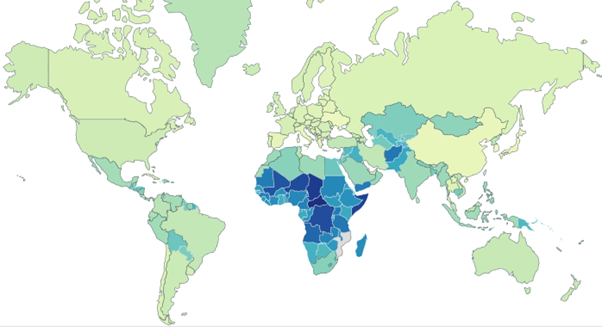
However, the world population is still growing at around 70 million a year because women born 20 years or more ago are now entering the peak of their fertility – but this effect will taper off over the next 20-50 years.
“Humanity’s current path will push societies into deeper crises unless we make major changes,” Bradshaw warns. “The planet’s life support systems are already under strain and, without rapid shifts in how we use energy, land, and food, billions of people will face increasing instability. Our study shows these limits are unfolding right now.”
To take a single example: it now takes 12 kilos of topsoil, 950 litres of water, 1.6 litres of diesel, 1g of highly toxic pesticides and 4.9 kilos of carbon emissions to feed one person for one day. And there are 8,260,000,000 people on the planet. This process is destroying the Earth’s ability to feed us. Similar processes are destroying the availability of fresh water, timber, fish, clean air and a healthy life for children.
Such warnings have been greeted with scepticism and denial ever since the Reverend Malthus first pointed out that food production (in the 18th Century) tended to grow in a linear fashion whereas population could grow exponentially. Their critics rarely have any scientific understanding – but often a selfish motive for denying them. For example billionaires, like Elon Musk and the pronatalists, fear that lowering the human population will curtail their personal ability to amass wealth and control people’s lives.
They ignore, or do not care about, the actual consequences of overpopulation:
- The risk of civilisational collapse increases markedly;
- global heating and global poisoning both accelerate;
- unborn children have fewer rights and fewer resources;
- child sickness and deaths increase;
- poverty increases in all overpopulated countries;
- food becomes scarcer and more expensive, child malnutrition more common;
- water starts to run out in big cities; and
- forests vanish, ocean dead zones spread … and many more.
On the other hand, the cost of providing family planning to every woman on Earth is less than the cost of a single nuclear submarine and would empower humanity to lower its population voluntarily. According to demographer Dr Jane O’Sullivan such an investment would save lives, reduce poverty, improve water and food security, and many more benefits beside.
As things stand, every child born today and for the next four decades subtracts from the rights and prospects of every other child, itself included, as the Earth moves deeper into biocapacity deficit.
Humanity has but two choices: to voluntarily lower its population towards 2.5 billion as quickly and fairly as possible or to allow collapse to occur naturally – and suffer the consequences.