War talks, danger for peacekeepers, and the ‘great insulation’ – Asian Media Report
April 10, 2026
Iran prefers Vance as lead negotiator, Indonesia’s Lebanon Blue Helmets ‘targeted’, developing countries seek superpower autonomy, Japanese troops join Philippines’ exercises, power centralised in Vietnam, and alarming loss of forest cover.
West Asian media adopted a note of triumph over Pakistan’s crucial diplomatic role in negotiating a ceasefire in the US-Iran war and organising talks between the two countries.
Journalist Khurram Husain wrote in Pakistan’s Dawn newspaper that he felt proud to be Pakistani. “This is, quite possibly, the biggest single day in the life of our country,” he said.
Writing in Al Jazeera, columnist Andrew Mitrovica said the thuggish logic of the US and Israel – logic that said enough pain can bend any nation to their imperial designs – had failed. “Today, to borrow a phrase, we are all Iranians,” he wrote.
The triumph was tempered when the US and Israel took the position that the two-week ceasefire did not include Lebanon. The Express Tribune reported that Pakistan would work on including Lebanon and Yemen during the Iran-US talks. The paper quoted Pakistan’s former ambassador to the UN, Maleeha Lodhi, as saying Pakistan had specifically asked the US if it could rein in Israel and were given an assurance that American would do so.
Indian media had a more sober tone. International affairs expert C Raja Mohan, writing in The Indian Express, said the pause in fighting was welcomed but the path ahead remained forbidding.
The massive divergence between the declared positions of the two sides – Washington’s 15-point proposal and Tehran’s 10-point counter – framed the challenge.
Mohan listed five entrenched contradictions – on Iran’s nuclear enrichment program and ballistic missile arsenal; the status of the Strait of Hormuz; Iran’s demand for the lifting of all sanctions; its support for regional allies (or proxies, as the US calls them); and the future regional security architecture (Iran is demanding the complete withdrawal of the US military presence in the region).
“Any attempt to finesse these contradictions will require not only bridging the gap between Washington and Tehran but also navigating divisions within each capital and between the US and its regional allies,” Mohan said.
Dawn published background details of those taking part in the Islamabad talks: Iranian Foreign Minister Abbas Araghchi; Iran’s parliamentary Speaker Mohammad Bagher Ghalibaf; US Vice-President JD Vance; Special Middle East Envoy Steve Witkoff; and Trump son-in-law Jared Kushner.
Iran preferred Vance as lead negotiator, Dawn said, not least because of his earlier position favouring military restraint.
Note: China has regained its position among ASEAN people as the preferred superpower, Singapore’s The Straits Times, reported. An annual state of Southeast Asia survey showed concern over Trump's foreign policies outweighed worries about Chinese aggression in the South China Sea, the paper said.
Jakarta’s peacekeepers caught in a war zone
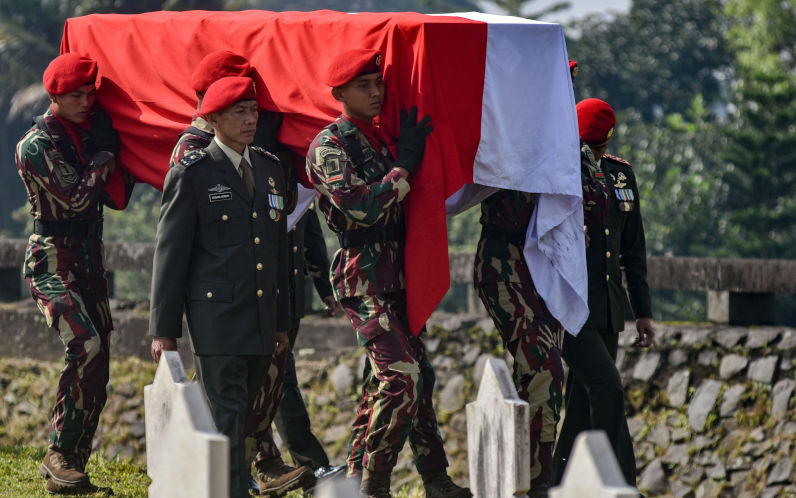
With a peacekeeping force of 755 personnel, Indonesia is the largest contributor to the operation known as UNIFIL – the UN Interim Force in Lebanon. Indonesian peacekeepers have been in Lebanon for almost 20 years; their bases, posts, convoys and convoy routes are well-known.
Yet they were hit by three attacks between 29 March and 3 April.
It raised a big question, said Indonesian defence analyst Muhammad Fauzan Malufti – whether the contingent might have been deliberately targeted, rather than simply caught in the crossfire.
The first attack, in which one peacekeeper was killed, was against a post that had served as the headquarters for Indonesia’s mechanised battalion since 2009. The second, in which two others were killed and five injured, was an explosion that hit a UNIFIL convoy. The vehicles were well-marked and the convoys operate in the area routinely. The third, a blast that injured three more soldiers, was close to the Blue Line meant to separate Israel and Lebanon.
Writing in The Diplomat, Malufti said some legislators were calling on the government to withdraw Indonesian troops from Lebanon. He said the deaths could reinforce Indonesia’s growing hesitation over its highly controversial involvement in Donald Trump’s Board of Peace for Gaza.
“Even before these incidents, Jakarta had already begun to distance itself from the Board, following US and Israel strikes on Iran,” he said. “It has paused discussions on the initiative and postponed plans to send troops to Gaza as part of the board’s international stabilisation force.”
One influential figure calling on the UN to end UNIFIL’s deployment, or to relocate them away from the raging battlefield, is former Indonesia President Susilo Bambang Yudhoyono. He said the Blue Line had turned into a war zone as Israeli troops advanced more deeply into Lebanon, The Jakarta Post reported.
The area had become too dangerous for the Blue Helmets. Their role, he said, was peacekeeping, not peacemaking.
Yudhoyono was the president who first deployed the peacekeeping detachment – in 2006.
Emerging nations feel the heat of US-led order
The US-Israel war on Iran has delivered the Gulf States the opposite of the promise offered by America’s military presence in their countries. It has catalysed turmoil instead of anchoring stability. US allies in the Gulf are paying the price of Washington’s decisions.
This is the view of Chinese commentator Zhang Zhipeng. But it is part of the bigger picture, a window on how the US-led order works. “It functions like an air-conditioner – cooling the American centre by pumping hot air into the periphery,” Zhang says.
Aggressive interest rate rises export inflation to emerging markets, he says in an article in Hong Kong’s South China Morning Post. Proxy wars outsource geopolitical risks. The US, he says, stays cool while the Global South absorbs the heat.
But a “ great insulation” is coming, he says. Developing nations are securing defence autonomy, fostering geoeconomic resilience and asserting resource sovereignty. Small and middle powers are building a firewall. “The goal is not to isolate but to insulate,” he says.
Zhang is a research fellow at Shanghai’s Fudan University. He specialises in the philosophy of technology, AI geopolitics and comparative Chinese-Western cultural studies.
The Middle East, he says, makes the most telling case for the coming “great insulation”. Treated for decades as a staging ground for great-power proxy conflicts, the region in recent years has been reclaiming geopolitical agency.
In 2023, Saudi Arabia and Iran reached a rapprochement, brokered by China, ending seven years of hostility.
Yet, the Gulf states found themselves in the crossfire of the US-Iran war, despite calling for de-escalation.
But geoeconomic insulation is accelerating, Zhang says. It is more accessible than military autonomy.
In Southeast Asia, for example, Indonesia financed the Jakarta-Bandung high-speed rail without any Western capital.
ASEAN, he says, promotes intraregional trade via local currencies and it now accounts for 15 per cent of transactions. Project mBridge, a settlement platform backed by the central banks of China, Thailand, the UAE, and Saudi Arabia, plus the HK Monetary Authority, has processed US$55.5 billion (A$78.8 billion) over 4,000 transfers.
This is dwarfed by the trillions processed each day by the SWIFT system, he says, but the significance of such nascent networks was proof of concept.
“Global South nations are choosing multi-alignment to achieve agency,” Zhang says. “They are not choosing one power over another – they are choosing pragmatism over power politics.”
Tokyo’s plan to strengthen Pacific defence
Japanese troops are making history, taking part for the first time in exercises held each year between the US and the Philippines – and also involving Australia.
The drills are being held as Manila positions itself as a regional hub for joint military activities between nations concerned about China’s military expansion.
It is the first time Japan has sent combat-ready troops to the Philippines since World War II.
More than 400 Ground Self-Defence Force troops have joined the exercises, known as Salaknib and held by the US-led Joint Pacific Multinational Readiness Centre.
The drills will run until 20 May.
The Japan Times said 4,400 Philippines troops, 2,800 US personnel and smaller contingents from Australia and New Zealand were also taking part.
The exercises would include the annual Balikatan drills, involving forces from the US, the Philippines, Canada, Australia, France and New Zealand – plus Japanese Ground and Maritime Self-Defence Forces. Japanese forces were also expected to be involved in drills with US and Philippines troops in June and July.
In a separate story, the newspaper said Japan planned to strengthen its Pacific Ocean defence system. Japan’s defence surveillance and warning systems are focused on the Sea of Japan and islands to the southwest, including Okinawa, to counter threats from North Korea and China.
“A vast area on the Pacific side is a defence vacuum,” Defence Minister Shinjiro Koizumi told the media.
China was believed to be boosting blue-water capabilities, the paper said. It was said to view the so-called second island chain, from Japan’s south-eastern Ogasawara Islands down to Guam, as a defensive line against the US.
Last year, China deployed its aircraft carriers Liaoning and Shandong to the area at the same time.
“The situation made Japan recognise the urgent need to strengthen the functions of [Self Defence Force] bases and develop a radar network in the Pacific,” the newspaper said.
End of Hanoi’s collective leadership
Tô Lâm, the chief of Vietnam’s Communist Party, has been elected president – a dual-role governing structure similar to that of China, where Xi Jinping is party general-secretary and president.
It spells an end to Vietnam’s system of collective leadership.
Lâm was elected this week by the National Assembly, with 100 per cent support from the 495 delegates present.
Leaders, including Lâm, have held both positions in the past but only temporarily. The last leader to fulfil the dual roles on a long-term basis was Ho Chi Minh, from 1951 until 1969.
A story in The Diplomat said Lâm’s consolidation of the two roles raised concerns about the erosion of Vietnam's collective leadership model that largely succeeded in preventing concentration of power in one individual.
A report in Nikkei Asia, the online politics and business magazine, said Vietnam had traditionally been ruled by “four pillars” – the party leader, the nation’s president, the prime minister and the National Assembly chair. Lâm now held two of the roles.
The story said Lâm was unhappy with Vietnam's stuttering economic growth and had ordered officials not to let delays hold up development.
In his inaugural address, Lâm listed his priorities as promoting rapid and sustainable development, maintaining a peaceful and stable environment, improving people’s living standards and contributing to regional and global peace, Vietnam News, a national daily newspaper, reported. He underscored the need to develop an independent, self-reliant and resilient economy, the paper said.
An analysis in ucanews.com, the Catholic Asian news site, said Lâm’s election to both roles marked a significant moment in Vietnam’s political evolution. The change represented a shift in how power is organised, at a time when the country was pursuing ambitious economic goals and navigating an increasingly competitive global landscape, the story said.
Vietnam’s collective leadership had helped maintain internal balance but it could also slow decision-making at times that required speed and co-ordination.
“Yet speed alone does not define a resilient system,” the analysis said. “The deeper question is whether a more centralized structure can still correct itself when necessary…Who can say ‘no’ when a policy begins to drift off course?”
Big projects accelerate forest loss
Indonesia is suffering from a loss of forest cover at a rate an editorial in The Jakarta Post says is alarming.
After several years of declining deforestation, Indonesia went backwards in 2025, the editorial says. Last year, more than 430,000 hectares of forest were cleared, a 66 per cent increase over the loss in 2024.
“This rate reverses nearly a decade of progress made since 2017, when annual losses remained below the 300,000ha threshold,” the paper says.
The editorial springs from a report by a non-governmental environmental watchdog called Auriga Nusantara. The paper says Kalimantan is of primary concern but Papua experienced the most dramatic spike in deforestation – a fourfold increase in clearing over 2024.
The paper attributes the rise to President Prabowo Subianto’s ambitious pursuit of energy and food self-sufficiency. The primary drivers of this ecological destruction are massive rice and sugar cane estates, which are designated National Strategic Projects.
The paper says the reports are particularly alarming as thousands of people in the provinces of Aceh, North Sumatra and West Sumatra are still struggling to recover from last November’s devastating floods and landslides. News reports at the time said deaths came to more than 600, while about one million people were evacuated.
“The severity of these disasters is widely believed to have been exacerbated by the loss of northern Sumatra’s forests to industrial plantations and commercial expansion,” the editorial says… “[T]he benefits gained from cutting down forests are usually reaped by a few political and business elites in Jakarta.
“The government must stop viewing forests as empty spaces to be utilised at will for personal gain.”