Why “drill baby drill” won’t solve Australia’s energy problem
April 13, 2026
Calls to expand fossil fuel production ignore Australia’s real energy vulnerabilities, while electrification and renewables offer a clearer path to lower costs and greater security.
The leader of the National Party might have recently conceded that he has a secret love of Teslas and wouldn’t mind owning one of Elon Musk’s electric cars, but that doesn’t mean for a minute that he’s made the link between electrified transport and energy sovereignty.
“If we’re going to have a wake-up call we should just get back to drill baby drill,” Matt Canavan told Sky News last month, in an interview about the regional fallout from the US and Israel invasion of Iran.
“The world is run by fossil fuels,” Canavan said. “We need strategic oil and gas production so that we can keep our country moving whatever happens overseas.”
Apart from being a remarkably frank distillation of the Queensland senator’s world view, Canavan’s Trumpistic rantings on energy have little basis in reality – not Australia’s reality, anyway.
Happily, a major new report published this week sets out why this view is wrong-headed – as well as what the federal government needs to do, or continue doing, to unshackle Australia from the grips of the endless global fossil crisis cycle.
The Climate Council report, published on Thursday ahead of the May federal budget, urges the Albanese government to keep incentivising the uptake of electric vehicles and home solar and batteries, and shifting the grid to a majority mix of wind, solar and battery storage, while also calling for new measures to step up the pace of the economy-wide decarbonisation journey that is already well underway.
Importantly, the report also sets out why the policy slogans being trotted out by opposition Coalition members and the fossil fuel lobby will not solve the problems Australia faces, on repeat, every time global energy supplies are disrupted. And why now, more than ever, the true solution is there for the taking.
For instance, on the matter of oil, the report notes that Australia does have a large resource of what is known as oil shale, which “often causes misconceptions” about its place in the global oil supply chain.
“Unlike liquid oil reserves, oil shale is a petroleum source rock which has not undergone the complete process to become oil. It requires mining and industrial processing to extract oil, and is one of the highest cost sources of oil. Australia currently has no oil shale production.”
Canavan has also suggested that answer lies in building new oil refineries – a option he claims is a relatively fast and “easy” way to secure Australia’s fuel independence compared to developing new oil fields. But this claim, too, is challenged.
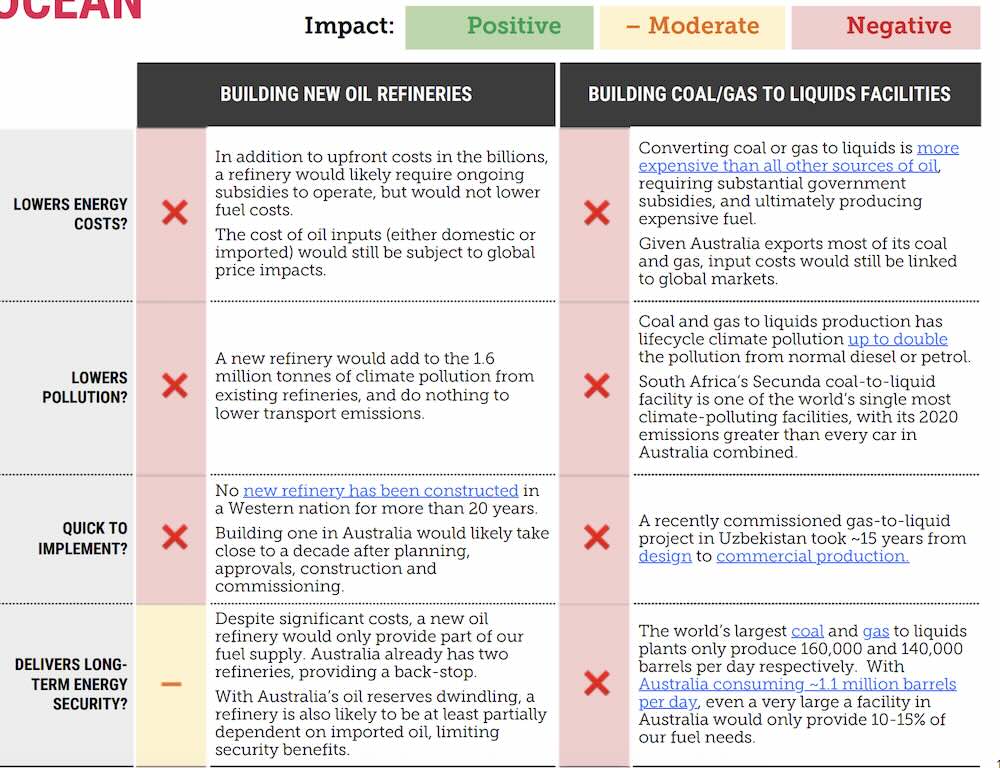
“I find it ludicrous that the Liberal National Party is advocating in 2026 for massive Australian government subsidies for new refineries given, under their watch in government, we dropped from six to two refineries,” Climate Energy Finance director Tim Buckley told Renew Economy.
“Australia is [not] producing anywhere near enough of our own oil or diesel to actually sustain our economy. So I find it absolutely hypocritical … that the party of ‘small government’ is advocating for massive ongoing taxpayer subsidies to invest in new white elephants that would take at least a decade to be built,” Buckley says.
“They do nothing for Australian energy security in the next decade, at a time when [electric vehicle] technology and battery technology is probably the most profound disruption globally in 2026 and we could be replacing $50 billion a year of annual diesel and oil imports with home grown, clean, low cost, deflationary Australian energy.”
According to the Climate Council report, Australia’s current fleet of almost 1.3 million fully-electric or hybrid-electric cars, utes and vans – comparatively small though it is – reduces national use of petrol and diesel by almost 15 million litres every week.

Meanwhile, consumers with petrol and diesel vehicles are feeling the pain of a far-flung global conflict. In March alone, the report says, the Iran invasion-driven increase in fuel prices cost Australians more than $1.05 billion in increased costs at the pump.
And even if Australia could readily – and economically – increase its domestic fuel supply the Climate Council argues that this is unlikely to do anything to insulate Australian fuel prices from global shocks.
“Australians pay international prices for coal, oil and gas – and increasing supply won’t break this link,” the report says – just take gas as an example.
“Australia already produces five times more gas than we need,” the report says. But “since we started exporting gas from the east coast, gas prices have almost quadrupled. This is despite declining production almost tripling, and demand falling 10 per cent.
“Extracting more gas would only hand more profits to multinational gas corporations, and lock in more expensive and polluting gas for longer.
“History shows that this won’t increase energy security or reduce prices in Australia, and will only increase corporate profits and climate pollution.”
Greg Bourne, a former BP executive and energy advisor to UK Prime Minister Margaret Thatcher – and now a Climate Councillor – says its time to embrace the future, “not cling to the past.”
“Unlike the global oil crises of the 1970s, this time there are cheap and abundant alternatives to fossil fuels: renewable energy and electric vehicles are already widely deployed. We just need more,” Bourne says.
“The sun doesn’t care about the Strait of Hormuz and the wind doesn’t care who’s in the White House.
“The Australian government is better placed than most to capitalise on renewable energy solutions. That would be the best response. The worst response would be to double down and commit to long-term investments in the fuels that are driving the price rises being felt by every Australian right now.”
Among the key budget measures the Climate Council wants to see is the continued use of fringe benefits tax exemptions to encourage EV uptake, while also extending it to shared and active transport and redirecting tax exemptions for large, fuel-intensive utes and vans to clean transport.
For heavy industry, the Climate Council targets Australia’s diesel dependence with a call to phase-out the fuel tax credit scheme – starting with a fuel tax credit rebate cap of $50 million for large mining corporations.
“Credits above this cap should be redirected to support the uptake of zero-emissions machinery, unlocking billions of dollars in budget-neutral support for energy security,” the report recommends.
Similarly, the Climate Council has joined the growing call for a national gas exports tax, with the revenue collected from this used to deliver cost of living relief and fund efforts to scale up clean energy – a bit like Norway’s oil-based Sovereign Wealth Fund.
At the household level, the Climate Council wants to see the Cheaper Home Batteries scheme continue its good work in slashing energy costs for households and soaking up the nation’s abundant rooftop solar.
On the to-do list is to strengthen the Household Energy Upgrades Fund by offering zero-interest finance for household energy upgrades, replacing the marginally discounted rates currently available.
“We’re proposing key measures that will set us up for energy security now and into the future: accelerating the roll out of renewables, electrifying homes, transport and industry, appropriately taxing fossil fuels and using the revenue to fund the transition,” says Climate Council CEO Amanda McKenzie.
“The more we can electrify our homes and transport, the more we reduce our reliance on imported oil and gas. That not only cuts costs, it shields Aussie households, farms and businesses from on-going global price shocks.
“It’s crucial that our government does not settle for short-term thinking and short-term fixes; it needs to meet the moment by reducing reliance on fossil fuels and investing in reliable, affordable Australian power from the sun, wind and batteries.”
As for Canavan, in his recent dissenting report to Parliament’s inquiry into renewable energy and climate mis- and disinformation, the newly minted Coalition co-leader went real deep, quoting Plato quoting Socrates as saying: “The only true wisdom is in knowing you know nothing.”
Hopefully the Climate Council report will help to remind Mr Coal that Socrates’ point was probably to remind humans to recognise their ignorances and remedy them, not lean into them.
Republished from Renew Economy, 10 April 2026
