Why ‘salvage logging’ undermines a promise to end native forest logging
February 2, 2026
Despite announcing an end to native forest logging, destructive logging practices continue in Victoria under the guise of firebreaks and post-storm debris removal – with serious consequences for biodiversity, fire risk and public trust.
In May 2024, the Government of Victoria announced that it would stop native forest logging in public forests. This would have been welcome news – if it were true. But it is not.
Previous media reports have highlighted the extent of log removal to create firebreaks in Victoria’s forests – an action for which there is very little empirical evidence for its effectiveness. The wood from hundreds of kilometres of firebreaks is being on-sold to sawmills or for firewood, and there is widespread loss of large old habitat trees for animals such as the Endangered Southern Greater Glider.
This matters not only for forests and wildlife, but for public trust in government commitments and the integrity of environmental policy.
New evidence is emerging that the Victorian Government is not only still logging via the creation of so-called firebreaks, it is doing an even worse kind of logging. It is called salvage logging and it is when a forest is logged after there has been a prior disturbance such as a wildfire or a windstorm.
The Wombat State Forest is currently being subjected to salvage logging after a major windstorm that occurred four years ago in the area. Piles of logs can be readily seen in the area – with the logs apparently to be sold off as firewood – another problem (as I discuss further below).
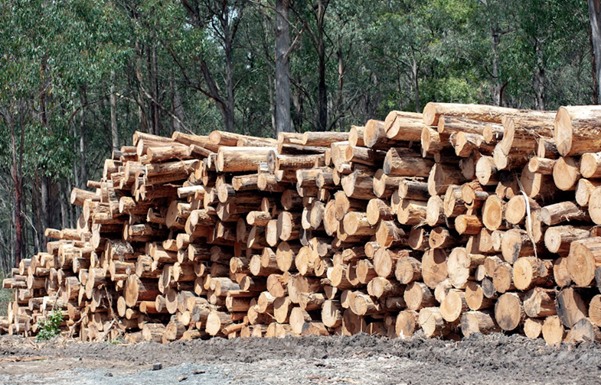
The logging has been cynically termed “post-storm debris removal” by Victorian government officials, but the sap on the extensive piles of these logs (see Figure 1) shows that these trees are very unlikely to have been lying on the forest floor for the past four years since the big storm in the Wombat State Forest. Rather, it appears that standing live trees are being cut down as part of “debris removal” – as they would be in a conventional logging operation.
Figure 1. Piles of recently salvage logged trees in the Wombat State Forest (Photo by Sandy Scheltema).
Why is salvage logging so bad? A key reason is that it is a double disturbance. That is, a forest is subject to a fire or a windstorm but then just as it is beginning to recover, it is targeted with an intensive additional disturbance – logging. Few ecosystems have evolved to deal with two such intensive disturbances in rapid succession. Many studies from around the world, including work by my own research group in Victoria, have highlighted the array of highly significant detrimental impacts of salvage logging in native forests. These include the marked loss of key plant species such as tree ferns, major declines in large old trees, significantly lower bird species richness, and large losses of key soil nutrients such as carbon.
Salvage logging effects on soils and the soil microbiome can persist for up to 80 years. The negative impacts of salvage logging on forest structure and biodiversity can be even more profound and last for up to 150 years – and potentially longer. This is the amount of time required to regrow the large old trees needed by animals such as the Southern Greater Glider.
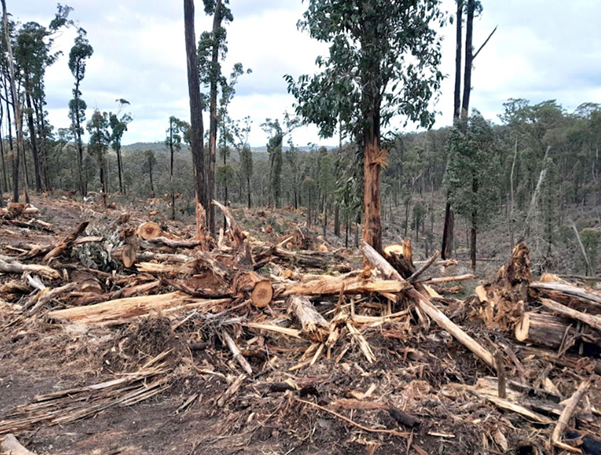
One of the reasons for the so-called “post-storm debris removal” is that the Victorian Government believes that fallen trees are fuel for wildfires. Yet, recent work published in the leading international journal, Proceedings of the National Academy of Sciences of the USA shows that fallen trees do not promote fast-moving wildfires. Conversely, there is evidence that salvage logged forests actually become more flammable, not only directly after they are cut (because of the extra debris that is left on the forest floor; see Figure 2)), but also then for a period of 7-40 years after the forests have been cut and started to regenerate.
Figure 2. Extensive debris left after salvage logging in the Wombat State Forest (photo by community member).
Much of the timber cut in salvage logging operations is being sold for firewood. However, selling timber for firewood generates significant carbon emissions. One tonne of wood generates about one tonne of carbon emissions and undermines the efficacy of attempts to tackle climate change. Another important fact is that cutting forests to create a very low value product such as firewood means that the costs of logging far exceed any financial return. That is, logging has to be heavily subsidised at great cost to the taxpayer. In essence, the taxpayer is ‘paying for the privilege’ of having their forests mis-managed by the government.
The bottom line is that the Government of Victoria is still allowing logging in the State’s native forests. It is disingenuous of the government to suggest otherwise. Worse still, the logging that it is supporting is the most severe forms of impact on forest ecosystems, fire risks, biodiversity, and the climate. The Government of Victoria needs to put an end to logging by stealth, including by banning salvage logging. A policy of no native forest logging in Victoria should mean exactly that.