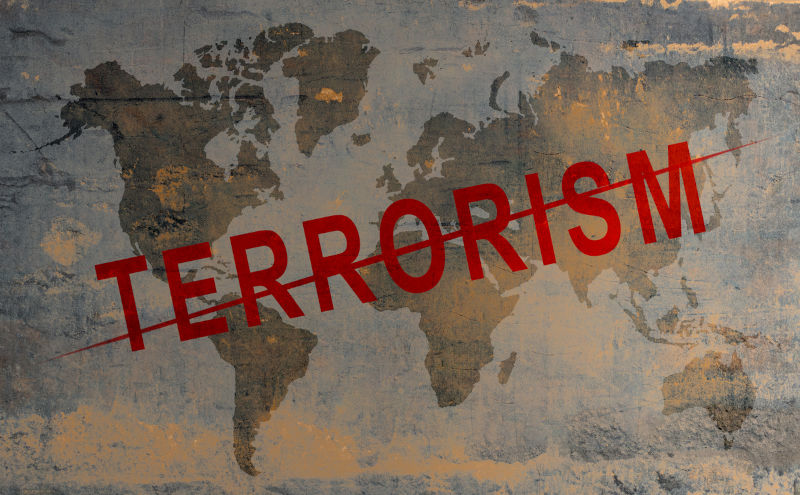
“Terrorism” may be the most powerful word in modern politics
March 28, 2026
The term “terrorism” simplifies complex conflicts, often obscuring history, perspective and the motivations behind violence.
“Terrorism” is a word that can shut down thinking and conversations before they even begin.
Governments invoke it, the media repeats it and legal systems reinforce it and in our minds, the term quickly settles into something simple and visceral – fear and terror.
However, powerful words can hide as much as they reveal.
Where did “terrorism” actually come from?
Historically, the term first appeared during the French Revolution, when violence was used to enforce political authority.
Later, its meaning shifted to describe violence carried out by groups outside the government, such as rebels, insurgents or political movements.
Today, dictionaries define it as “the unlawful use of violence and intimidation, especially against civilians, in pursuit of political aims.”
However, these definitions tell us little about context, motive or perspective and that’s where clarity begins to really blur.
Recently, I read a series of articles and interviews by Hüseyin Doğru, a Berlin-based German/Turkish independent journalist, who has spoken directly with representatives of Palestinian groups.
His work is rare in today’s media landscape and like many people of integrity, he has suffered for his truth-telling.
Rather than reporting second-hand, he actually talks with people themselves to understand how they see their struggle.
In one conversation, a representative linked to the Popular Front for the Liberation of Palestine (PFLP) ended with a sentence that lingers:
“Resistance lives in the hearts of the Palestinian people.”
Whether you agree with their ideology or actions isn’t the point.
The point is that movements rarely emerge in a vacuum.
Across history, when people have been dispossessed, occupied or denied self-determination, resistance movements appear.
The African National Congress during apartheid and the Irish Republican Army during the Northern Ireland conflict were both labelled “terrorist” before political settlements later reframed their struggles.
Recognising this doesn’t justify violence and it doesn’t erase anyone’s suffering, but it does challenge us to confront uncomfortable thoughts –
- Is terrorism only about control?
- Can violent resistance be understood in ways that go beyond fear?
- Whose perspective are we ignoring when we use the word casually or normalise it?
For Palestinians, memory is shaped by the Nakba of 1948 and decades of displacement that followed.
For Israelis, the trauma of the Holocaust informs a determination that vulnerability must never recur.
These histories seem to collide every day in the same small piece of land, shaping stories, images, fears and identities.
Words like “terrorism” are tools. They simplify, categorise and moralise, but they also obscure the truth.
Doğru’s articles and interviews made me reflect that behind each violent act are human stories, subjective viewpoints, historical grievances and deeply felt political convictions.
Understanding these doesn’t ever excuse harm, but it does make it possible to think critically about ‘conflict’, accountability, resolution and peace.
If we refuse to examine why people believe they are resisting, can we ever really understand the conflicts we hope to resolve?
If we continue to use “terrorism” as a blunt label, are we shaping our own perceptions more than the reality on the ground?
Ultimately, should we be asking – not whether violence against civilians is wrong because it clearly is, but what the word “terrorism” hides and what it neglects to reveal.
It forces us to ask why we use it, whom we label and how we might begin to see the world through the eyes of those with the lived experience of ‘conflict’.
Read more of Hüseyin Doğru’s interviews.