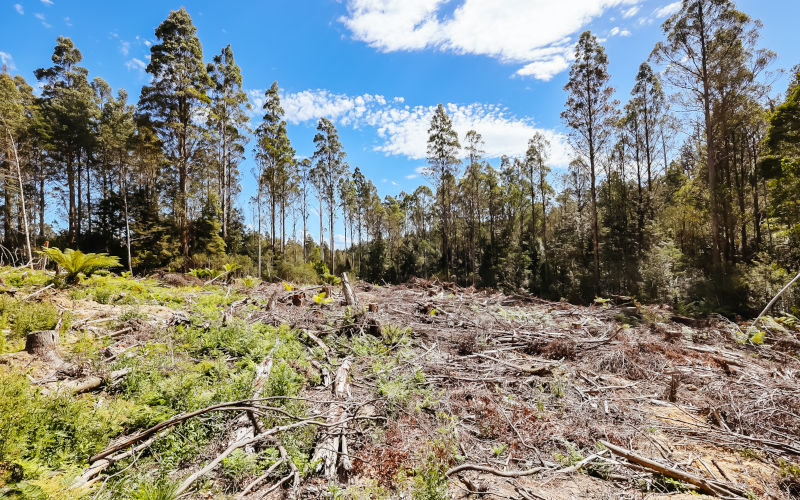
Ending native forest logging subsidies need not cost jobs
March 13, 2026
Claims that environmental reforms will destroy jobs in native forest logging are overstated. Labour market dynamics and the growth of plantation forestry point to a manageable transition.
The Australian government passed new environment laws late last year to help reform the Environmental Protection and Biodiversity Act. At that time there was intense lobbying from extractive industries about the impacts of changes in legislation.
This included a presentation to a Senate Inquiry on 20 November 2025 in which a prominent advocacy group for the native forest logging industry claimed (erroneously) that the industry is well regulated, has few environmental impacts, and employs large numbers of people. What was not discussed was that large subsidies are needed to prop up the native forest logging industry wherever it occurs in Australia.
Part of the case frequently made for these subsidies is the alleged huge damage that environmental reforms would do to employment. For example, some mainstream media, such as the Daily Telegraph, argued on 6 September 2025 that initiatives like the establishment of the Great Koala National Park will result in the loss of thousands of jobs – although no evidence was presented to support this claim.
It is commonplace (and indeed now expected) for supporters of native forest logging to refer to alleged job losses resulting from decreases in government subsidies.
In contrast, we argue the direct employment costs of environmental changes are highly exaggerated and generally misunderstood by proponents of the continuation of the current large subsidies for native forest logging. The obvious implication is that governments should not keep subsidising native forest logging jobs.
Several key points justify our scepticism that subsidy reductions will lead to significant job losses, labour market disruption and, by implication, high and avoidable social costs. An informed understanding of the labour market leads to quite different policy directions.
We started by considering the impact of policy changes on aggregate employment related to the dynamics (changes through time) of the labour market. A major point that is poorly known and always ignored is that the Australian labour market is in a constant state of change, with substantial job losses and job gains happening daily. The loss of a seemingly large number of jobs (say 1,000) – even in a specifically defined area of the labour market – is normal and simply reflects the ebb and flow of business and government pursuits. As one area of activity winds down and finishes, others emerge and grow. This is usual and is not a cause for concern of government.
Some data here are instructive. About 8-15 per cent of workers voluntarily leave their employment every year, for example to retire, to take other jobs, to look after children, or to start or restart formal education. Thus, even if no workers are affected by the existence of subsidies in a normal process over any two-year period, as many as 30 per cent of workers would be relocating voluntarily.
A second, and perhaps the most significant point, is that if government reduces assistance, then resources become available for alternative expenditure. For example, government outlays could remain the same for aggregate wood production with the money saved from eliminating subsidies to the native forest logging industry being used to facilitate job transitions in the more efficient and financially viable plantation sector. This could easily mean no net employment losses for the forestry industry.
We note that parts of the plantation sector are having difficulties in finding qualified labour to fill vacancies. This suggests that a solution could be for the government to provide short-term wage subsidies to assist in the permanent transition of employees from native forest logging to plantation businesses. After such a transition and over time, the subsidies could be removed with benefits to taxpayers.
Our two key points indicate that job losses do not equate with increases in unemployment, even for those displaced from native forest logging. The creation of new jobs, and the scope for workers to move between jobs, is why total employment in Australia remains relatively stable over time, The adoption of spending reallocation from cutting subsidies is clearly available for government.
A critical consideration is that many forestry activities are broadly similar in native forest logging and plantation forestry, meaning that workers’ skill set are easily transferable. Expenditure reallocation is the kind of “just transition” where redeployment is feasible, timely and often geographically practical. We note that for instance, New South Wales towns such as Tumut, Bombala and Coffs Harbour host both native forest logging and plantation forestry, implying minimal relocation and disruption costs.
Certainly, there will be employment consequences from government subsidy reductions currently propping up native forests logging. However, for many reasons, the employment costs of transitioning to a plantation-only industry will be limited and can be handled through assistance to displaced workers with limited budgetary costs.
Governments need to be aware of the true employment consequences of policy changes, and to provide informed assistance to workers in the transition to a more just and sensible allocation of taxpayer funds.