Logging and thinning are putting Alpine Ash forests at risk
April 15, 2026
Australia’s Alpine Ash forests are endangered and highly vulnerable to fire. Logging, thinning and burning are increasing that risk – not reducing it.
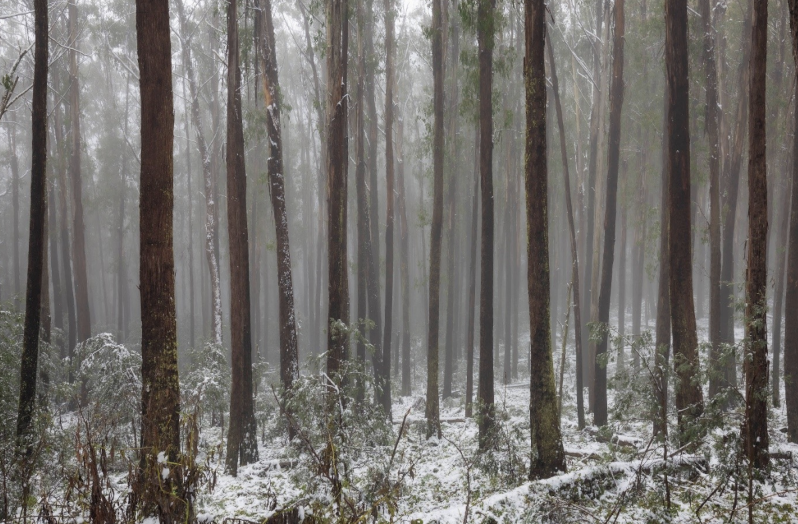
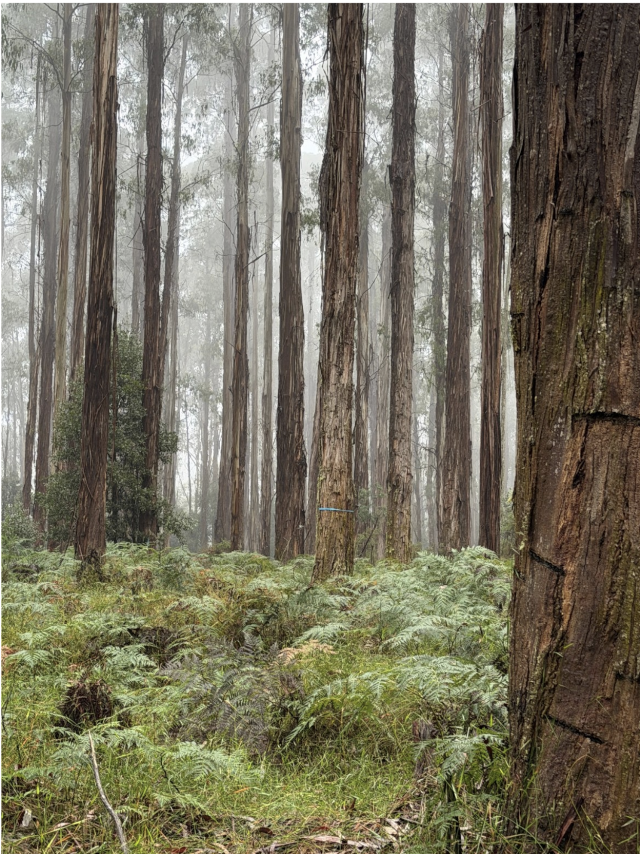
Australia has many kinds of beautiful forest. One of these is Alpine Ash forest, which occurs in montane areas in New South Wales, Victoria, and Tasmania. The tall, straight trees in these forests can exceed 60 metres in height. In some places in New South Wales and Victoria, Alpine Ash forests provide habitat for Critically Endangered animals like Leadbeater’s Possum. Independently and together, we have studied Alpine Ash forests for many decades, and published research on tree and other plant growth, animal occurrence, and fire, logging, and mechanical thinning impacts.
Alpine Ash forests are threatened by logging and wildfires. They are particularly vulnerable to human and natural disturbances. This is because young trees are highly flammable after previous logging or wildfire but at the same time do not produce a viable crop of seeds until mature beyond a prolonged juvenile period. Fires occurring every few decades have the potential to completely eliminate stands of Alpine Ash.
The conservation status of Alpine Ash forests has recently been assessed by the Threatened Species Scientific Committee. The Committee is a panel of experts that provides high-quality scientific advice to the Australian Government. As a result of the committee’s advice, Australian mainland Alpine Ash forests have been listed as an Endangered Ecological Community.
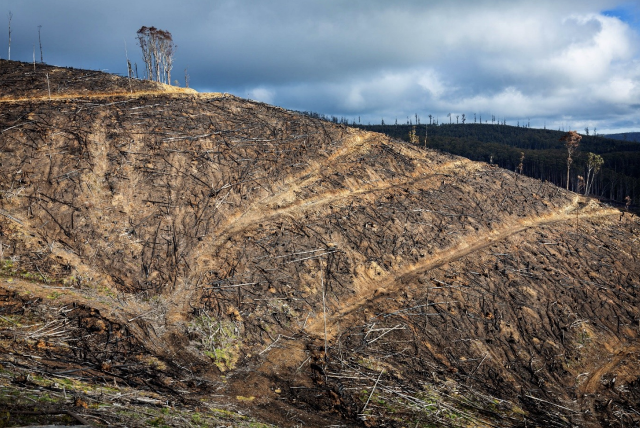
Conservation scientists and foresters alike have rightly expressed deep concern about the future of Alpine Ash forests. But what is the best way to protect them? Strict protection in National Parks is a key strategy, especially as extensive areas of Alpine Ash forest have been clearfelled in the past. Old growth Alpine Ash forest is also now very rare; just 0.47 per cent of the Alpine Ash forests in the Central Highlands of Victoria (a mainland stronghold for the species) is old growth.
Proper protection is also needed to protect Alpine Ash forests from logging. This is critical because an increasing body of research is showing that logging makes tall, wet forests like those dominated by Alpine Ash more flammable and at greatly elevated risk of high-severity wildfire.
Foresters have recommended Alpine Ash be protected by mechanical thinning. They have also proposed widespread prescribed burning of forests adjacent to stands of Alpine Ash – Alpine Ash itself is not appropriate for burning. A key question is: Are these conventional forestry management methods likely to be effective in reducing fire risks? The empirical evidence and hence the scientific answer is no, as we briefly explain below.
Mechanical thinning involves using wheeled or tracked machines to remove up 50 per cent of the trees in a stand. It is a widely used forestry method aimed at growing large diameter trees faster. That is, to grow bigger trees that will become logs for sawn timber.
But what are its impacts on fire? Thinning creates a more open, windier, and warmer forest and also leaves behind a large amount of debris. This can make forests more flammable.
Empirical studies of fires in thinned versus unthinned forests in Tasmania and Victoria show that thinning either has no effect on wildfires or makes forests more flammable. At the same time as having limited impacts on fires or making them worse, thinning can have negative environmental effects such as removing habitat for wildlife (like Leadbeater’s Possum), compacting soils, reducing forest resilience, and generating large amounts of greenhouse gas emissions. It is also expensive to do but with limited benefits other than providing more timber for the logging industry.
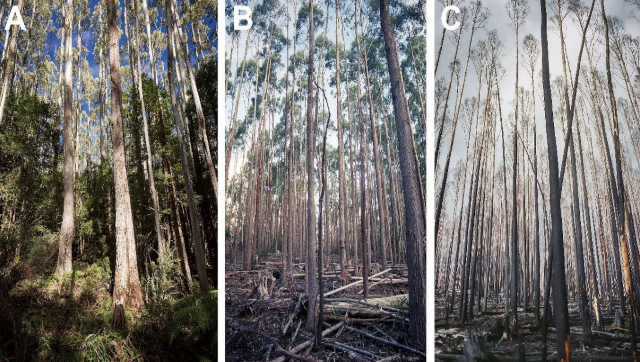
What about prescribed burning, will that help save Alpine Ash forests? Again, the answer is no. Tall, wet Alpine Ash forests are entirely unsuited to being repeatedly burnt – such disturbance regimes can collapse these forests. But what about forests adjacent to stands of Alpine Ash? At elevations below Alpine Ash are Mountain Ash forests – another tall, wet fire-sensitive forest type where prescribed burning is ecologically inappropriate. At elevations above Alpine Ash is sub-alpine woodland such as Snow Gum woodland.
Our studies of fire frequency have shown that these forests have been massively disturbed by repeated wildfires over the past two decades. At the same time, the dead wood created by fires has made extensive areas of Snow Gum woodland a target for native wood-boring beetles that can kill trees. Like Alpine Ash forests, Snow Gum woodlands are at risk of ecological collapse and they certainly do not need yet more fire.
Importantly, disturbances such as prescribed burning, thinning, and logging all produce a pulse of regrowth which adds significantly to the flammability of vegetation. These conventional forestry methods will not save Alpine Ash forests; rather, they will exacerbate the problem and increase the chance we will lose them altogether. That is, we should not expect forestry practices that have caused many of the problems now facing Alpine Ash forests to be the solution to those problems.
Beyond proper protection and dispensing with logging, thinning and widespread burning, are there other things that can be done to better protect Alpine Ash forests? The answer is yes. A key one is to embrace new technologies to help more quickly detect fires as soon as they start and then also deploy high-payload drones to more rapidly suppress fires. The best time to control fires is when they are small. Drone and other detection technology is not a replacement for people.
Another strategy is to invest in far more remote area fire-fighters and the equipment they need. Fire problems in Australia, including those associated with past management that has made vegetation more flammable, needs more people and more technology, not one or the other.